


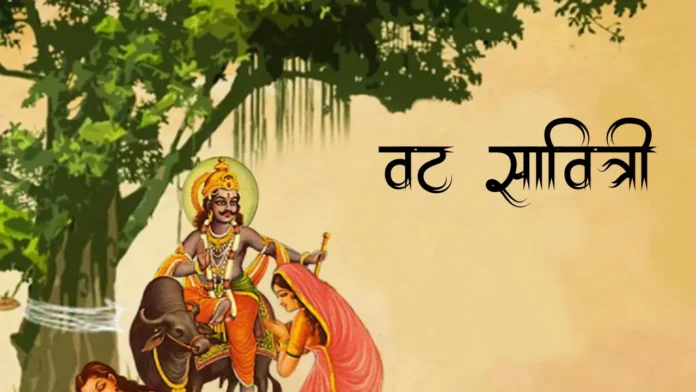
Every year, just before the monsoon arrives, millions of married Hindu women across India fast, dress in their finest clothes, and gather around a banyan tree. They carry flowers, kumkum, sacred threads, and water. They walk around the tree in circles, tying the thread as they go, praying quietly for one thing — the long life of their husbands.
This is Vat Savitri Puja. And it is much more than a ritual.
The festival traces back to one of the most powerful stories in Hindu mythology — the story of a woman who refused to accept death. A woman who followed the god of death himself and argued, debated, and outwitted him until he had no choice but to give her back what he had taken.
Her name was Savitri. And every year, this puja is observed in her honour.
Vat Savitri Puja 2026 — Date and Tithi
The date of Vat Savitri Puja differs across regions of India. This is because different states follow different Hindu lunar calendars.
In North Indian states — including Uttar Pradesh, Madhya Pradesh, Bihar, Punjab, and Haryana — the vrat falls on Jyeshtha Amavasya (New Moon day).
In Maharashtra, Gujarat, and several southern states, the vrat is observed on Jyeshtha Purnima (Full Moon day), and it is commonly known as Vat Purnima Vrat. Women here observe it 15 days later than their counterparts in the north.
For 2026, the dates are:
- North India (Amavasya): Saturday, May 16, 2026
- Amavasya Tithi begins: May 16 at 5:11 AM
- Amavasya Tithi ends: May 17 at 1:30 AM
The legend and rituals remain the same across both dates. Only the regional calendar differs.
It is also worth noting that the North Indian Vat Savitri in 2026 falls on the same day as Shani Jayanti — the birth anniversary of Shani Dev. This makes the day doubly significant for many devotees.
The Story That Started It All — Savitri and Satyavan
To truly understand Vat Savitri Puja, you need to know this story. It comes straight from the Vana Parva (Book of the Forest) of the Mahabharata. The sage Markandeya narrates it to Yudhishthira when Yudhishthira asks whether there has ever been a woman whose devotion matched Draupadi’s.
Markandeya’s answer is Savitri.
A King Without a Child
King Ashwapati ruled the kingdom of Madra. He had power, wealth, and an entire kingdom — but no child. For years, he performed penance, praying to the Sun God Savitr. Finally, the Goddess Savitri appeared before him and granted him a boon. A daughter was born. The king named her Savitri, in honour of the goddess who blessed him.
Savitri grew up to be a woman of remarkable beauty, intelligence, and discipline. But when she reached the age of marriage, no man came forward to ask for her hand. Her strength and wisdom intimidated people. So her father did something unusual for that era — he told Savitri to go out into the world and find her own husband.
She Chose the One She Should Not Have
Savitri travelled across kingdoms and forests. Then, one day, she came across a young man helping his blind father in the forest. His name was Satyavan — the son of King Dyumatsena of Salwa, a king who had lost his kingdom to enemies and now lived in exile as a forest dweller.
Savitri’s heart was certain. She returned to her father and told him she had chosen Satyavan.
But there was a problem. Sage Narada was present at court that day. When he heard Satyavan’s name, he immediately warned the king: Satyavan was destined to die within exactly one year of marriage. He was noble and kind, yes — but he was cursed with a short life.
King Ashwapati urged Savitri to choose someone else. Anyone else.
Savitri refused. She said she had already accepted Satyavan in her heart. A true daughter of dharma chooses only once, she told her father. The king gave in. They were married.
Living in the Forest, Counting the Days
After marriage, Savitri left behind her royal life. She dressed simply, lived simply, and devoted herself fully to serving her husband, her father-in-law Dyumatsena, and her mother-in-law. She never once let Satyavan see her fear.
But inside, she counted every day.
Three days before the date Narada had predicted, Savitri began a rigorous fast — a three-day nirjala vrat, without food or water. On the fourth morning — the day of Satyavan’s death — she asked permission from her in-laws to accompany her husband into the forest. They agreed, unaware of what Savitri knew.
The Day Death Arrived
In the forest, Satyavan began cutting wood from a tree. Suddenly, he felt unwell. A sharp pain hit his head. He stopped, walked to Savitri, and lay his head in her lap.
Savitri held him. She did not move.
Then she saw him — a tall, dark, powerful figure in yellow robes, carrying a noose. His eyes were red. His presence was overwhelming. It was Yamraj, the god of death, himself. He rarely came personally to collect souls. He came for Satyavan because of the merit of Savitri’s presence — she was so devoted and pure that ordinary messengers could not approach.
Yamraj tied his noose around Satyavan’s soul and began walking south — towards Yamlok, the realm of the dead.
Savitri stood up. And she followed.
The Argument That Changed Everything
Yamraj turned and told her to go back. It was not her time. She could not follow the dead.
Savitri did not argue. Instead, she walked beside him and began speaking — about dharma, about devotion, about righteousness. She praised Yamraj for his perfect adherence to the laws of the universe.
Yamraj was impressed. He offered her a boon — anything except the life of her husband.
Savitri asked for eyesight to be restored to her father-in-law. Yamraj granted it and continued walking. Savitri kept following.
He offered her another boon. She asked for the restoration of Dyumatsena’s kingdom. Granted. She kept walking.
A third boon. She asked for a hundred sons for her father, King Ashwapati. Granted.
And still, Savitri followed.
Finally, Yamraj offered one last boon — again, anything except Satyavan’s life. This time, Savitri asked for a hundred sons born of Satyavan himself.
Yamraj paused. He had walked into his own trap. He had promised her children to Satyavan. But he was also carrying Satyavan’s soul away. It was a contradiction. And Yamraj was bound by dharma — he could not break his word.
He untied his noose. He released Satyavan’s soul. He blessed them both with long life and happiness.
Savitri ran back through the forest to where Satyavan’s body lay beneath the banyan tree. She took his head in her lap. His eyes opened. Blood returned to his face. He was alive.
That banyan tree — the Vat tree — is why this festival carries its name.
Why the Banyan Tree?
The banyan tree holds deep spiritual meaning in Hinduism. It represents the Holy Trinity — its roots symbolise Brahma, its bark symbolises Vishnu, and its branches symbolise Shiva. The tree is known for its longevity, its strength, and the way it grows — always expanding, always supporting, always sheltering.
Savitri sat under a banyan tree when Satyavan collapsed. She remained there as death came and went. And it was to that tree that Satyavan returned alive.
This is why women worship the banyan tree on Vat Savitri. The tree is not just a symbol. It is the witness to one of the most extraordinary acts of devotion in all of Hindu mythology.
Who Observes Vat Savitri Vrat?
Vat Savitri Vrat is observed by married Hindu women. They fast and pray for the health, longevity, and well-being of their husbands. In many families, it is the first major vrat a new bride observes after marriage, and it continues every year after that.
However, there is a deeper spiritual dimension that often goes unmentioned. The Skanda Purana and the Bhavishyottara Purana both describe the spiritual merit of this vrat as belonging to the woman herself. The vrat builds patience, discipline, and devotion in the woman who observes it. It is as much about her own spiritual strength as it is about her husband’s long life.
Savitri, after all, was not a passive figure praying helplessly. She was bold, intelligent, and strategic. She walked beside Yamraj. She argued with him. She outwitted him. The vrat honours that strength.
Shubh Muhurat for Vat Savitri Puja 2026
The most auspicious time to begin the puja is in the morning, after sunrise, during the Brahm Muhurat or morning hours. Devotees are advised to avoid the Rahu Kaal period, which is considered inauspicious for starting rituals.
For exact regional timings, consulting your local panchang (Hindu almanac) is always recommended, as the precise muhurat can vary slightly based on your city’s sunrise time.
What You Need for the Puja — The Complete Samagri List
Before you begin the puja, collect all the necessary items. Here is the complete list:
- Fresh flowers (marigolds or mixed flowers)
- Kumkum (red vermilion powder)
- Haldi (turmeric)
- Roli (sacred red paste)
- Raw cotton thread or Mauli (sacred red thread)
- Kalash (copper or brass vessel filled with water)
- Incense sticks and a diya (earthen lamp) with ghee
- Rice grains (akshat)
- Fruits and sweets for prasad
- Coconut
- Betel leaves and betel nuts (paan and supari)
- Soaked gram (chana)
- Sandalwood paste
- Idol or image of Savitri, Satyavan, and Yamraj
If a picture or idol of the banyan tree is needed (when a physical tree is not nearby), you can create a symbolic representation using sandalwood paste or turmeric drawn on a wooden plank.
Puja Vidhi — Step by Step
The puja follows a specific sequence. Here is how to do it correctly:
Step 1 — Wake up before sunrise. Take a bath. Wear fresh clothes, preferably in red or yellow — the colours of auspiciousness and devotion. Apply sindoor, bangles, and other symbols of married life.
Step 2 — Prepare the prasad. Traditional prasad includes Malpua, Poode (a kind of pancake), and semolina halwa. Prepare these before heading to the puja.
Step 3 — Go to the banyan tree. Carry your puja thali with all the items. If no banyan tree is nearby, set up your altar at home using a branch, a picture, or a drawn representation.
Step 4 — Offer water. First, water the roots of the banyan tree. Clean the surrounding area.
Step 5 — Make your Sankalp. This is the sacred vow. Sit quietly, focus your mind, and take a formal vow to observe the vrat for your husband’s well-being. Meditate on Lord Brahma, Savitri, Satyavan, and Yamraj.
Step 6 — Offer flowers, kumkum, and haldi. Place these at the base of the tree with devotion.
Step 7 — Wrap the sacred thread. Take the raw cotton thread or Mauli and begin circumambulating (doing parikrama) around the banyan tree. Walk around the tree 5 to 7 times, wrapping the thread around the trunk with each round, while praying for your husband’s long life and family well-being.
Step 8 — Light the diya and offer aarti. Light the ghee lamp and perform aarti to the banyan tree and to Goddess Savitri.
Step 9 — Listen to the Vrat Katha. Sit near the tree and hear the story of Savitri and Satyavan. This is not optional — listening to the katha is an essential part of the puja’s completion.
Step 10 — Seek blessings. After the puja, seek blessings from elders in the family.
Step 11 — Charity. Before breaking the fast, offer food, clothing, and other essentials to those in need. This act of giving is described in the scriptures as integral to the vrat’s spiritual merit.
Step 12 — Break the fast. In the evening, after completing everything and distributing prasad, break the fast.
Types of Fasting
Not all women observe the same kind of fast. There are three common approaches:
Nirjala Vrat — The strictest form. No food and no water throughout the day. This mirrors Savitri’s three-day fast before Satyavan’s death.
Phalahar Vrat — Fasting with fruits, milk, and water. A gentler alternative, suitable for those with health conditions.
Full fast with one meal — Some women observe a complete fast during the day and break it in the evening with one proper meal after the puja.
Personal health always matters. The spirit of the vrat lies in devotion — not in physical suffering. Choose the form of fasting that you can sustain with sincerity.
The Difference Between Vat Savitri and Vat Purnima
Many people confuse these two. Here is the simple distinction:
Both festivals observe the same legend and the same rituals. The only difference is the date — determined by which lunar calendar the region follows.
Vat Savitri Vrat is observed on Jyeshtha Amavasya (New Moon) — primarily in North Indian states.
Vat Purnima Vrat is observed on Jyeshtha Purnima (Full Moon) — primarily in Maharashtra, Gujarat, and southern states. This version falls 15 days after Vat Savitri.
In 2026, North India observes the vrat on May 16 and the western and southern states observe it on June 29.
What This Festival Really Means
At its core, Vat Savitri Puja is a celebration of love that refuses to surrender. It is a story of a woman who did not sit and weep when death came to her door. She stood up. She followed. She spoke with clarity and wisdom and brought her husband home.
The banyan tree — ancient, vast, and impossibly rooted — stands as the perfect symbol. A marriage, at its best, is exactly that. Deep-rooted. Sheltering. Patient enough to outlast any storm.
Every woman who ties a thread around that tree and walks its circles is not just praying. She is standing in the tradition of Savitri — choosing love, choosing life, choosing to fight for what matters most.
That is why this festival has survived thousands of years. And why it will continue to.

