


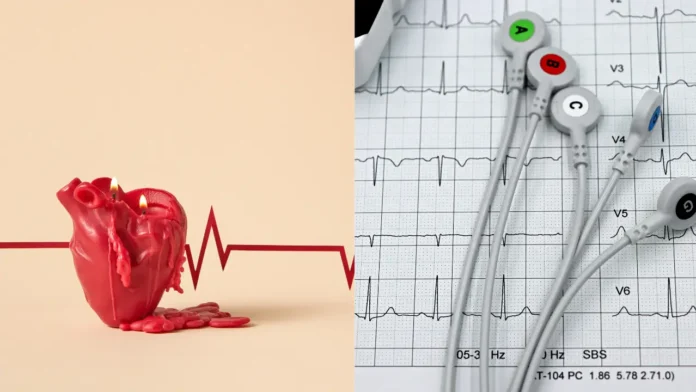
On the morning of May 13, 2026, Kannada actor Dileep Raj woke up at his residence and never made it through the day. He suffered a massive heart attack at 47. Rushed to Apollo Hospital, he could not be revived. Gone — just like that. He had a career of over 24 films, starring in beloved productions like Milana, U-Turn, and the Zee Kannada serial Hitler Kalyana. He had a production company, a team, a family.
He was 47.
His death adds to a growing, deeply disturbing pattern. Actors, athletes, executives, teachers, ordinary men in their 40s and 50s — all collapsing without warning. And each time it happens, the world says “too young” and moves on. But cardiologists are not moving on. They are alarmed. Because the data now makes one thing painfully clear: your 40s are not too early for a heart attack. For men, they may actually be the most dangerous decade of your life.
The Science Is Settled: Men’s Hearts Are Already in Danger by Their Mid-30s
Most people still think of heart disease as an old man’s problem. Something that happens after retirement. Something you worry about at 65. That belief is killing people.
A landmark study published in early 2026 by Northwestern Medicine tracked cardiovascular risk across age groups and found that men begin developing coronary heart disease — plaque buildup in the arteries — as early as their mid-30s. The risk gap between men and women widens sharply from there. On average, men reach dangerous cardiovascular disease levels a full seven years before women. For coronary heart disease specifically — the type that causes most heart attacks — men fall into high-risk territory nearly a decade ahead of women.
Dr. Sadiya Khan, professor of cardiovascular epidemiology at Northwestern University, put it simply: “Heart disease doesn’t happen overnight. It develops over years. It can start really early in your 30s or 40s. Even if you don’t have heart disease at that time, your risk can start at that time.”
That is the brutal truth. By the time you feel the chest pain, the damage may have been building for ten to fifteen years.
Why Men’s Hearts Are Wired Differently — and More Dangerously
The biology is not fair. Men’s hearts face threats that women’s hearts do not — at least not until much later in life.
Estrogen, the primary female hormone, acts as a natural protector of the cardiovascular system. It helps keep blood vessels flexible and reduces plaque buildup. Women benefit from this protection through most of their reproductive years. Men have no equivalent shield. Testosterone, instead, influences fat distribution in a way that increases visceral fat — the deep abdominal fat that wraps around organs. That fat constantly releases inflammatory chemicals that damage arterial walls, quietly, over years.
Beyond hormones, male cholesterol patterns tend to be worse in midlife. LDL — the “bad” cholesterol — builds plaque inside arterial walls. When a plaque ruptures, a blood clot forms. That clot blocks blood flow to the heart. The result is a heart attack.
But here is what makes it especially dangerous for men: they ignore it.
Cardiologists consistently note that men are far less likely to visit doctors for preventive care. They dismiss early symptoms — unusual fatigue, mild chest tightness, unexplained shortness of breath — as stress or age. They wait until the pain becomes unbearable. And sometimes, by then, it is too late.
The Hidden Warning Signs Men Almost Always Miss
A heart attack does not always announce itself with Hollywood-style chest-clutching drama. In fact, many men experience what doctors call a “silent heart attack” — one that happens without classic symptoms, often misread as indigestion, muscle strain, or fatigue.
The four most commonly ignored warning signs include:
Unusual fatigue that lasts for days — not tiredness from a hard workout, but a deep, persistent exhaustion that rest does not fix. Mild chest discomfort or pressure that comes and goes — often dismissed as heartburn or gas. Unexplained shortness of breath during normal activities like climbing stairs or walking. Pain that travels to the arm, jaw, neck, or back — not always severe, sometimes just a dull ache.
Beyond these, cardiologists at Johns Hopkins highlight one particularly underrated early warning: erectile dysfunction in men under 50. The arteries supplying blood to that region are much smaller than the heart’s arteries. Damage shows up there first — often years before a cardiac event. Men in their 40s with erectile dysfunction but no other known risk factors carry an 80 percent chance of developing heart problems within 10 years. That signal, if caught and treated early, could save lives.
Depression is another one. People with depression have measurably worse heart disease outcomes. Yet most men avoid seeking help for it — compounding risk on risk.
The Real Killers: What Actually Causes a Heart Attack at 47
When someone like Dileep Raj dies at 47, people ask: “But he seemed fine. How?” The answer is that heart disease hides well. The buildup of plaque in coronary arteries is a slow, silent process that happens without pain or signals. Here is what actually drives a heart attack in midlife men:
Chronic stress sits at the top of the list. Work pressure, financial strain, family responsibilities, career uncertainty — all of these raise blood pressure and cortisol levels over years. Extreme stress can trigger a sudden arterial spasm or plaque rupture that causes a heart attack.
High blood pressure, often called the “silent killer,” damages artery walls constantly. Most men with hypertension feel nothing unusual. But the damage accumulates every single day.
High LDL cholesterol deposits fat into arterial walls. Over time, those deposits harden into plaques. A plaque rupture can kill in minutes.
Sedentary lifestyle weakens the heart muscle itself. An inactive heart pumps less efficiently, handles stress poorly, and deteriorates faster.
Poor sleep and sleep apnea are major and underappreciated factors. Sleep apnea — more common in men — causes repeated oxygen drops through the night. Each episode stresses the heart. Over years, it raises blood pressure, inflames arteries, and significantly increases cardiac risk.
Smoking, even occasional social smoking, constricts blood vessels and reduces oxygen delivery to the heart.
Diabetes and prediabetes damage nerves and blood vessels. Diabetic men often experience heart attacks without classic chest pain — the nerve damage blunts sensation, making the attack even harder to recognise.
The Age at Which Everything Changes
The 40s and 50s represent a specific biological inflection point for men. This is when years of accumulated damage from diet, stress, inactivity, and genetics finally start expressing themselves clinically. Blood pressure that was slightly elevated at 35 becomes hypertension at 45. Cholesterol that was borderline at 38 becomes arterially dangerous at 48.
Moreover, the death rates tell a stark story. Heart disease death rates among the 45 to 60 age group have been rising — not falling — since 2011. Among men in their 40s who do suffer heart attacks, the odds of dying from a second one are just as high as for older men. Younger doesn’t mean more survivable. It just means more unexpected.
Middle age is also when lifestyle choices compound. That decade of fast food, late nights, skipped workouts, and unmanaged stress doesn’t stay abstract — it shows up as a blocked artery at 2 am.
What You Must Do Differently — Starting Now
Here is the important part. Most heart attacks are preventable. Cardiologists estimate that a healthy lifestyle can prevent over 80 percent of coronary artery disease cases, 80 percent of sudden cardiac deaths, and over 70 percent of premature heart disease deaths. Those numbers should feel like a lifeline. Because they are.
Know Your Numbers — All of Them
Blood pressure, LDL cholesterol, blood sugar, and body weight are your four vital markers. If you don’t know yours right now, book a check-up this week. The optimal blood pressure is below 120/80. LDL should ideally stay below 100 mg/dL for men with risk factors. Prediabetes often has no symptoms — only a blood test reveals it.
Men in their 30s and 40s should get a full cardiac screening every two to three years at minimum. Men over 45 with any risk factor — family history, smoking, obesity, stress, diabetes — should get screened annually.
Move Every Single Day
Your heart is a muscle. It weakens without use and strengthens with exercise. You don’t need a gym membership or a marathon goal. You need 150 minutes of moderate physical activity per week — a brisk 30-minute walk five days a week qualifies entirely. That alone lowers blood pressure, improves cholesterol, reduces arterial inflammation, and strengthens the cardiac muscle.
Resistance training twice a week adds further protection. Building muscle mass improves insulin sensitivity, which directly reduces cardiac risk.
Eat to Protect Your Arteries
The heart-healthy dietary pattern is not complicated. Load your plate with fruits, vegetables, whole grains, nuts, and seeds. Use olive oil over butter. Choose fish over red meat several times a week. Cut processed foods, refined sugar, trans fats, and excess salt — these directly accelerate plaque formation.
The Mediterranean dietary pattern, endorsed by cardiologists worldwide, has been linked to a 30 percent reduction in major cardiac events. You don’t need to follow it perfectly. Even partial adoption makes a measurable difference.
Manage Stress — Treat It as a Medical Issue
Chronic stress is not just uncomfortable. It is physiologically destructive. It raises cortisol, keeps blood pressure elevated, drives unhealthy coping habits like smoking and drinking, and can directly trigger a cardiac event in arteries already weakened by plaque.
Meditation, even ten minutes a day, lowers cortisol meaningfully. Regular physical activity is one of the most effective stress-reducers known to medicine. Sleep — seven to eight hours — is non-negotiable. And if you are depressed or chronically anxious, seek help. Depression is a cardiac risk factor. Treating it protects your heart.
Stop Dismissing Symptoms
This one is cultural as much as medical. Many men — particularly in South Asian contexts — treat symptoms of chest tightness or breathlessness as something to push through. That instinct kills people.
If you feel pressure in your chest, pain radiating to your arm or jaw, sudden unexplained fatigue, or shortness of breath during light activity — stop. Don’t wait. Don’t drive yourself to the hospital. Call emergency services immediately. Time is muscle. Every minute of delayed treatment during a heart attack means more permanent cardiac damage.
A Word About India Specifically
Indian men face a compounded risk. Genetic predisposition to higher LDL cholesterol and lower HDL cholesterol is more common in South Asian populations. Urban Indian lifestyles — sedentary desk work, late-night eating, high-stress professional environments, poor sleep hygiene, and social smoking — stack risk factors fast. Studies have found that South Asians develop heart disease nearly a decade earlier than their Western counterparts on average.
The entertainment industry, in particular, carries high-intensity occupational stress. Irregular schedules, physically demanding shoots, long hours, and performance pressure create the exact psychological environment that keeps cortisol chronically elevated. Dileep Raj’s death is not an isolated tragedy. It is a symptom of a broader pattern affecting working men across professions throughout India.
The Bottom Line
Dileep Raj was 47. He had roles to play, serials to produce, stories left to tell. His death is a loss for Kannada cinema. But it is also a warning — one that every man in his 30s, 40s, and 50s needs to hear clearly.
Your heart is not invincible. It has been quietly accumulating damage since your mid-30s. The difference between the men who survive and the men who don’t is often not luck — it is whether they got checked, made changes, and took early warning signs seriously.
Book the screening. Take the walk. Sleep the hours. Manage the stress. Know your numbers.
Your heart won’t send a second invitation.
This article is based on medical research and cardiology guidance available as of May 2026. It is intended for awareness purposes and does not substitute professional medical advice. Please consult a qualified cardiologist for personalised guidance.

