


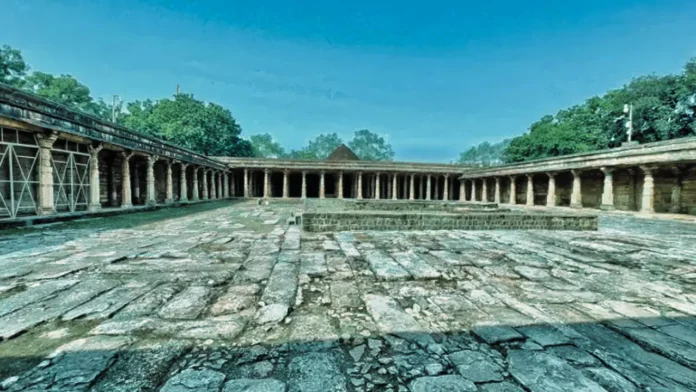
Bhojshala Verdict: A Turning Point In A Centuries-Old Dispute
The Bhojshala dispute in Madhya Pradesh has entered a new phase after the Madhya Pradesh High Court delivered a landmark verdict on May 15, 2026. The court declared that the Bhojshala complex in Dhar is a temple dedicated to Goddess Vagdevi, also known as Saraswati.
The ruling has already sparked strong reactions across political, religious, and legal circles. For many Hindus, the judgment marks the restoration of a historical identity. Meanwhile, several Muslim organisations have expressed disappointment and may challenge the order in the Supreme Court.
The verdict is not just about one monument. It touches history, archaeology, faith, law, and India’s ongoing debate over religious heritage.
What Is Bhojshala?
Bhojshala is a historic structure located in the Dhar district of Madhya Pradesh. Historians associate it with Raja Bhoj, the famous Paramara king known for promoting Sanskrit learning, art, and architecture.
Many Hindu groups believe Bhojshala was originally a Saraswati temple and a major centre of education. On the other hand, sections of the Muslim community identify the structure as the Kamal Maula Mosque.
Because of these competing claims, the site remained sensitive for decades.
The Archaeological Survey of India currently protects the monument under national heritage laws.
Why Was Bhojshala Controversial?
The dispute largely revolved around religious usage rights.
In 2003, the Archaeological Survey of India created a special arrangement:
- Hindus could perform puja on Tuesdays
- Muslims could offer namaz on Fridays
This arrangement continued for years. However, tensions often increased whenever Vasant Panchami fell on a Friday. Both communities considered the day important for worship.
Over time, Hindu organisations approached the courts seeking exclusive recognition of the site as a temple. Muslim groups argued that prayers had been offered there for generations and that historical records supported their position.
As the legal battle intensified, the matter reached the Madhya Pradesh High Court.
The ASI Survey Changed The Course Of The Case
In 2024, the High Court ordered a scientific ASI survey of the Bhojshala complex. The decision became one of the most closely watched archaeological exercises in recent years.
The survey reportedly continued for several weeks under court supervision. Experts studied inscriptions, pillars, carvings, architectural patterns, and underground structures.
According to discussions during the case:
- Several temple-style architectural elements were identified
- Sanskrit and Prakrit inscriptions appeared older than Persian and Arabic inscriptions
- The site showed signs of being a centre of Sanskrit learning
- Temple remains allegedly existed beneath later additions
The Muslim side questioned these findings and argued that the report lacked neutrality. Still, the ASI defended its conclusions before the court.
What Did The Madhya Pradesh High Court Say?
The High Court delivered its verdict on May 15, 2026.
The bench ruled that the religious character of the site is that of Bhojshala, a temple dedicated to Goddess Saraswati.
The court made several important observations:
- Hindu worship at the site had continued historically
- Historical literature linked the place to Sanskrit education during Raja Bhoj’s period
- Archaeological evidence supported the existence of a temple structure
The court also cancelled the 2003 arrangement that allowed namaz inside the complex.
However, the judgment also attempted to balance religious concerns. The court said the Muslim side could apply for alternative land in Dhar district to construct a mosque.
Why The Verdict Matters Beyond Dhar
The Bhojshala verdict carries political and cultural significance far beyond Madhya Pradesh.
First, the judgment strengthens the role of archaeological evidence in religious property disputes. The court relied heavily on inscriptions, structural analysis, and historical continuity.
Second, the verdict may influence future debates involving disputed heritage structures across India.
Third, it has revived discussions around the protection and restoration of ancient educational and spiritual centres connected to India’s medieval history.
Security was tightened across Dhar after the ruling because authorities expected strong public reactions.
The Raja Bhoj Connection
Raja Bhoj remains one of central India’s most respected historical figures.
He ruled the Paramara kingdom during the 11th century and gained recognition for supporting literature, astronomy, architecture, medicine, and Sanskrit scholarship.
Many scholars and Hindu groups believe Bhojshala functioned as a major educational institution during his reign. This connection became central to the Hindu side’s argument in court.
The High Court also referred to Bhojshala as a centre of Sanskrit learning while discussing historical evidence.
What Happens Next?
The legal fight may not end here.
Muslim organisations and other parties are expected to challenge the High Court verdict before the Supreme Court. Legal experts believe the case could now move into a fresh constitutional debate involving religious rights, heritage protection, and archaeological interpretation.
At the same time, the central government and ASI may now face pressure regarding:
- Management of the site
- Worship arrangements
- Preservation work
- Security planning
- Possible restoration projects
The High Court also asked authorities to consider representations regarding the return of the Saraswati idol currently kept in a museum in London.
The Emotional Reactions After The Verdict
The judgment triggered emotional scenes in Dhar.
Several Hindu petitioners reportedly celebrated outside the court premises. Some became visibly emotional after hearing the decision.
Meanwhile, Muslim representatives stated that they respected the judiciary but disagreed with the findings. Many indicated they would continue the legal battle through constitutional channels.
This emotional divide explains why the Bhojshala issue remained sensitive for so many years.
A Dispute Rooted In History, Faith, And Identity
The Bhojshala case was never just a property dispute. It represented competing historical narratives and deep religious emotions.
For one side, Bhojshala symbolises a lost centre of learning dedicated to Goddess Saraswati. For the other, it remains tied to centuries of Islamic worship traditions.
The Madhya Pradesh High Court has now delivered one of the most significant judgments in the dispute’s history. Yet the broader national conversation around heritage, identity, and coexistence is likely to continue for years.
For now, the Bhojshala verdict has become a defining legal and cultural moment in modern India.

