


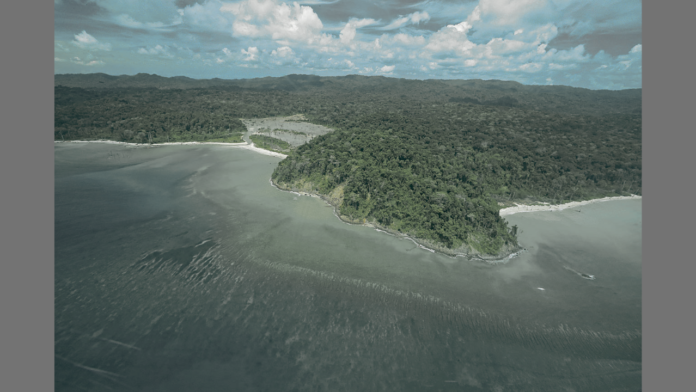
Most Indians could not find Great Nicobar Island on a map. And yet, this small, forested island at the very southern tip of India may soon become one of the most strategically important pieces of land on the planet.
Great Nicobar sits at the northern entrance to the Strait of Malacca — the narrow corridor between Indonesia, Malaysia, and Singapore through which nearly a quarter of all global trade passes every year. It is closer to Indonesia than it is to the Indian mainland. It is nearly equidistant from Singapore, Port Klang, and Colombo.
Geographers and military strategists call the Andaman and Nicobar Islands a “natural aircraft carrier.” Great Nicobar is the tip of that carrier — the southernmost point, the closest to the chokepoint, and the most valuable.
India wants to use it. And that decision has sparked one of the most intense debates the country has seen in years.
What Is the Great Nicobar Project?
The Great Nicobar Island Development Project is the Government of India’s plan to transform this remote island into a world-class maritime, commercial, and military hub. NITI Aayog conceived the project in the late 2010s. The Andaman and Nicobar Islands Integrated Development Corporation (ANIIDC) leads the implementation.
The total project cost stands at ₹81,000 crore — roughly $8.5 billion. Construction will happen in phases over 30 years, from 2025 to 2047. The project covers 166.10 square kilometres across seven revenue villages.
There are four core components:
The Galathea Bay International Container Transshipment Terminal is the centrepiece. It will handle 14.2 million TEUs (Twenty-Foot Equivalent Units) of cargo at full capacity. The location has a natural water depth of over 20 metres — ideal for large container ships. India currently routes much of its transshipment cargo through Colombo in Sri Lanka, Singapore, and Port Klang in Malaysia. This port aims to bring that business home.
The Great Nicobar International Airport is a dual-use greenfield airport — serving both civilian passengers and military operations. It will handle 4,000 passengers per peak hour. A second airfield at Chingen village, near Galathea Bay, is already in groundwork phase, specifically for defence use. India’s existing naval base INS Baaz at Campbell Bay already handles maritime surveillance in the region.
The Gas and Solar Power Plant will supply 450 MVA of power — enough to run the entire planned infrastructure on the island.
The Township spans 16,610 hectares. Two greenfield cities are on the drawing board — one between Campbell Bay and Galathea Bay on the southeastern side, and another on the southwestern side. Together, they will house a planned population of over 350,000 people. The island today has only a few thousand residents.
The Logic Behind It — Why India Needs This
To understand why India is pushing this project so hard, you need to understand two things: India’s trade problem and the China factor.
India’s Transshipment Problem
Right now, India sends a significant share of its international container cargo to foreign ports for transshipment. Colombo in Sri Lanka handles a large chunk of Indian cargo. So do Singapore and Port Klang. India pays for this — in money, in time, and in strategic vulnerability.
A deep-water port at Galathea Bay changes this entirely. Its location near the East-West shipping lane means ships do not need to divert significantly to call at the port. Transshipment cargo that currently goes to Colombo would instead come to Indian soil, generating revenue and reducing dependence on foreign infrastructure.
The China Factor
This is the part the government rarely puts in a press release — but everyone in strategic circles talks about openly.
The Strait of Malacca is China’s economic lifeline. Over 80% of China’s oil imports pass through this narrow corridor. Approximately $3.5 trillion in global trade travels these waters annually. For Chinese strategic planners, this dependence is a nightmare they call the “Malacca Dilemma” — a term that former Chinese President Hu Jintao himself used.
China’s response to this vulnerability has been to build ports all along the Indian Ocean — at Gwadar in Pakistan, at Hambantota in Sri Lanka, at Kyaukphyu in Myanmar. Analysts call this the “String of Pearls” — a network of Chinese-built ports encircling India.
India’s response is Great Nicobar.
By positioning a transshipment port, a dual-use airport, and military infrastructure near the northern approaches to the Malacca Strait, India does not just observe the chokepoint. It acquires the capacity to monitor and, if necessary, influence it. Former IAF Chief R.K.S. Bhadauria has argued that the project is vital for expanding India’s military footprint in the Indo-Pacific, and that opposition to it could inadvertently benefit China. Air Vice Marshal P.K. Srivastava has noted that maritime chokepoints have become decisive instruments in modern geopolitics — and that this project will allow India to better manage movement in one of the world’s most critical trade corridors.
The project fits squarely into India’s broader maritime vision — aligning with India’s Maritime Vision 2030 and the Amrit Kaal Vision 2047.
What the Island Actually Looks Like — And What Will Be Lost
Great Nicobar Island is not a beach resort. It is something far rarer.
The island holds one of the last intact tropical rainforests in India. It hosts species found nowhere else on Earth. The Leatherback sea turtle — the largest turtle species in the world, and a critically endangered one — nests on its beaches. Galathea Bay, the site of the proposed port, is one of the most important leatherback nesting grounds in the entire northern Indian Ocean. The island also shelters saltwater crocodiles, Nicobar macaques, Nicobar megapodes, and robber crabs. New species are still being discovered here — a bird called the Great Nicobar Crake remains undescribed by science even as of 2026, and a wolf snake named Lycodon irwini was formally identified only in 2025.
The forest diversion numbers are stark. The project involves clearing 130.75 square kilometres of forest. The government estimates 1.865 million trees stand in the affected area, of which up to 711,000 face felling as construction advances in phases.
Only 1.82% of the island’s total forest cover, the government says. Critics ask — is that a reassurance or an admission?
The environmental clearance from the Ministry of Environment, Forest and Climate Change came in November 2022, subject to 42 strict compliance conditions. Compensatory afforestation is planned over 97.30 square kilometres — but here is the catch: Andaman and Nicobar has over 75% forest cover and no spare land available, so the compensatory afforestation will happen in Haryana. A forest in Haryana replacing trees felled in a tropical island ecosystem. Critics call this ecologically meaningless.
The Seismic Threat Nobody Wants to Talk About
Here is something the project documents acknowledge but rarely headline.
Great Nicobar sits directly on a major seismic fault line. On December 26, 2004, an earthquake with its epicentre about 80 miles from the island triggered the Indian Ocean tsunami — one of the deadliest natural disasters in human history, killing 230,000 people across 14 countries. On that day, the southern tip of Great Nicobar sank by approximately 15 feet. The coastline physically changed. Most settlements on its shore were washed away.
The fault line is still active. In July 2025, a geologist warned that an ongoing cluster of smaller earthquakes near the Nicobar Islands could signal volcanic activity building up in the Andaman Sea. A major seismic event there could trigger another tsunami.
The project plans include a disaster management framework. But building a port, an airport, two cities, and a power plant on a coastline that sank 15 feet in living memory raises questions that engineering alone cannot answer.
The Shompen — A People Standing Between Survival and Extinction
Of all the concerns surrounding the Great Nicobar Project, the one that carries the heaviest moral weight involves people who cannot even speak to the press.
The Shompen are one of India’s most isolated tribal communities. Their total population is estimated at between 200 and 300 individuals. They live deep in the forests of Great Nicobar, semi-nomadic, surviving by hunting, gathering, and fishing. They have minimal contact with the outside world. Their language has not been fully deciphered. They share their isolation with a comparable community — the Sentinelese of North Sentinel Island, whom India protects fiercely from any outside contact.
The Shompen hold the legal status of a Particularly Vulnerable Tribal Group (PVTG) — the highest tier of protection under Indian law. In theory, that should make any development affecting their habitat extremely difficult to clear. In practice, the clearances came anyway.
In February 2024, 39 genocide experts from 13 countries issued a formal warning. They said the project would function as a “death sentence for the Shompen, tantamount to the international crime of genocide.” Their concern was not land displacement alone. It was disease. The Shompen have no immunity to common infectious diseases from the outside world. History is clear on what happens when uncontacted or minimally contacted tribes come into sustained contact with large outside populations. The results are almost always catastrophic.
Survival International submitted a report to the United Nations describing the project in similar terms. A Shompen woman, quoted in research documentation, put it simply: “Don’t come into our forests and cut them down. This is where we collect food for our children and ourselves. We don’t want outsiders in our forests.”
The government’s official position is that no displacement is planned. Settlements at New Chingen and Rajiv Nagar remain untouched, it says. The government also points out that while 73.07 square kilometres of Tribal Reserve land was de-notified for the project, an equivalent 76.98 square kilometres were re-notified elsewhere — a net addition of 3.9 square kilometres to the reserve.
Critics respond that moving a reserve on paper does not protect a semi-nomadic people who roam the forests according to their own needs. And even if their physical settlement does not move, the arrival of hundreds of thousands of workers, migrants, and eventually residents on the same island ends the isolation that keeps them alive.
Beyond the Shompen, the Nicobarese — a larger Scheduled Tribe community — have also raised alarms. Barnabas Manju, Chairman of the Tribal Council for Great Nicobar and Little Nicobar, recalled that many Nicobarese families displaced by the 2004 tsunami were relocated to other islands and are still waiting to return to their ancestral lands. “Even if the government offers compensation for their land,” he said, “the tribal communities are not willing to accept it.”
The Legal Battle — Clearances, Courts, and Contested Consent
The project received environmental clearance in November 2022. That clearance immediately faced legal challenges.
The Forest Rights Act of 2006 is a critical instrument here. It gives Gram Sabhas — village councils — the legal power of consent, not just consultation, over decisions involving forest land diversion. Critics argue that the process followed here gave tribal communities consultation at best, while bypassing the stronger right of consent.
In 2025-2026, the Nicobarese Tribal Council alleged that the administration falsely certified tribal consent for certain procedures. A High-Powered Committee was set up by the National Green Tribunal to monitor implementation. But critics describe this committee as a conflict of interest — its members often come from the same ministries that granted the original clearances.
The National Green Tribunal cleared the project in February 2026, saying it found “no good ground” to intervene. But the NGT imposed strict conditions — no loss of sandy beaches, protection of coral reefs through regeneration, protection of all endangered species, and absolute binding compliance with environmental clearance conditions.
Former Environment Minister Jairam Ramesh called the NGT ruling “deeply disappointing,” saying there is “clear evidence that the project will have disastrous ecological impacts” and that the conditions imposed “will do little to deal with these long-term consequences.”
Environmentalist Debi Goenka said bluntly: “The NGT and even the Supreme Court are not willing to stay a project if the government has a significant interest in it.”
What Is Actually Happening on the Ground Right Now — 2026
The project has moved beyond planning. It is now in early implementation.
In January 2023, bids for the ₹41,000 crore transshipment port at Galathea Bay were opened. Ten major companies submitted Expressions of Interest, including Adani Ports, JSW Infrastructure, Container Corporation of India, and Essar Ports. Phase 1 of the port targets 4 million TEU capacity and a completion timeline of 2028.
In April 2025, NTPC invited bids for a 5 MW solar power project with battery energy storage — the first energy infrastructure step on the island.
In 2026, India commenced groundwork for the second airfield at Chingen, close to Galathea Bay. This dual-use airfield sits alongside the existing INS Baaz naval base at Campbell Bay.
In April 2026, Rahul Gandhi visited Great Nicobar Island and walked through forests marked for clearance. He called the project “one of the biggest scams and gravest crimes against the natural and tribal heritage of the country.” His visit pulled national media attention to a project that had largely moved forward away from public scrutiny.
Two Sides of the Same Island
It is genuinely hard to hold both sides of this debate in your head at once — because both sides have a point.
India’s strategic case is strong. The Strait of Malacca is the most critical maritime chokepoint in the world. China has systematically built ports, roads, and infrastructure across the Indian Ocean — from Pakistan to Sri Lanka to Myanmar. India sits in the middle of this competition, and its geography gives it one enormous natural advantage: the Andaman and Nicobar Islands, sitting right at the entrance to the chokepoint. Not using that advantage, in a world where maritime power determines national security, would be a serious strategic error.
But the environmental and human case is also strong. Galathea Bay is not just any bay — it is a primary leatherback nesting ground. The forests of Great Nicobar are not generic tropical greenery — they hold species found nowhere else on Earth. The Shompen are not just another tribal group — they are one of the last uncontacted communities in Asia, with no immunity to diseases that the rest of the world carries casually. Felling 711,000 trees and building two cities on a seismically active coastline where the ground sank 15 feet in 2004 is not a routine infrastructure decision.
The question India is really wrestling with is not “development vs environment.” It is much harder than that. It is: how much are we willing to risk, and who bears the cost of that risk?
What Happens Next
The project moves forward. Construction is underway. The port bidding process is live. The airfield groundwork has begun. The legal challenges have been largely cleared — though appeals continue.
The Shompen remain on the island. Their forests are being measured, marked, and planned for. Their future depends on whether the safeguards written into clearance documents actually get enforced — or become footnotes.
The Strait of Malacca continues to carry a quarter of global trade past Great Nicobar’s coast, every single day.
And India continues to build — betting that what it gains in strategy, in commerce, and in geopolitical leverage is worth what it may cost in forests, in species, and in a tribe of 300 people who simply want to be left alone.
That bet is now locked in. The only question left is how the decades will judge it.

