


Politics in West Bengal has entered a new phase. The battle is no longer limited to elections, rallies, or speeches. It has now moved into public spaces, monuments, symbols, and cultural identity.
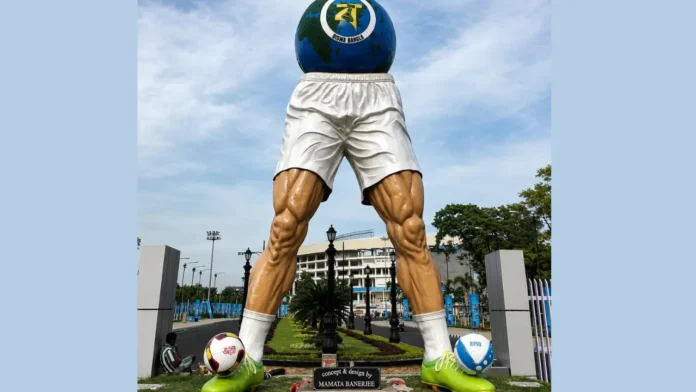
The latest flashpoint is the controversy surrounding a structure near Kolkata’s Salt Lake Stadium, officially known as Vivekananda Yuba Bharati Krirangan.
The BJP government in West Bengal has reportedly ordered the removal of a controversial installation associated with the Mamata Banerjee era. Supporters of the move call it a correction of political branding. Critics describe it as political revenge.
However, the issue goes much deeper than a statue.
It reflects a larger struggle over who controls Bengal’s public narrative.
What Exactly Is the Controversy?
The controversy revolves around a decorative installation or artistic structure near Salt Lake Stadium that became closely associated with the previous Trinamool Congress government led by Mamata Banerjee.
The structure drew criticism for years. Many people questioned:
- its design,
- the public money spent on it,
- and its political symbolism.
Opposition parties repeatedly claimed that the installation represented the excessive personalization of public infrastructure during the TMC regime.
After the BJP came to power in West Bengal in 2026 under Suvendu Adhikari, the administration began removing several visual markers associated with the previous government. This reportedly included the controversial structure near Salt Lake Stadium.
The Bigger Issue: Political Branding in Bengal
To understand the controversy, one must understand the rise of “Biswa Bangla” branding during the Mamata Banerjee years.
The TMC government aggressively promoted the “Biswa Bangla” identity across:
- stadiums,
- airports,
- government buildings,
- tourism projects,
- and cultural events.
Supporters viewed it as a celebration of Bengali identity and local culture.
Critics saw something different.
They argued that the branding slowly transformed state infrastructure into political messaging tools linked to one leader and one party.
That criticism has now become central to the BJP government’s justification for removing several symbols from public places.
Why Salt Lake Stadium Became Symbolically Important
Vivekananda Yuba Bharati Krirangan is not an ordinary venue.
It is one of India’s most iconic football stadiums. Generations of Bengalis emotionally connect with it.
Because of that emotional connection, every visible change at the stadium becomes politically sensitive.
Over the last few years, the stadium has already witnessed multiple controversies:
- branding disputes,
- maintenance criticism,
- administrative conflicts,
- and public anger after event management failures linked to international football programs.
Therefore, the removal of any structure there automatically carries symbolic weight.
BJP’s Political Calculation Behind the Move
The BJP government appears to be pursuing three parallel objectives.
Replacing Political Identity With State Identity
The administration has reportedly started replacing “Biswa Bangla” symbols with the Ashoka emblem and more conventional government identity markers.
The message is clear.
The BJP wants state infrastructure to appear institution-driven rather than personality-driven.
Sending a Message of Administrative Change
Political transitions often rely on visible actions.
Removing high-profile symbols associated with the previous regime creates an immediate psychological impression that power has shifted completely.
This is not unique to Bengal. Similar symbolic removals have happened in many states after regime change.
Consolidating Anti-TMC Sentiment
The BJP’s rise in Bengal came largely from anti-incumbency sentiment against the TMC government.
Therefore, dismantling symbols associated with the old administration also helps the BJP reassure its core support base that it is delivering visible change.
Why TMC Supporters Are Angry
For Trinamool Congress supporters, the issue is not merely about a structure.
They believe the BJP government is trying to erase the cultural and political legacy of the Mamata Banerjee era.
Many TMC leaders argue that:
- Biswa Bangla branding promoted Bengal globally,
- Public art should not become a political target,
- and the BJP is attempting cultural replacement rather than governance reform.
This emotional argument matters because Mamata Banerjee’s political image was deeply tied to Bengali cultural identity for over a decade.
As a result, attacks on symbols associated with her government often get interpreted as attacks on that larger identity narrative.
The Politics of Public Spaces
Public spaces have become powerful political battlegrounds across India.
Governments increasingly use:
- statues,
- murals,
- branding,
- architectural projects,
- and cultural symbols
to shape public memory.
When governments change, these symbols often become contested.
That is exactly what Bengal is witnessing now.
The Salt Lake Stadium controversy is essentially a battle over:
- memory,
- legitimacy,
- and ownership of Bengal’s public imagination.
Social Media’s Role in Amplifying the Controversy
Social media significantly intensified the issue.
Images and videos related to the structure spread rapidly online. Many users mocked the design. Others defended it emotionally.
Political supporters from both camps pushed competing narratives:
- BJP supporters framed the removal as “cleaning political clutter,”
- while TMC supporters called it “symbolic destruction.”
As happens in modern politics, perception became more important than the physical structure itself.
What Happens Next?
The controversy may continue for several reasons.
First, Bengal remains politically polarized after the 2026 Assembly election.
Second, symbolic politics generates emotional reactions quickly.
Third, the BJP government is expected to continue reviewing projects, branding, and structures associated with the previous regime.
This means similar controversies could emerge across:
- government buildings,
- sports infrastructure,
- tourism projects,
- and cultural installations.
Final Analysis
The Salt Lake Stadium statue controversy is not really about one installation.
It represents a transition of political power in Bengal.
The Mamata Banerjee years transformed public branding into a visible political identity project. The BJP government now wants to dismantle that ecosystem and replace it with a different administrative and ideological image.
Therefore, the fight is ultimately about symbolism.
Who defines Bengal?
Who controls its public spaces?
And whose identity becomes permanent in the state’s memory?
That is why a single structure near a football stadium has suddenly become a major political story in West Bengal.

