


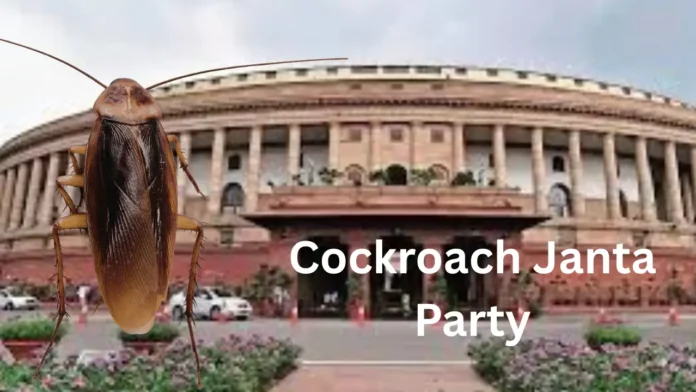
CJI Surya Kant called unemployed youth “cockroaches” in open court. Within 24 hours, 80,000 people had signed up for a satirical party built on that insult — and it is no longer just a joke
One Word. One Courtroom. One Unexpected Rebellion.
On the morning of May 15, 2026, India’s Supreme Court was hearing what most people would consider a routine, even minor case — a petition related to the senior advocate designation process at the Delhi High Court. The bench, led by Chief Justice of India Surya Kant alongside Justice Joymalya Bagchi, found the petition frivolous and said so bluntly.
Then the Chief Justice kept talking.
“There are already parasites of society who attack the system,” he said, “and you want to join hands with them? There are youngsters like cockroaches — they don’t get any employment, they don’t have any place in a profession. Some of them become media, some of them become social media, some of them become RTI activists, some of them become other activists, and they start attacking everyone.”
The courtroom moved on. The case was disposed of. The hearing ended.
But those words did not stay in that courtroom. They escaped into the internet. And what followed was one of the most unexpected, funny, angry, and politically significant digital moments of 2026.
What Actually Happened in Court — The Context That Got Lost
Before understanding what followed, it is important to be fair about what the Chief Justice was actually saying — because context matters enormously here.
The hearing on May 15 involved a case related to fake professional credentials in the legal field. The broader issue on the CJI’s mind was individuals who had entered the legal profession and other skilled fields, using fraudulent or bogus degrees. People who had essentially lied their way into positions of professional trust. His pointed remarks about “parasites” and people who “attack everyone” were, by his own subsequent account, directed squarely at that specific category of fraud.
The very next day, on May 16, CJI Surya Kant issued a formal clarification. He said he was “pained” by how sections of the media had reported his words. “What I had specifically criticised were those who have entered professions like the Bar with the aid of fake and bogus degrees,” he stated. “Such persons have sneaked into media, social media, and other noble professions, and hence they are like parasites.” He added: “It is totally baseless to suggest that I criticised the youth of our nation. Not only am I proud of our present and future human resources, but every youth of India inspires me. I see them as the pillars of a developed India.”
The clarification was prompt, clear, and genuine. But here is the problem. The original remarks, spoken in open court without the caveat about fake degrees being explicit enough in the transcript that circulated, landed on an audience of young Indians who are already exhausted. Youth unemployment in India remains a persistent and painful national wound. Millions of qualified graduates compete for inadequate jobs every year. The frustration had been building for years.
When the headline “Chief Justice calls unemployed youth cockroaches” hit social media, it did not land as a misquotation. It landed as confirmation of something many young Indians already felt — that authority in India looks down on them.
The clarification arrived too late to stop what had already begun.
The Man Who Started It All — Abhijeet Dipke
Abhijeet Dipke is 30 years old. He grew up in Aurangabad, Maharashtra. At the time of the CJI’s remarks, he was completing a graduate degree in public relations at Boston University in the United States.
He is also, importantly, someone who knows exactly how the internet works. From 2020 to 2022, Dipke worked on the Aam Aadmi Party’s social media team, where he helped create meme-driven campaign material during the Delhi Assembly elections. He understands digital momentum. He knows how to build a joke that carries a real point inside it.
On May 16, the morning after the CJI’s remarks went viral, Dipke posted a Google Form on X with a simple, pointed message: “Launching a new platform for all the cockroaches out there.”
Within hours, thousands of people had filled out the form.
He then built a website in a single evening using AI-based design tools and the help of friends. He set up Instagram and X accounts. He wrote a party manifesto. And he gave the whole thing a name that was equal parts absurdist joke and precision-targeted political commentary.
The Cockroach Janta Party. CJP for short.
The Name Is Not an Accident
The abbreviation CJP is not random. It is a direct play on BJP — the Bharatiya Janata Party, the ruling party of India under Prime Minister Narendra Modi. The full name, Cockroach Janta Party, mirrors the structure of BJP exactly: an animal or quality + “Janta” (People) + “Party.”
The joke works on multiple levels simultaneously. It reclaims the insult — if the Chief Justice called them cockroaches, they will wear it as a badge. It pokes at the establishment — using the same grammatical template as the country’s most powerful political party. And it signals to anyone paying attention that this is not just a gag, it is a commentary.
The party’s official motto on X: “A political front of the youth, by the youth, for the youth. Secular — Socialist — Democratic — Lazy.”
That last word is key. “Lazy” is not an admission — it is a reclamation. It echoes the CJI’s broader implication that unemployed youth are unambitious or parasitic. The party is saying: Fine, call us lazy. We will call ourselves that, too. And then we will ask you uncomfortable questions.
The Manifesto — Funny on the Surface, Serious Underneath
The Cockroach Janta Party’s membership eligibility criteria are intentionally hilarious. To join, you must be: unemployed, lazy, chronically online, and capable of ranting professionally. Prashant Bhushan, the noted Supreme Court advocate and activist, joked publicly that he would have joined but sadly does not meet the criteria.
However, the actual manifesto goes much further than a punchline.
The party’s stated ideology — secular, socialist, democratic, and anti-caste — directly invokes the founding principles of the Indian Constitution and the legacies of Gandhi, Ambedkar, and Nehru. The party explicitly says it draws inspiration from all three.
The manifesto then takes sharp aim at several live issues. It addresses voter manipulation allegations against the Modi government. It criticises what it describes as a largely pliant corporate media. And notably, it raises the issue of judges accepting government positions after retirement — a question about judicial independence that legal scholars and civil society have debated for years.
Dipke responded directly to the CJI’s clarification on X. “I have my differences with the PM,” he wrote, “but I believe the CJI has no right to insult him. Not having a legitimate degree does not give anyone the right to call fellow citizens ‘parasites’.” The statement was pointed and deliberate — making clear that the movement’s issue was not just with the word “cockroach” but with the institutional attitude it revealed.
The Numbers That Made People Stop Laughing It Off
Within 48 hours of Dipke’s first post, the Cockroach Janta Party had over 25,000 followers on X and more than 13,000 on Instagram. By May 17, total membership sign-ups had crossed 50,000. By May 19, the count stood at over 80,000 registered members.
To put that number in perspective, most actual registered political parties in India, ones with legal standing and ballot access, struggle to demonstrate that level of organised public engagement online in such a short period.
The movement also organised an online gathering called “Rochak Sabha” — the Interesting Assembly — which drew thousands of participants. People joined from across India and from the Indian diaspora internationally. The demographic profile was overwhelmingly Gen Z and millennial, largely urban and semi-urban, and notably cross-regional. People from Kerala, Maharashtra, Bihar, Delhi, Assam, and the Indian diaspora in the US and UK all showed up.
From Online Joke to Electoral Threat
Here is where the story shifts from entertaining to genuinely significant.
By mid-May 2026, reports emerged that supporters of the Cockroach Janta Party were actively discussing fielding their first candidate in an upcoming by-election. The seat in question is the Bankipur Assembly constituency in Bihar. The proposed candidature would place a CJP candidate directly against nominees from the BJP and Prashant Kishor’s Jan Suraaj Party — two of Bihar’s most formidable political forces.
Political observers described the move cautiously but seriously. A satirical online movement turning into an electoral entry is unusual but not unprecedented in Indian politics. The AAP itself began as a movement — the India Against Corruption campaign — before becoming one of the country’s most significant state-level parties within a few years. The CJP’s roots in AAP’s social media playbook are not coincidental.
Dipke himself has been measured but firm. “It started as a joke,” he said in an online discussion. “But it has gradually moved beyond a joke now. I think I will be in India soon, and we will decide what to do about the movement. We have 80,000 sign-ups. It can’t be left as such.”
Why This Touched a Raw Nerve
The Cockroach Janta Party is funny. But the reason it spread so fast is not humour. It is pain.
India’s youth unemployment crisis is real and documented. Millions of graduates enter an economy that does not produce enough formal-sector jobs to absorb them. Many end up in gig work, informal labour, or extended education cycles that delay their entry into stable careers. A significant subset turns to freelance writing, social media content creation, RTI activism, or digital journalism — precisely the occupations the CJI described as the refuge of those who “start attacking everyone.”
For a young person doing exactly that — writing online, filing RTI requests, building a social media presence because formal employment is out of reach — hearing the Chief Justice of the Supreme Court describe their existence as “cockroach behaviour” is not a misquotation. It is a wound.
The CJI’s clarification, whatever its intent, did not reach most of these young people in time. And even those who read it found the logic unconvincing — because the original remarks, as delivered in open court, did not draw the line between fake-degree fraudsters and frustrated young activists clearly enough.
“People are finally asking questions and demanding accountability,” said Prashant Bhushan, commenting on the movement’s appeal. “Some connect with it because it’s funny. Others connect because they are frustrated.”
Both are true. And both are valid.
The Institutional Question Nobody Wants to Answer
Beneath the satire and the membership drives lies a serious institutional question.
India’s Supreme Court has long been seen as a temple of authority — remote, elevated, and above the kind of informal scrutiny that social media now applies to everything else. Judges speak from the bench with the weight of the Constitution behind them. Their oral observations, even the informal ones made during hearings, carry a particular authority.
When the country’s top judge describes a category of young people — unemployed, digitally active, civically engaged — as “cockroaches” in open court, it matters not just because of what was said, but because of who said it, and where.
The CJP’s manifesto touches on this directly. It raises questions about post-retirement judicial appointments to government positions. It asks about accountability mechanisms for the judiciary itself. These are not fringe questions — they are debated by serious legal scholars, retired judges, and civil society organisations. The Cockroach Janta Party has simply given those questions a sharper, louder, more irreverent platform.
The Broader Pattern — When Insults Become Movements
This is not the first time a dismissive label has become the seed of a political identity. Historically, groups have repeatedly reclaimed words used against them and turned them into symbols of pride and solidarity.
The dynamic here is familiar. An authority figure uses a dehumanising word. The targets of that word refuse to be diminished by it. They adopt the word, invert its meaning, and use the very act of adoption as a political statement. The insult becomes the identity. The identity becomes the movement.
The Cockroach Janta Party is operating in exactly this tradition — with the added dimension of being native to the internet in a way that older movements never were.
Final Thought
One courtroom remark. Spoken during a minor hearing on a case most people would never have heard about. Reported without its full context. Landing on a generation of young Indians who are overqualified, underemployed, and out of patience.
That is how you accidentally launch a political movement with 80,000 members in three days.
The Cockroach Janta Party may remain a satirical footnote. Or it may contest Bihar and prove something. Either way, it has already done something important — it forced a conversation about how India’s institutions regard its youth, and it gave a generation that felt invisible a name to rally behind.
They chose to be cockroaches. And cockroaches, as the old saying goes, survive everything.

