


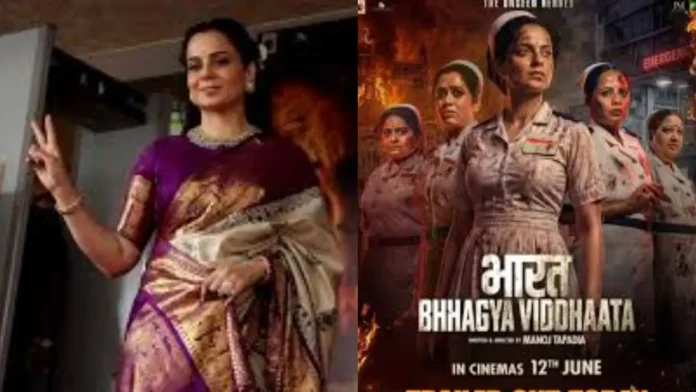
Manoj Tapadia’s thriller turns its gaze away from the Taj and the commandos, and onto the nurses of Cama Hospital — unarmed women who kept the lights off, hid their patients, and refused to run. The result is flawed, sincere, and quietly devastating.
Language: Hindi
Runtime: 130 mins
★★★½☆3.5 / 5 — The Indian Bugle
Title Bharat Bhhagya Viddhaata
Director Manoj Tapadia
Release 12 June 2026
Runtime130 minutes
Language Hindi
Genre Historical Thriller / Drama
Every year, November 26 scrolls past our news feeds with the same images: the burning dome of the Taj Mahal Palace Hotel, the scarred walls of Nariman House, the blood-stained floors of Chhatrapati Shivaji Maharaj Terminus. What rarely makes that scroll — what has never, until now, made it to the cinema screen with any sustained attention — is the ground floor of Cama and Albless Hospital, where a group of nurses in white uniforms turned off the lights, locked the gates, and spent the longest night of their lives keeping over 400 patients alive while two terrorists searched the building for targets.
That is the story Bharat Bhhagya Viddhaata chooses to tell. And for choosing it alone, director Manoj Tapadia earns considerable goodwill.
The Setup: A Hospital Before the Storm
The film opens with an unhurried, almost tender first half. Nurse Geeta Madhav Gandhare — played by Kangana Ranaut and inspired by the real-life Anjali Kulthe — is assigned the night shift of November 26, 2008. Her colleagues Sheila (Girija Oak Godbole) and Babita (Smita Tambe) banter around her, patients in their wards have their own quiet dramas, and the institution hums along with the ordinary warmth of a public hospital at night. Tapadia is deliberate here: he wants us to know these nurses as people before he puts them in danger. The camaraderie is earned, not assumed.
“In times of crisis, it is not only those carrying weapons who protect the nation — but also the nurses who stand beside their patients and care for them under the most dangerous circumstances.”— The film’s central argument, and its most resonant truth
When the reports begin filtering in — gunshots near the Taj, then the station, then word from Geeta’s husband Kedar (Prasad Oak) calling her phone in a panic — the film shifts register with quiet efficiency. The nurses do not run. They shut the gates. They kill the lights. They whisper, crouch, and pray that the building looks abandoned to anyone approaching from the street. It does not.
The Terror Sequence: Tense, Claustrophobic, Overlong
When Abu Ismail and Ajmal Kasab breach the hospital, the film’s second half pivots into survival thriller territory. Tapadia shoots these sequences with commendable restraint — there is no stylised action choreography, no cathartic confrontation. The fear comes from silence, from the sound of boots on staircases, from the nurses making impossible choices about which floor to hide on and which lights they dare not switch on. It is genuinely harrowing.
But the film stumbles in its execution here. Audiences are left uncertain about which nurse is on which floor at which moment — a problem that could have been solved simply by a floor-number caption. The narrative grows cluttered in ways that undercut the tension rather than build it. And the terrorist thread wraps up somewhat earlier than the pacing seems to warrant, leaving the final thirty minutes overstuffed with resolution and emotion that haven’t quite been earned.
400+Patients Protected
25 Nurses on Duty
2008 Night of 26/11
130 Minutes Runtime
Kangana Ranaut: A Return to Restraint
Let it be said plainly: Kangana Ranaut is excellent here. After the operatic excess of Emergency, her work as Geeta is defined by economy — the flicker of fear held behind professional composure, the trembling hands steadied by duty, the moment she makes a decision that could kill everyone she is responsible for and makes it anyway. She remembers, in this film, to serve the story rather than command it. The result is one of her most mature performances in recent memory.
Girija Oak Godbole matches her, bringing layers to a character that lesser films would have reduced to wallpaper. Smita Tambe’s Babita is the film’s emotional anchor. The ensemble — which includes Rasika Agashe, Asha Shelar, Vijay Gokhale, and Aditya Mishra as Abu Ismail — operates with the cohesion of a genuine company rather than a star vehicle’s supporting cast.
The Technical Picture: A Mixed Scorecard
Cinematographer Ayan Sil does exceptional work — the hospital’s institutional fluorescence becoming sinister once the lights drop, shadows doing the work that exposition might otherwise have cluttered. Editor Dev Rao Jadhav keeps the film crisp for the most part, though the final act’s structural looseness suggests the cutting room didn’t quite solve what the screenplay left unresolved.
The film’s most pronounced weakness, however, is GV Prakash Kumar’s background score. Where restraint would have amplified the tension — where silence, or near-silence, would have placed the audience inside the nurses’ terrified waiting — the score arrives too often, too loudly, and too heroically. The inherent drama of the story is powerful enough on its own. The music, unfortunately, doesn’t trust it.
What Works
- Kangana Ranaut’s controlled, matured performance
- Brilliant ensemble — Girija Oak Godbole and Smita Tambe shine
- Brave subject matter, largely handled with respect
- Genuinely tense second-act survival sequences
- Ayan Sil’s atmospheric, disciplined cinematography
- The nurses’ camaraderie — warm, believable, earned
What Doesn’t
- Overly loud background score undercuts tension
- Confusing spatial storytelling in the second half
- The final thirty minutes feel rushed and overstuffed
- Certain plot developments strain credibility
- Terrorist track concludes abruptly
The Verdict: A Story That Needed to Be Told
There is a version of Bharat Bhhagya Viddhaata that is an outstanding film. The bones are there — an extraordinary true story, a committed cast, a director who understands both the emotional and the political stakes of what he’s making. The version on screen is a very good one, held back from greatness by technical choices that fight against rather than for its material.
But here is what matters: the nurses of Cama Hospital saved over 400 lives on the worst night in recent Indian history. They did it without weapons, without training for combat, without any of the recognition that was lavished on the army and the commandos who eventually ended the siege. They got none of it. Nearly eighteen years later, this film finally gives them a frame. That act of remembrance, for all the film’s imperfections, is not a small thing.
Watch it for the subject. Watch it for the ensemble. Watch it for Kangana Ranaut, who, for once, steps back and lets the story breathe. Bharat Bhhagya Viddhaata is worth your Friday.
The Indian Bugle Verdict: 2.5/5
Cast
- Kangana Ranaut Geeta Madhav Gandhare
- Girija Oak Godbole Sheila
- Smita Tambe Babita
- Prasad Oak Kedar (Geeta’s husband)
- Rasika Agashe Supporting role
- Vijay Gokhale Babbanrao Zambre
- Aditya Mishhra Abu Ismail
- Zahid Khan Ajmal Kasab
- Asha Shelar Supporting role
Crew
- Director Manoj Tapadia
- Screenplay Manoj Tapadia
- Music GV Prakash Kumar
- Cinematography Ayan Sil
- Editor Dev Rao Jadhav

