


$100 Billion, Arctic Routes, Sovereign Wealth and Green Tech — The Real Reasons India Is Wooing the World’s Quietest Powerhouses
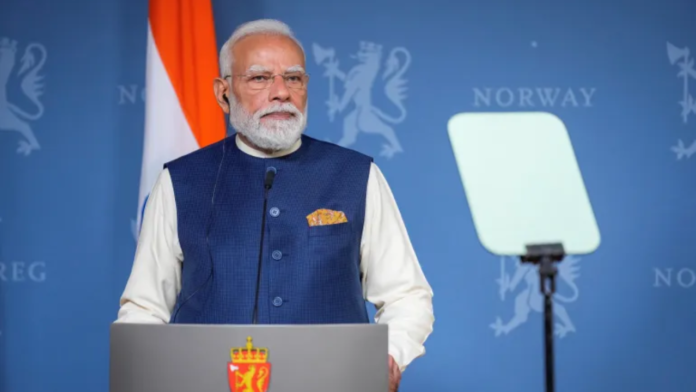
On May 19, 2026, Prime Minister Narendra Modi sat across the table with the leaders of Norway, Denmark, Sweden, Finland, and Iceland at the third India-Nordic Summit in Oslo. It was a historic moment. Modi’s visit to Norway was the first by an Indian Prime Minister in 43 years — the last being Indira Gandhi in June 1983.
But this was not nostalgia. This was a strategy.
Behind the handshakes and summit declarations sits a carefully constructed plan. India is building a new axis of partnerships — not with the loudest powers, but with some of the world’s most capable and financially powerful ones. The five Nordic nations may be small in population. But they punch far above their weight in clean technology, sovereign capital, Arctic influence, and maritime expertise. And India needs all of that — urgently.
So why exactly is Modi wooing Northern Europe? Let’s dig in.
First, Who Are the Nordic Countries?
Before diving into strategy, it helps to understand who India is actually dealing with.
The Nordic group — Norway, Sweden, Denmark, Finland, and Iceland — is five nations with a combined population smaller than Maharashtra. But together, they lead the world in offshore wind energy, green shipping, ice-class shipbuilding, satellite infrastructure, healthcare innovation, and democratic governance. Norway alone runs the world’s largest sovereign wealth fund, currently valued at over $2 trillion. Sweden houses SAAB and Ericsson. Denmark leads global wind energy. Finland makes nuclear-grade icebreakers. Iceland is a world leader in geothermal energy and carbon capture.
These are not peripheral players. They are quiet, technology-rich, finance-heavy partners — exactly what India needs as it attempts one of the most ambitious economic transformations in modern history.
The $100 Billion Deal That Changes Everything
The most consequential development in the India-Nordic relationship is not even from this summit. It happened earlier. In October 2025, India and the European Free Trade Association — which includes Norway, Switzerland, Iceland, and Liechtenstein — signed the Trade and Economic Partnership Agreement, or TEPA.
This is a landmark deal. Under TEPA, EFTA countries made a legally binding commitment to facilitate $100 billion in investments into India over the next 15 years. The goal is to create more than one million jobs in India. Norwegian PM Jonas Gahr Støre called the agreement “unique,” noting that Norway had never before made such a sweeping investment commitment to another country.
Modi reinforced this at the India-Norway Business and Research Summit in Oslo. He told Norwegian companies directly: India has changed its economic DNA. Reforms in taxation, labour laws, and governance have created a fundamentally more investor-friendly environment. The message was clear — the opportunity window is open, and Norway should walk through it.
The $100 billion is not charity. It is capital seeking long-term, stable returns in a fast-growing market. And India, with its 8% average GDP growth and massive infrastructure pipeline, offers exactly that.
Norway’s $2 Trillion Sovereign Wealth Fund Is Already in India
Here is something most people do not know. Norway’s Government Pension Fund Global — the world’s largest sovereign wealth fund, with assets exceeding $2 trillion as of May 2026 — already holds approximately $30.8 billion in Indian capital markets, spread across nearly 500 publicly listed Indian companies. Those holdings have more than doubled in value since 2020.
That is not a small bet. That is one of the clearest votes of confidence in India’s long-term economic story from any single institutional investor on earth.
During the Oslo Business Summit, Modi pushed further. He urged Norwegian companies to increase investments in renewable energy, blue economy, shipbuilding, health-tech, startups, and critical minerals. He specifically pointed to the sovereign wealth fund’s growing focus on clean energy as a natural bridge to India’s green transition goals.
Norway’s PM Støre echoed the sentiment, calling India “not only a market — but a solution to global climate challenges.” He added that Norwegian capital and technology, combined with India’s scale and manufacturing strength, could together bring down the cost of green energy for the entire world.
That kind of alignment between capital and purpose is rare. And it explains why this relationship matters far beyond diplomatic courtesy.
The Arctic — India’s Surprising New Frontier
Here is where the story gets genuinely unexpected. Arctic geopolitics may seem distant from India’s concerns. But it is, in fact, central to why Modi is building deeper ties with Nordic nations.
The Arctic is melting. As ice recedes, new shipping routes are opening up — most notably the Northern Sea Route, which connects Europe to Asia through Arctic waters. These routes could dramatically cut shipping times and costs between Indian ports and European markets. A journey that currently takes 25–30 days through the Suez Canal could shrink to 15–18 days through the Arctic.
India is already an observer nation on the Arctic Council. It has maintained its Himadri research station on Norway’s Svalbard island since 2008. And during Modi’s Oslo visit, a major milestone was operationalised — ISRO-installed ground antennas at Norway’s KSAT satellite facility in Svalbard became fully functional. These antennas significantly boost India’s deep-space communication capabilities and polar satellite data reception. India is investing in Arctic access because it directly serves both scientific and economic goals.
There is also a monsoon connection that most people do not know about. Indian researchers have spent years studying how melting Arctic ice affects the Indian monsoon. The relationship between Arctic temperature changes and India’s rainfall patterns is real and consequential. Stronger Arctic cooperation gives India better data, better climate models, and ultimately better agricultural planning.
Norway’s $2 trillion sovereign wealth fund traces its origins to North Sea oil. Now, Norway is one of the most advanced nations in offshore wind, carbon capture, and green hydrogen. That expertise is directly relevant to India’s energy transition. The two countries formally elevated their bilateral relationship to a Green Strategic Partnership — a framework that commits both sides to annual ministerial-level dialogues on energy, ocean management, and climate adaptation.
What Each Nordic Country Brings to the Table
The India-Nordic relationship is not a single bilateral story. Each of the five countries contributes something distinct and irreplaceable.
Norway brings sovereign capital, offshore energy expertise, maritime governance, and Arctic access. Norway’s Kongsberg Group already signed an MoU with India’s Garden Reach Shipbuilders to help design India’s first indigenous Polar Research Vessel — a ₹2,329 crore project expected by 2029–30.
Sweden brings defence and aerospace technology through companies like SAAB and Ericsson, satellite infrastructure through the Esrange Space Centre in Kiruna — which already supported India’s Chandrayaan-3 mission — and now a formal AI cooperation corridor with India. Both countries elevated their relationship to a full Strategic Partnership at this very summit, with a target of doubling bilateral trade from $7.75 billion to $15 billion by 2030.
Denmark brings the world’s most advanced offshore wind technology. Denmark’s Odense Maritime Technology ecosystem is a potential partner for Indian shipyards looking to build green shipping capability. India wants to be among the world’s top ten shipbuilding nations by 2030 — Denmark can help get it there.
Finland brings icebreaker technology through companies like Aker Arctic. Finland also offers nuclear-grade engineering and advanced materials manufacturing. As India builds polar research capacity and deepens Arctic engagement, Finland’s technical expertise is invaluable.
Iceland brings geothermal energy knowledge that India has barely tapped. India has an estimated 10.6 GW of geothermal potential concentrated in Ladakh, Himachal Pradesh, and the Andaman and Nicobar Islands. Iceland’s CarbFix project — which mineralises carbon dioxide into rock — is also being studied as a potential model for carbon sequestration in India’s Deccan Traps basalt formations. That could be transformative for India’s net-zero journey.
The Geopolitical Timing Is No Accident
Beyond the economics and technology, there is a geopolitical dimension to Modi’s Nordic push that is easy to miss.
Trump’s claims over Greenland have rattled Nordic nations. His broader unpredictability has forced European countries — including the Nordics — to actively seek alternative strategic partners. India, as a large democratic market with genuine global influence, fits that need perfectly.
At the same time, Finland and Sweden joined NATO in 2022 and 2023, respectively, deepening the Nordic bloc’s Western alignment. But India maintains strategic autonomy. It does not take sides in US-Russia or US-China tensions. That makes India a safe, non-threatening, and valuable partner for Nordic nations that want to diversify their own strategic relationships.
There is also the Russia question. Nordic nations have taken a strong stance against Russia following the Ukraine war. India has maintained dialogue with Moscow while also deepening ties with the West. For Nordic countries navigating a complex Russia relationship, India’s independent position is actually an asset — a channel for dialogue that NATO-aligned nations cannot maintain.
What India Gets Out of All This
Let’s be direct. India is not doing this out of generosity. Every relationship Modi is building serves a specific Indian need.
Green technology is the most obvious. India has committed to 500 GW of non-fossil fuel energy by 2030 and net-zero by 2070. Nordic countries lead the world in offshore wind, green hydrogen, geothermal energy, and carbon capture. India cannot meet its climate commitments without that technology.
Sovereign capital is the second driver. India needs trillions of dollars in infrastructure investment over the next two decades. Nordic sovereign wealth funds and pension funds provide exactly the kind of long-term, patient capital that infrastructure projects require — unlike speculative foreign portfolio investment that can exit at the first sign of turbulence.
Shipbuilding is the third. India’s ambition to become a top-ten global shipbuilder by 2030 requires partnerships with countries that already master green ship design, ice-class vessels, and maritime technology. Denmark, Finland, and Norway lead in all three.
Space and defence are the fourth. Sweden’s satellite infrastructure, Norway’s KSAT facility, and Nordic expertise in dual-use technologies all serve India’s growing space ambitions and defence manufacturing push.
And finally, diplomatic credibility. A strong India-Nordic relationship gives India a credible Western alignment without compromising its strategic autonomy. It signals to European institutions that India is a reliable partner — a message that directly supports the India-EU FTA that Modi signed earlier in 2026.
The Honest Challenges
No story of this scale is without friction.
The Russia-Ukraine conflict creates real tension. Nordic nations — especially Finland, which shares a long border with Russia — have strong anti-Russia positions and deep NATO alignment. India’s continued purchase of Russian oil and its refusal to condemn Russian actions create awkward moments in these conversations. Both sides manage this gap diplomatically, but it does not disappear.
Regulatory differences create friction, too. Nordic investors find India’s complex procurement processes, inconsistent quality standards, and regulatory unpredictability frustrating. Translating the $100 billion TEPA commitment into actual capital deployment requires sustained confidence and a clear pipeline of bankable projects.
And India’s historical FDI from EFTA countries, while growing, has been relatively low compared to its total inflows. The gap between commitment and execution is real.
The Bottom Line
Five small countries. One enormous strategic logic.
Modi is not courting Northern Europe because it looks good in photographs. He is doing it because the Nordic nations hold exactly what India needs for its next phase of growth — patient capital, green technology, Arctic access, maritime expertise, and democratic credibility.
The India-Nordic Summit is not a feel-good forum. It is a building block of India’s long-term global positioning. Each summit — 2018 in Stockholm, 2022 in Copenhagen, 2026 in Oslo — has elevated the relationship further. Each time, the commitments have grown larger, and the engagement has deepened.
The third summit produced a Green Strategic Partnership with Norway, a full Strategic Partnership with Sweden, a $100 billion EFTA investment framework, 12 bilateral agreements, active ISRO infrastructure in the Arctic, and a clear roadmap for cooperation in clean energy, shipbuilding, AI, and space.
For India, the question is no longer whether the Nordic relationship matters. It clearly does. The question now is whether India can execute — deliver the regulatory clarity, the infrastructure pipeline, and the policy consistency that will turn these commitments into actual factories, wind farms, satellites, and ships.
The handshakes are done. The real work starts now.

