


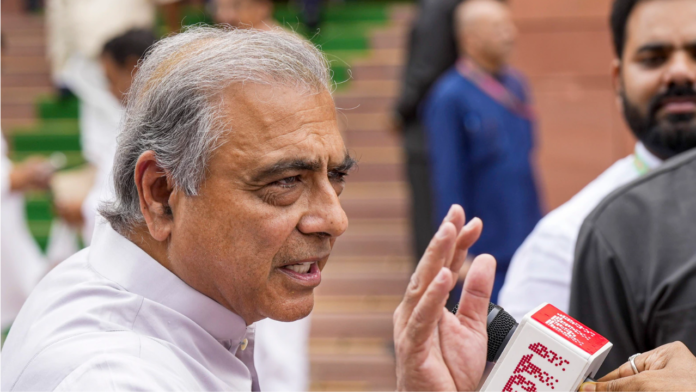
West Bengal is witnessing one of the biggest political confrontations in its recent history. The controversy began after Chief Minister Mamata Banerjee refused to resign following the 2026 Assembly election results. Soon after, senior Supreme Court advocate Mahesh Jethmalani launched a fierce attack on her stand.
His blunt remark — “Kick her out” — instantly became the centre of a nationwide debate. The statement did not remain a political slogan. Instead, it opened serious discussions about constitutional norms, democratic ethics, and the powers of a Governor during political uncertainty.
The issue now goes far beyond Bengal politics. It has become a test case for India’s democratic traditions.
What Exactly Happened?
The Bharatiya Janata Party secured a massive victory in the 2026 West Bengal Assembly elections. The result marked a historic political shift in a state where the Trinamool Congress had ruled for nearly 15 years.
However, Mamata Banerjee refused to accept defeat. She alleged large-scale irregularities in the election process and accused the Election Commission of bias.
During her public remarks, she declared that she would not resign because she believed the mandate had been “stolen.”
Her statement shocked political observers because defeated Chief Ministers in India usually resign immediately after the results confirm a loss of majority.
That is when Mahesh Jethmalani entered the debate.
Mahesh Jethmalani’s Explosive Response
Mahesh Jethmalani strongly criticised Mamata Banerjee’s refusal to step down. He argued that once a government loses the electoral mandate, remaining in office becomes constitutionally questionable.
According to him, if an outgoing Chief Minister refuses to resign despite losing majority support, the Governor has every right to intervene.
His most controversial statement was:
“Kick her out.”
The remark spread rapidly across television debates, social media platforms, and political discussions.
Many BJP leaders supported his view. On the other hand, TMC supporters described the statement as aggressive and politically motivated.
Still, the controversy raised an important constitutional question:
Can a Chief Minister legally refuse to resign after losing an election?
What Does the Constitution Say?
India’s Constitution does not directly mention a fixed timeline for resignation after electoral defeat. However, the parliamentary system depends heavily on constitutional conventions and majority support.
Under Article 164 of the Constitution:
- The Chief Minister holds office during the pleasure of the Governor.
- The government must enjoy majority support in the Assembly.
- If the majority disappears, the ministry loses legitimacy.
In normal situations, resignation follows naturally after defeat. That convention protects democratic stability.
However, if a Chief Minister refuses to resign, the Governor can:
- Ask the government to prove the majority,
- Seek resignation,
- Invite another party to form a government,
- Or dismiss the ministry in exceptional circumstances.
This is the legal basis behind Jethmalani’s argument.
Why Mamata Banerjee Refused to Step Down
Mamata Banerjee claimed that the election process suffered from manipulation and irregularities.
She alleged:
- EVM-related irregularities,
- Administrative bias,
- Electoral roll controversies,
- And unfair intervention by central agencies.
She repeatedly argued that the BJP’s victory did not reflect the true public mandate.
Her supporters say she is fighting to protect democracy. They believe she has the right to challenge the election outcome legally and politically.
However, critics argue that challenging results in court is different from refusing to resign after defeat.
That distinction lies at the heart of the present controversy.
The Governor’s Role Becomes Crucial
Whenever political uncertainty emerges after elections, the Governor becomes a key constitutional authority.
The Governor’s responsibilities include:
- Ensuring a stable government,
- Confirming legislative majority,
- Supervising the peaceful transfer of power.
If the outgoing government refuses to cooperate, the Governor can act to maintain constitutional order.
Experts believe the Governor would normally follow these steps:
- Wait for formal election certification,
- Invite the majority alliance to stake a claim,
- Seek resignation from the outgoing Chief Minister,
- Ask for a floor test if required,
- Take stronger action only if a constitutional breakdown occurs.
Therefore, dismissal remains the last option, not the first.
Still, the possibility itself has intensified political tensions in Bengal.
BJP’s Aggressive Political Strategy
The BJP quickly turned the controversy into a larger political campaign.
Party leaders accused Mamata Banerjee of:
- Disrespecting democracy,
- Insulting voters,
- And creating constitutional instability.
Several BJP spokespersons argued that the peaceful transfer of power forms the foundation of parliamentary democracy.
The party also claimed that refusing to resign after such a massive defeat damages democratic credibility.
At the same time, BJP leaders projected the victory as a turning point in Bengal politics.
Why the 2026 Bengal Election Was Different
The 2026 election carried enormous political significance.
The campaign revolved around:
- Anti-incumbency,
- Identity politics,
- Women voters,
- Border security,
- Citizenship debates,
- Electoral roll revision,
- Economic concerns,
- And allegations of corruption.
Political analysts believe anti-incumbency after 15 years of TMC rule played a major role in the outcome.
The BJP also made strong gains in urban and semi-urban areas.
Meanwhile, internal political tensions inside the TMC weakened the party’s organisational structure in several districts.
Suvendu Adhikari’s Rise Changed Bengal Politics
One of the biggest political developments in Bengal over the last few years has been the rise of Suvendu Adhikari.
Once a close associate of Mamata Banerjee, Adhikari later joined the BJP and became one of her strongest challengers.
His political shift transformed Bengal’s electoral dynamics.
The BJP used its grassroots influence to expand its reach across the state.
Many analysts believe this helped the BJP convert anti-incumbency into a decisive electoral advantage.
A Bigger Debate About Democratic Morality
The controversy is not only about legal procedure. It is also about democratic morality.
In parliamentary democracies, peaceful transfer of power holds immense symbolic importance. Even when leaders disagree with results, they generally step down first and challenge the outcome later through legal channels.
That convention maintains public trust in democratic institutions.
Critics argue that rejecting election results without strong evidence weakens institutional credibility. Supporters, however, say leaders have every right to raise concerns if they believe the process was compromised.
This clash between constitutional legality and political legitimacy now defines the Bengal controversy.
Could the Matter Reach the Courts?
There is a strong possibility of legal battles in the coming weeks.
The Trinamool Congress may:
- Challenge counting procedures,
- File election petitions,
- Seek judicial review,
- Or demand an investigation into alleged irregularities.
However, constitutional experts believe courts usually avoid interfering in government formation unless procedural violations become serious.
That means the Governor’s decisions may become more important than judicial intervention in the immediate future.
Why This Crisis Matters Nationally
The Bengal controversy has national implications because it touches the core principles of Indian democracy:
- Respect for electoral verdicts,
- Constitutional conventions,
- The Governor’s authority,
- And institutional credibility.
If unresolved peacefully, such confrontations could create dangerous precedents for future elections in India.
That is why legal experts, political analysts, and constitutional scholars are closely watching every development.
What Happens Next?
Several major developments may unfold soon:
- Formal certification of election results,
- BJP legislature party meetings,
- Government formation process,
- Possible intervention by the Governor,
- Legal challenges from the TMC,
- And heightened political mobilisation across Bengal.
The coming days will decide whether the crisis ends through constitutional procedure or escalates into a prolonged political confrontation.
Conclusion
Mahesh Jethmalani’s “Kick Her Out” remark captured national attention because it reflected the extraordinary nature of the current situation in West Bengal.
At one level, the controversy is about Mamata Banerjee’s refusal to resign. But at a deeper level, it is about how democracies manage defeat, transition, and legitimacy.
India’s Constitution provides mechanisms to handle political crises. Yet institutions also depend on convention, restraint, and democratic maturity.
West Bengal now stands at the centre of that constitutional test.

