


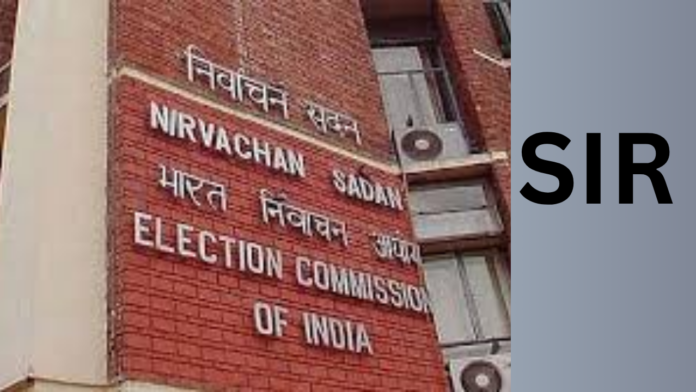
On October 27, 2025, Chief Election Commissioner Gyanesh Kumar stepped up to a podium at Vigyan Bhawan in New Delhi and announced something India had not seen in over two decades. The Election Commission of India would conduct a Special Intensive Revision — or SIR — of voter rolls across the entire country.
The idea sounded straightforward. Go house to house. Verify voters. Remove those who are dead, have moved, or do not belong. Add those who are newly eligible. Clean up the list.
What followed was anything but simple.
What Is the Special Intensive Revision?
The SIR is a large-scale, door-to-door voter verification drive. It is far more intensive than the routine annual updates the ECI typically conducts. In a normal summary revision, officials update the rolls without visiting homes. The SIR is different. Booth Level Officers — called BLOs — physically visit every household, collect documents, verify identities, and update the data on a central portal.
The ECI draws its authority for this from two sources: Article 324 of the Constitution, which gives the Commission superintendence over elections, and Section 21(3) of the Representation of the People Act, 1950, which empowers it to revise electoral rolls.
The last time India conducted an intensive revision of this kind was between 2002 and 2004. That was over 20 years ago. Since then, India’s population has changed dramatically. Cities have grown. Millions have migrated. Lakhs of voters died without their names being removed. And according to the ECI, several constituencies had voter rolls that no longer reflected ground reality.
So the Commission decided it was time to start again.
Why Now — The Four Reasons the ECI Gave
Chief Election Commissioner Gyanesh Kumar laid out four specific reasons for launching the SIR.
First, migration. Millions of Indians have moved from their registered constituencies to other cities for work, but their names remain on the rolls back home. Second, duplicate registrations. Many voters appear in more than one location. Third, unreported deaths. Names of deceased voters continue to sit on the rolls because no one officially notifies the Commission. Fourth, and most politically charged — illegal immigrants. The ECI specifically flagged concerns about non-citizens in West Bengal, Assam, and Tripura who had allegedly obtained voter ID cards using forged documents.
The fourth reason is where the trouble started.
How the SIR Rolled Out: Three Phases
The ECI did not launch the SIR everywhere at once. It rolled it out in phases, state by state.
Phase I began in Bihar in June 2025, ahead of the Bihar Assembly elections. This was the pilot run. Approximately 47 lakh voters were removed from Bihar’s rolls after verification.
Phase II launched on November 4, 2025, covering 9 states and 3 Union Territories — including Uttar Pradesh, West Bengal, Tamil Nadu, Kerala, Rajasthan, Gujarat, Madhya Pradesh, Goa, Chhattisgarh, and the island territories. This phase covered over 51 crore voters across 1,843 Assembly constituencies and 321 districts.
Phase III — the final stretch — began in May 2026. On May 14, 2026, the ECI formally announced Phase III for 16 states and 3 Union Territories including Delhi, Maharashtra, Andhra Pradesh, Telangana, Karnataka, Odisha, Punjab, Haryana, and others. This phase covers another 36.73 crore electors. Himachal Pradesh, Jammu and Kashmir, and Ladakh remain excluded for now due to terrain challenges and ongoing Census house-listing operations.
Once Phase III concludes, the SIR will have covered all 99 crore voters across the country. It will be the most comprehensive electoral roll revision India has ever seen.
The Numbers Behind the Exercise
The scale is hard to grasp without looking at the numbers directly.
In West Bengal alone, the SIR removed 91 lakh names — that is 11.88 percent of the entire pre-revision electorate of 7.66 crore. In Uttar Pradesh, over 2.04 crore names were deleted. Across the nine states and three UTs covered in Phase II, the combined voter rolls shrank by 10.2 percent — from 50.99 crore to 45.81 crore. Over 66 lakh deceased voters were removed, with Uttar Pradesh accounting for 25.47 lakh and West Bengal for 24.16 lakh.
Those numbers tell a story about how outdated India’s electoral rolls had become. But they also raised a far more uncomfortable question. Were all those deletions legitimate?
The Problems on the Ground
This is where the SIR story gets difficult.
The entire field operation rested on Booth Level Officers. A BLO is typically a government employee — a teacher, a health worker, a local official — assigned to cover a specific polling booth. Their job under the SIR was enormous. Go door to door. Distribute pre-filled enumeration forms. Collect documents. Upload data to an online portal. Do all of this within a tight deadline.
The Election Commission initially gave states roughly one month to complete the enumeration phase. That timeline was brutal.
Reports began emerging from Uttar Pradesh, Bihar, Rajasthan, and West Bengal about BLOs collapsing under the pressure. A 46-year-old BLO in Uttar Pradesh’s Baheri village died by suicide. In a note he left behind, he said he was “unable to cope” with the burden. Another BLO in Rajasthan’s Dholpur died after collapsing while uploading voter data late at night. In West Bengal, a 50-year-old rural health worker died of a stroke while on SIR duty.
District officials were sending messages to BLOs telling them to complete 200 forms or face consequences. One BLO’s son told journalists that his father received such messages repeatedly. The ECI doubled BLO compensation to ₹1,000 and announced an additional ₹6,000 incentive on completion. But critics pointed out that the Commission had provided no training, no devices, and no data entry support before launching the exercise.
The ECI called the deaths unfortunate and maintained the work was “not overburdening at all.” That response satisfied very few people on the ground.
The Document Problem
The SIR’s verification process created another serious challenge — the document requirement.
For voters who could trace their name or a parent’s name to the 2002 electoral roll, no additional documents were needed. But for everyone else — anyone who enrolled after 2002 — the SIR required proof of eligibility from a list of approved documents.
Here is the problem. The initial list of eleven approved documents did not include Aadhaar cards, voter ID cards, or ration cards. These are the most common identity documents in India, especially among the poor and the migrant population. Bihar, for example, has an estimated 75 lakh migrants working in other states. Many of them do not carry obscure documents like birth certificates or pre-1987 government records.
Only after the Supreme Court intervened did the ECI expand the list to include Aadhaar and voter ID as valid proof.
Even then, the structural problem remained. Only 32 percent of West Bengal’s voters could be matched to the 2002 legacy roll. That left 68 percent — effectively every voter enrolled after 2002 — carrying the burden of proving they belonged on the list. That is not a clean-up exercise. That is, as critics argued, a re-registration drive in disguise.
The Political Storm
Predictably, the SIR became intensely political.
Opposition parties — the Congress, TMC, CPI(M), Samajwadi Party, DMK, and RJD — all came out against it. They accused the ECI of acting in favour of the ruling BJP. They argued that the SIR’s design systematically targeted minority communities, migrants, and marginalised voters groups that historically lean away from the BJP.
In West Bengal, the TMC alleged that the exercise was an attempt to reshape the voter base before the 2026 elections. The data from Nandigram, where 95.5 percent of deleted voters were Muslim, added weight to that concern.
The BJP countered by calling those deleted “infiltrators” from Bangladesh. Union Home Minister Amit Shah defended the SIR in Parliament. On the other side, Rahul Gandhi called it a “sinister plan to destroy democracy.”
Senior Congress MP Shashi Tharoor, notably, broke with his party’s line and publicly supported the SIR, praising both the ECI and the government for the move. The government agreed to hold a parliamentary debate on the issue during the winter session.
The argument did not stay in Parliament for long. It quickly reached the Supreme Court.
The Supreme Court Steps In
In July 2025, the Association for Democratic Reforms, along with Yogendra Yadav, Mahua Moitra, and the People’s Union for Civil Liberties, filed a public interest litigation challenging the SIR’s constitutionality.
Their core argument was that the SIR violated fundamental rights under Articles 14 (equality), 19(1)(a) (freedom of expression), and 21 (right to life) of the Constitution. They also argued that the SIR’s design — placing the burden of re-enrolment on existing registered voters — inverted the legal presumption that an enrolled voter is a valid voter.
The Supreme Court, through a bench of Justices Surya Kant and Joymalya Bagchi, issued several interim orders that progressively tightened constraints on the ECI. The Court directed the Commission to accept Aadhaar and voter ID as valid documents. It insisted the goal must be “mass inclusion, not en masse exclusion.” It ordered the ECI to publish district-wise, booth-level lists of every deleted voter along with the reason for deletion.
For West Bengal, the Court deployed approximately 700 judicial officers to adjudicate deletion appeals. It then constituted 19 Appellate Tribunals, chaired by retired High Court judges, to hear further appeals.
On January 29, 2026, the Supreme Court reserved its judgment in the case, even as the elections in West Bengal, Tamil Nadu, Kerala, and Assam went ahead.
The judgment, when it arrives, will be the most significant judicial review of electoral administration since the Constitution came into force.
Three Constitutional Questions the Court Must Answer
Legal experts have identified three core questions that the Supreme Court judgment must resolve.
The first is whether Section 21(3) of the Representation of the People Act authorises a de novo reconstruction of the voter roll — meaning, can the ECI essentially rebuild the list from scratch, or only update an existing one?
The second is whether the SIR’s reverse burden of proof is constitutional. A 1995 Supreme Court judgment in Lal Babu Hussein v. Electoral Registration Officer held that a voter cannot be deleted without proper notice and hearing. The SIR’s design, critics argue, violates that precedent by presuming ineligibility and asking voters to prove otherwise.
The third is whether Article 326 of the Constitution — which guarantees the right to vote to every adult citizen — creates a justiciable right that the executive cannot impair without following due process under Articles 14, 19, and 21.
Notably, legal scholars have also pointed out that the term “Special Intensive Revision” does not appear anywhere in any statute. The ECI constructed this category administratively, under its broad powers. That makes the legal challenge even more significant.
What Happened to the People
Behind all the legal arguments and political battles, ordinary people lived through the SIR in very real ways.
In West Bengal, the requirement to match names to a 2002 roll terrified communities that had settled in the state after that year. The Matua community — Hindu refugees from Bangladesh who migrated post-2002 — found it impossible to meet the legacy linkage requirement. Many had never been on any pre-2002 roll. Their parents had not been either.
The fear of being erased from the voter list — and by extension, being treated as an illegal immigrant or even deported — caused severe anxiety in multiple communities. Reports emerged of suicides and unnatural deaths among people who feared the SIR would strip them of their citizenship and settled life.
BJP leaders tried to calm fears by pointing to the Citizenship Amendment Act as a safety net for Hindu refugees. Many in the Matua community remained unconvinced. The CAA offers a path to citizenship; it does not guarantee a spot on the voter roll, and the two processes work on entirely different timelines.
What Comes Next
Phase III of the SIR is now underway. Over 3.94 lakh BLOs will go door to door across 36.73 crore electors in 16 states and 3 UTs. The process across most states runs from May to September 2026. States like Maharashtra, Karnataka, Jharkhand, Meghalaya, and Delhi begin in late June and conclude by October 7, 2026.
The Supreme Court’s reserved judgment could arrive at any time. Legal scholars note that its ruling will set the boundaries for what the Election Commission can and cannot do in future revisions. Some experts have called for Parliament to amend the Representation of the People Act to explicitly clarify that the ECI’s verification powers cover identity, age, and ordinary residence — but not citizenship status or immigration history. That boundary, they argue, the Commission crossed in its SIR design.
The ECI, for its part, maintains that the exercise is essential. India’s voter rolls had not been intensively revised in over 20 years. Urbanisation, migration, and demographic change made a correction overdue. The Commission insists the SIR is about democratic hygiene, not disenfranchisement.
The Bigger Question
The SIR has forced India to confront an uncomfortable truth. Voter rolls are not neutral databases. Every decision about who goes on the list — and who comes off — carries political weight. The criteria, the timelines, the document requirements, and the burden of proof all shape who gets to vote. And in a democracy of 99 crore, those decisions matter enormously.
The Election Commission began this exercise with a legitimate goal: clean, accurate, and inclusive voter rolls. That goal is not wrong. A voter list with millions of dead people, duplicates, and non-citizens is a problem that needs fixing.
But the method — compressed timelines, impossible document requirements, an algorithmic process that flagged more people than it correctly identified, and a ground workforce given no training and no support — turned a necessary exercise into a crisis.
The SIR will be remembered not for what it set out to do, but for what it revealed: that even the most well-intentioned administrative exercise can harm the very democracy it claims to protect, when the process is built without adequate safeguards for the people at the bottom.

 to clean up voter rolls nationwide. But what is it, why is it controversial, and who does it affect? Read the full story.)