


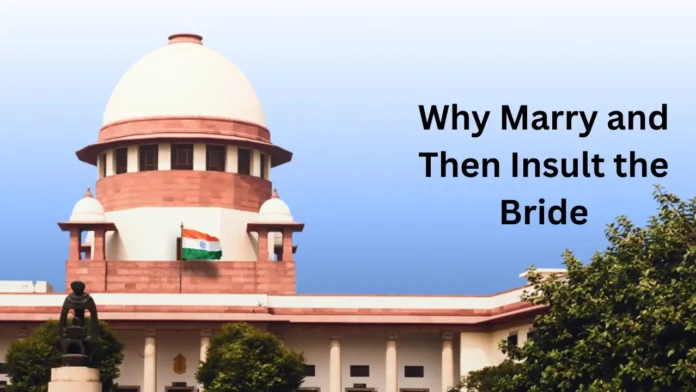
The Supreme Court’s recent remarks in a dowry death case have gone far beyond a courtroom discussion. They have touched a painful reality that many families across India continue to face after marriage.
While hearing a case linked to the death of a young married woman, the court asked a question that resonated with millions:
“Why do boys marry girls and then insult them and their families?”
The observation was simple. Yet it exposed a deep social problem that has survived despite decades of laws, awareness campaigns, and public debate.
More importantly, the court made it clear that marriage cannot become a licence for humiliation, financial pressure, or emotional abuse.
What Was the Case About?
The matter before the Supreme Court originated from a 2010 case in Chhattisgarh.
According to the prosecution, a woman died by hanging within a few years of her marriage. Her family alleged that she faced continuous harassment from her husband and in-laws over dowry demands.
The allegations included repeated demands for money and a vehicle. The woman’s family claimed they were subjected to pressure and humiliation while trying to meet those demands.
The trial court examined witness testimonies, medical evidence, and surrounding circumstances. It concluded that the woman had suffered cruelty linked to dowry demands before her death.
As a result, members of the husband’s family were convicted under provisions related to dowry death, cruelty, and abetment of suicide.
The Chhattisgarh High Court later upheld those convictions.
When the matter reached the Supreme Court, one of the convicted family members sought relief. However, the apex court refused to interfere with the findings of the lower courts.
The Remark That Became the Headline
During the hearing, the judges expressed concern over a pattern that appears repeatedly in dowry-related cases.
The bench questioned why some families welcome a bride into the household but later subject her and her parents to insults, pressure, and financial demands.
The judges observed that many such cases reveal a disturbing attempt to extract money from the bride’s family even after marriage.
The court also referred to allegations that the bride’s family had been treated disrespectfully despite trying to help their daughter.
These observations quickly became the most discussed part of the hearing because they addressed not only the legal issue but also the social mindset behind it.
Why the Court’s Words Matter
The Supreme Court was not merely deciding an appeal.
It was sending a message.
For years, courts have dealt with cases where women allegedly faced harassment after marriage over money, gifts, vehicles, property, or other demands.
In many situations, the pressure begins subtly. It may start with taunts, comparisons, or repeated requests. Over time, it can turn into emotional abuse, threats, isolation, and violence.
The court appeared concerned about how such behaviour becomes normalised within some households.
That is why the judges emphasized that a strong message must go out against the humiliation of brides and their families.
The Dowry Problem India Still Faces
India banned dowry through the Dowry Prohibition Act in 1961.
Yet the practice continues in different forms.
In some families, demands are made openly. In others, they are disguised as expectations, gifts, social obligations, or status symbols.
As a result, many women enter marriage carrying emotional and financial burdens that should never exist in the first place.
The problem becomes even more serious when a woman’s safety and dignity become linked to her family’s ability to satisfy those demands.
That is precisely the pattern the Supreme Court highlighted during the hearing.
The judges pointed out that financial coercion inside matrimonial homes often creates an environment where the bride and her family feel trapped and helpless.
Understanding the Law
Several legal provisions deal with dowry-related offences in India.
Section 498A
This provision addresses cruelty by a husband or his relatives.
Cruelty may include physical harm, mental harassment, or pressure connected to unlawful demands.
Section 304B
This provision deals with dowry death.
If a woman dies under unnatural circumstances within a specified period after marriage and evidence shows dowry-related harassment before her death, the law creates a strong presumption against the accused.
Section 306
This section relates to the abetment of suicide.
Courts examine whether harassment or conduct by the accused contributed to the victim taking such an extreme step.
These provisions were central to the case discussed by the Supreme Court.
A Wider National Conversation
The timing of the Supreme Court’s remarks has added to their impact.
India has recently witnessed intense discussions around alleged dowry harassment and suspicious deaths involving young married women.
Several high-profile cases have attracted public attention and triggered demands for stronger accountability.
Against that backdrop, the court’s comments have become part of a larger national debate about how women are treated after marriage and whether society has done enough to eliminate dowry-linked abuse.
Marriage Must Not Become a Transaction
Perhaps the strongest takeaway from the hearing is that marriage cannot be reduced to a financial arrangement.
A relationship built on demands, pressure, and humiliation cannot be justified by tradition, status, or family expectations.
The Supreme Court’s remarks reflected a broader principle: a bride enters a family with dignity, not as a source of money or material gain.
That principle sounds obvious. Yet many families continue to struggle because it is not always respected in practice.
The Road Ahead
Laws can punish wrongdoing. Courts can deliver judgments. However, social change requires something more.
Families must reject dowry demands in every form.
Young men must speak against the financial expectations attached to marriage.
Parents must stop treating marriage as a transaction.
Most importantly, society must recognize that respect cannot depend on wealth.
The Supreme Court’s question was not only directed at one family involved in a legal case.
It was directed at a mindset.
And that is why the remark has travelled far beyond the courtroom.
It forced the country to confront an uncomfortable truth: if marriage begins with dignity, why should it continue with humiliation?

