


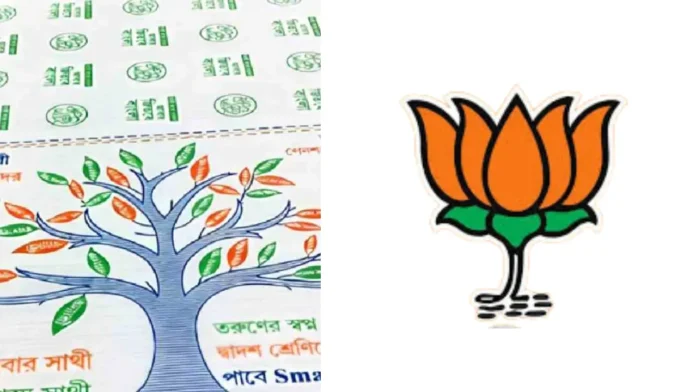
In West Bengal, politics is rarely confined to speeches, rallies, or manifestos. It spills into culture, language, and everyday life. In the run-up to the West Bengal Assembly Elections 2026, an unexpected yet powerful medium has emerged—handloom saris from Santipur.
These are not just garments. They are now symbols of political allegiance, cultural identity, and grassroots campaigning. What was once a traditional weave has transformed into a moving political message.
Santipur: The Historic Heart of Bengal’s Handloom Legacy
Located in Santipur, the town has long been synonymous with taant cotton saris, known for their light texture, breathable fabric, and intricate borders.
Key characteristics of Santipur handloom:
- Made from fine cotton yarn, ideal for Bengal’s humid climate
- Known for minimalist elegance and daily wear comfort
- Deeply embedded in Bengali cultural identity (“Bangaliana”)
For generations, weaving here has been more than an occupation—it is a heritage economy, sustaining thousands of artisan families.
The Political Turn: When Saris Became Campaign Tools
As election momentum builds, Santipur saris have undergone a striking transformation. They are now printed with:
- Party symbols
- Campaign slogans
- Welfare scheme graphics
- Visual narratives of governance
Two major political forces dominate this textile battlefield:
- All India Trinamool Congress (TMC)
- Bharatiya Janata Party (BJP)
Distinct Design Philosophies
- TMC Saris:
Rich in storytelling, featuring welfare schemes and slogans like “Jotoi koro hamla, abar jitbe Bangla”. These designs function almost like wearable manifestos. - BJP Saris:
Focused, repetitive lotus motifs—clean, symbolic, and visually assertive. This reflects a structured and uniform campaign approach.
This contrast is not accidental. It mirrors two different political communication strategies—narrative-driven vs symbol-driven.
Raju Das: The Entrepreneur Behind the Movement
At the center of this trend is Raju Das, a 41-year-old printer-designer who has turned a seasonal idea into a booming micro-industry.
His Business Model
- Procures plain taant saris directly from weavers
- Prints political designs and slogans
- Supplies in bulk to party workers and organizers
Scale and Demand
- Each sari is priced at approximately ₹240
- Orders have crossed 15,000 units
- Demand flowing from multiple districts, including North Bengal
What began as a small experiment gained traction after going viral on social media, quickly turning into a high-demand campaign commodity.
Women at the Center of the Strategy
These saris are not just products—they are strategic campaign tools aimed at women voters.
Why Saris Work Politically
- Women form a decisive voter base in Bengal
- Saris are part of daily life and identity
- Wearing a political sari becomes a visible, non-verbal endorsement
Political parties are encouraging women workers to:
- Wear them during rallies and nominations
- Use them in everyday settings, increasing visibility
This creates a continuous, organic campaign presence—far beyond traditional advertising.
Culture Meets Campaign: The Power of “Bangaliana”
At a deeper level, these saris tap into cultural nationalism within Bengal.
Key insight:
The battle is not just political—it is also about protecting and promoting Bengali identity.
By using traditional taant fabric, both parties:
- Anchor themselves in local heritage
- Avoid appearing overly commercial or disconnected
- Build emotional resonance with voters
Thus, the sari becomes a bridge between tradition and modern political messaging.
Beyond Novelty: A Structured Campaign Ecosystem
What initially appeared as a novelty has evolved into a systematic campaign mechanism.
Emerging Trends
- Organized distribution through party-aligned supply chains
- Bulk logistics reaching urban and rural constituencies
- Integration into campaign planning and outreach
There are indications that structured networks—particularly on the BJP side—may be enabling faster and wider distribution.
Democracy You Can Wear
One of the most striking aspects of this phenomenon is its symbolic meaning.
For many women, wearing these saris represents:
- Freedom of political expression
- Participation in democracy
- Personal alignment with ideology
It transforms voting from a private act into a public, everyday declaration.
Conclusion: The Fabric of Electoral Innovation
Santipur’s handloom saris illustrate how Indian elections constantly reinvent themselves through culture. What we are witnessing is not just a creative campaign tactic but a fusion of heritage, commerce, and political communication.
In 2026, Bengal’s electoral battlefield is not limited to streets or screens. It is woven into cotton threads, carried in daily life, and displayed with pride.
In Santipur, the loom is no longer just weaving fabric—it is weaving political narratives, identities, and aspirations.

