


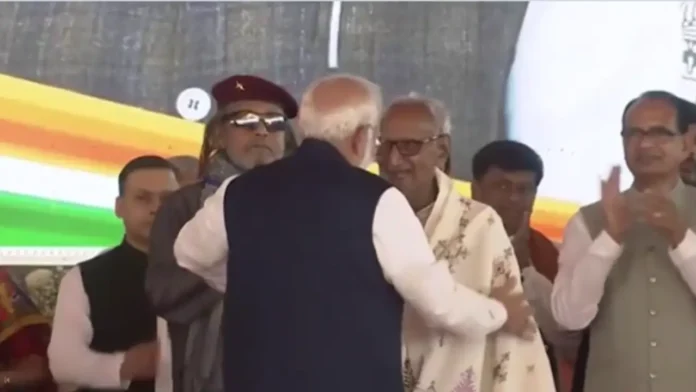
On May 9, 2026 — at the swearing-in ceremony of Suvendu Adhikari as West Bengal’s first BJP Chief Minister since Independence — Prime Minister Narendra Modi paused before a frail but bright-eyed 98-year-old man seated in the audience. He bent forward, joined his hands, and took the elder’s blessings. For a moment, the ceremony belonged entirely to Makhanlal Sarkar.
The extraordinary story of Makhanlal Sarkar·BJP’s senior-most karyakarta in Bengal
Some men make history by holding office. Others make it by holding the line — decade after decade, far from the spotlight, driven by conviction alone. Makhanlal Sarkar belongs to that rarer, quieter kind.
It was not a gesture of political theatre. It was an acknowledgement — long overdue — of a life spent in selfless service to the nationalist cause, a life that began its most defining chapter over seven decades ago, in the mountains of Jammu & Kashmir.
The Kashmir of 1953
To understand what Makhanlal Sarkar did, one must first understand what India was in 1953. The new republic was barely six years old. The Constitution had been adopted, but the map of the nation remained unsettled in spirit and in law. Jammu & Kashmir, while acceded to India, operated under a special permit system — Indian citizens could not enter the state freely. They were required to carry identification cards and seek prior permission.
Dr. Shyama Prasad Mookerjee, founder of the Bharatiya Jana Sangh, called this arrangement an affront to national unity. His now-legendary declaration — “Ek desh mein do Vidhan, do Pradhan aur do Nishan nahi chalenge” (One country cannot have two constitutions, two prime ministers, and two national emblems) — galvanised a generation of nationalists across Bengal and beyond.
Among those galvanised was the young Makhanlal Sarkar. When Dr. Mookerjee resolved to defy the permit system by crossing into Kashmir and hoisting the Indian tricolour — a powerful symbolic act of constitutional defiance — Makhanlal walked with him.
At a Glance — Makhanlal Sarkar
- Age 98 years (as of 2026)
- State West Bengal
- Party BJP (Bharatiya Janata Party) — senior-most karyakarta
- Felicitated by PM Narendra Modi, May 9, 2026
The Arrest at the Border
Dr. Mookerjee was arrested on May 11, 1953, at Lakhanpur while crossing the border. His companions — among them the young Makhanlal Sarkar — were arrested alongside him. They were taken to the Central Jail of Srinagar, then transferred to a cottage outside the city.
For Makhanlal, this was not a moment of defeat. It was, in the truest sense of the word, a baptism into national service. The willingness to be jailed for a principle — that every Indian citizen had an inalienable right to move freely within their own country — was an act of moral courage that asked for no reward and expected none.
Dr. Mookerjee tragically died in detention on June 23, 1953, under circumstances that remain contested in Indian political memory. The movement he led, however, echoed through decades — finding its culmination, many would argue, on August 5, 2019, when Article 370 was revoked and Jammu & Kashmir was fully integrated into the Indian Union.
One country cannot have two constitutions, two prime ministers, and two national emblems.— Dr. Shyama Prasad Mookerjee, 1953
A Life Lived in the Background
What is remarkable about Makhanlal Sarkar is not just what he did in 1953 — it is what he did in the decades that followed: he stayed. He remained a grassroots karyakarta in West Bengal, a state where the BJP spent most of its existence as a marginal force, where its workers faced social ostracism, violence, and political persecution. He did not seek office. He did not seek fame.
For much of Bengal’s post-Independence political history — dominated first by the Congress and then by three decades of Left Front rule — carrying the BJP’s (and before it, the Jana Sangh’s) flag was an act of stubborn, unrewarded faith. Makhanlal Sarkar carried it anyway.
His very presence at the swearing-in ceremony of Bengal’s first BJP Chief Minister is a testament to that faith — finally, unexpectedly, vindicated in his own lifetime.
The Meaning of That Bow
When a Prime Minister bows before a 98-year-old party worker — not a former minister, not a celebrated leader, but a karyakarta — it says something important about what is valued and what is remembered.
Makhanlal Sarkar represents a generation of Indians who built political movements brick by brick, in obscurity, without institutional support or social media, motivated purely by the idea that the nation mattered more than personal comfort. They organised at the village level, knocked on doors, sat through meetings in borrowed rooms, and faced hostility with quiet dignity.
In Bengal especially, that commitment carried real personal cost. To be a Jana Sangh or BJP worker in the decades of Left dominance was to be in permanent opposition — not just politically, but culturally. Makhanlal Sarkar absorbed that cost for a lifetime.
The moment PM Modi bent to take his blessings was not just a political photo opportunity. It was the nation — through its highest elected representative — acknowledging that such lives matter. That service rendered without reward is not forgotten.
A Living Connection to Unfinished History
At 98, Makhanlal Sarkar is among the last living bridges to a chapter of post-Independence India that is often overlooked in mainstream historical memory: the struggle of non-Congress nationalists who believed in a unified, indivisible India and were willing to pay a price for that belief.
With the full integration of Jammu & Kashmir in 2019 and now the historic political transformation in West Bengal, many of the causes for which he and his contemporaries sacrificed have found resolution. He has lived to see them.
That, too, is part of his story — not just the arrest, not just the decades of toil, but the extraordinary grace of living long enough to witness the fruition of what he believed in.

