


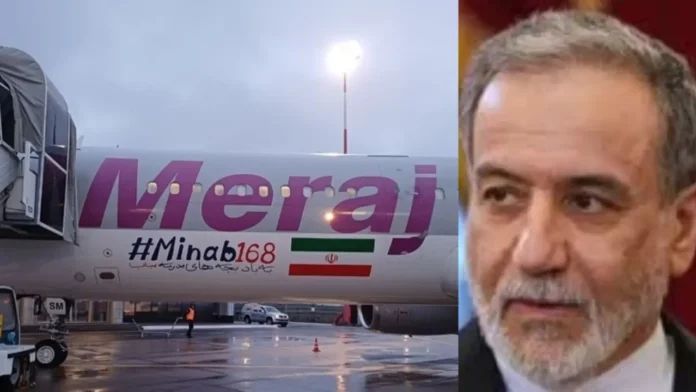
Araghchi Didn’t Just Bring Diplomacy to Delhi — He Brought 168 Dead Children With Him.
On May 14, 2026, Iran’s Foreign Minister Seyed Abbas Araghchi walked into the BRICS Foreign Ministers’ Meeting in New Delhi. Officially, he came to discuss regional stability, multilateral cooperation, and economic resilience. But he didn’t arrive empty-handed. He carried a symbol — Minab168 —, and that symbol says more than any diplomatic speech ever could.
To understand why this matters, you need to go back to February 28. That was the day everything changed.
The Day the War Began — and a School Collapsed
On the morning of February 28, 2026, US and Israeli forces launched Operation Epic Fury — nearly 900 strikes across Iran in under 12 hours. They killed Supreme Leader Ali Khamenei. They hit military bases, government buildings, oil facilities, and infrastructure across 28 provinces.
But at 10:45 am local time, something happened that the world could not ignore.
A missile struck the Shajareh Tayyebeh girls’ elementary school in Minab, a city in the southern province of Hormozgan. Classes were in session. The two-storey building collapsed. When the dust settled, 168 people were dead — most of them young schoolgirls.
The school sat near an IRGC base. US officials called it a possible “accidental double-tap strike.” Defense Secretary Pete Hegseth said an investigation was underway. But no findings were ever released. No one was held accountable. For the families of Minab, the words “accidental” and “under investigation” rang hollow — and still do.
The UN Human Rights Chief Volker Türk addressed the Human Rights Council directly: “Whatever differences countries have, we can all agree they will not be solved by killing schoolchildren.”
How “Minab168” Became Iran’s Diplomatic Identity
Iran did not let the world forget.
In April 2026, Iran’s Parliament Speaker Mohammad Bagher Ghalibaf flew to Islamabad for US-Iran peace talks. He named the aircraft “Minab-168.” Inside the cabin, seats held photographs of the children killed at the school. Blood-stained school bags and tiny personal belongings sat in the front row. Ghalibaf posted a photograph on social media with a single caption: “My companions on this flight.”
The image spread instantly. It was haunting. It was calculated. And it worked.
Iranian diplomats attending multilateral meetings in Geneva wore “Angels of Minab” badges on their suits. The Iranian national football team held children’s school bags during the national anthem before a friendly match. Iran’s FIFA World Cup convoy was officially named “Minab168” in memory of those children.
This was not grief expressed privately. Iran made its grief a geopolitical tool — and used it consistently, everywhere, in every forum.
Why Delhi? Why BRICS? Why Now?
The timing of Araghchi’s visit to Delhi is not coincidental. It is deeply strategic.
A fragile ceasefire between Iran and the US has been in place since April 2026. However, the ceasefire is barely holding. A US naval blockade of Iranian ports continues. Peace talks have stalled after Washington rejected Tehran’s latest peace proposal. Iran is isolated from Western financial systems. And the Strait of Hormuz — one of the world’s most critical oil routes — remains disrupted.
Iran needs allies. More specifically, it needs the Global South to stand with it.
BRICS is the perfect room for that conversation. The group now includes Brazil, Russia, India, China, South Africa, Iran, Egypt, Ethiopia, and others — representing a significant share of the world’s population and GDP. India holds the BRICS chairmanship in 2026. Russia’s Lavrov attended in person. China, though absent at the ministerial level due to Trump’s concurrent visit to Beijing, remains a key stakeholder.
Iran came to this meeting with a clear agenda: push BRICS to condemn US and Israeli actions, build consensus against unilateral sanctions, and position Tehran as the defending victim, not the aggressor.
By carrying Minab168 into that room, Araghchi made sure the conversation started from a moral position, not just a political one.
What Iran Wants From BRICS
Iran’s Deputy Foreign Minister Kazem Gharibabadi laid it out plainly ahead of the meeting. He said BRICS should become “a platform for equal cooperation, mutual respect, independent decision-making, and the defense of nations’ rights against monopoly, sanctions, and coercive policies.”
That is a direct message to the United States. Every word of it.
Iran also pressed India — as BRICS chair — to build a consensus condemning the US-Israeli strikes. However, India finds itself in a delicate position. India imports a significant share of its oil through the Strait of Hormuz. The Chabahar Port project, where India has made large investments, sits inside Iran. At the same time, India cannot afford to openly antagonise Washington.
So India is walking a tightrope. New Delhi wants to play peacemaker. It wants de-escalation. It wants a joint BRICS statement — one that signals relevance without burning bridges. Whether that is possible remains uncertain, as sharp differences have reportedly emerged between Iran and the UAE, both BRICS members.
The Deeper Message to the World
Strip away the diplomacy. Strip away the summit agenda. What does Minab168 at a BRICS table actually mean?
It means Iran is reframing this war. Not as a nuclear standoff. Not as a rogue state versus the West. But as a conflict where a superpower bombed a girls’ school and walked away without consequence.
It means Iran is asking the Global South a pointed question: If this happened to your children, would you stay silent?
It means every time Araghchi enters a room carrying that name, he forces the world to choose a narrative. Either the war was a justified counter-proliferation operation, or it was the day 168 children died and nobody answered for it.
Tehran knows it cannot win a military war against the United States. So instead, it is fighting a moral war. In every diplomatic setting, Minab168 is Iran’s weapon. Not a missile. Not a drone. A name. Scrawled on aircraft, stitched on badges, held up on school bags at football matches.
What This Means Going Forward
The BRICS meeting in Delhi on May 14–15 is a precursor to the full BRICS Leaders’ Summit, scheduled for New Delhi in September 2026. That summit will carry even higher stakes. If Iran succeeds in building a BRICS coalition that voices opposition to Western military unilateralism, it reshapes the global order in small but meaningful ways.
If it fails — if the divisions between Iran and UAE fracture any joint statement — the meeting exposes BRICS as a bloc that cannot agree on anything beyond economics.
Either way, the symbol of Minab168 does not disappear. Iran has embedded it too deeply into its international identity now. It travels on every plane. It sits in every diplomatic photograph. It stares from lapel badges in Geneva, Islamabad, and now Delhi.
The world has to decide what to do with it.

