


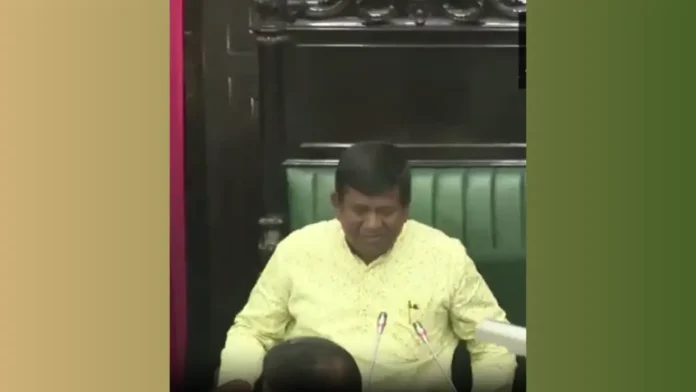
On May 15, 2026, something quietly historic happened inside the West Bengal Legislative Assembly. A first-time MLA — a Chartered Accountant from Cooch Behar — walked to the Speaker’s chair. Chief Minister Suvendu Adhikari personally escorted him there, in keeping with Assembly tradition.
His name is Rathindra Bose. And his election as the Speaker of the 18th West Bengal Legislative Assembly is not just a political appointment. It is a signal.
Who Is Rathindra Bose?
Rathindra Bose is 65 years old. He is a practising Fellow Chartered Accountant (FCA) by profession. He holds a B.Com degree from the University of North Bengal and completed his Chartered Accountancy training at the Institute of Chartered Accountants of India in 1990.
He is a resident of Siliguri, in North Bengal. He has spent years deeply rooted in both professional accounting work and BJP party organisation. He served as the State Vice-President of BJP West Bengal, as its State General Secretary, and as the Convener of the BJP’s North Bengal Division. Alongside this, he has long-standing ties with the RSS.
So while the Speaker’s chair is new to him, political and organisational work certainly is not.
The 2026 Election Win
Bose contested the 2026 West Bengal Assembly election from the Cooch Behar Dakshin (South) constituency. He defeated TMC candidate Avijit De Bhowmik by a margin of 23,284 votes, receiving 1,08,482 votes — that is 52.81% of the total votes cast in his constituency. It was a convincing win.
Notably, this was his first-ever Assembly election win.
The Surprise Nomination — Why Everyone Was Caught Off Guard
Here is where the story gets interesting.
When political circles were speculating about the Speaker’s post, most fingers pointed towards Tapas Roy. Roy is a veteran politician who crossed over to the BJP from the TMC. He had just been sworn in as the Pro-tem Speaker of the new Assembly. He was widely seen as the frontrunner.
Then, on Thursday, May 14, CM Suvendu Adhikari made an unexpected announcement on X (formerly Twitter):
“Shri Rathindra Bose, Bharatiya Janata Party MLA of the Cooch Behar Dakshin (South) Constituency, has been nominated as our Candidate for the Post of Hon’ble Speaker of the 18th West Bengal Legislative Assembly. I hope that his Candidature is supported by one and all and he gets elected unanimously.”
The political establishment did not see this coming. Bose is a first-timer. He has no prior parliamentary experience. Yet, the BJP chose him over senior faces.
CM Adhikari described Bose as a “dedicated party worker” and pointed to his professional background as a Chartered Accountant — someone who brings administrative understanding and financial discipline to a constitutional role that requires both fairness and procedural rigour.
A Historic First for North Bengal
Beyond the surprise, this nomination carries real weight for a specific reason. Rathindra Bose is the first-ever Speaker of the West Bengal Legislative Assembly to come from a North Bengal constituency.
For decades, the Speaker’s chair has been held by leaders from the south of the state. North Bengal — despite being a BJP stronghold since 2019 — had never seen one of its own occupy this post. That changes now.
This is not a small detail. North Bengal has distinct geographic, cultural, and political concerns. Elevating a leader from there to this constitutional chair is a symbolic gesture — and a strategic one.
What This Means Politically
The BJP won the 2026 West Bengal Assembly elections with 207 seats in a 294-member House. The TMC, which had dominated the state for 15 years under Mamata Banerjee, finished with just 80 seats. Congress managed only 2 seats. It was a decisive shift.
With a majority this large, the numbers for Bose’s election were never in doubt. The TMC did not field a rival candidate. The election went ahead, and Bose won.
CM Adhikari also appealed to the opposition to uphold a long-standing Bengal Assembly tradition — that the Speaker be elected unanimously. “The Speaker’s election has traditionally been unanimous in West Bengal,” he said.
The choice of a first-time MLA — rather than a seasoned veteran — also says something about the BJP’s strategy. They wanted a Speaker without factional baggage. Someone who has not spent years accumulating political debts. Someone from North Bengal who could signal to that region: you matter.
Bose himself, after the announcement, said he would carry out his responsibilities with the guiding principle of “Sabka Saath, Sabka Vikas” — together with all, development for all.
What the Speaker’s Role Actually Means
The Speaker of a State Legislative Assembly holds one of the most important constitutional positions in Indian democracy. The Speaker presides over all sessions of the Assembly. They decide whether a member can be disqualified. They maintain order during debates. They certify Money Bills. They decide who speaks, and when.
In short, the Speaker controls the rhythm of the House. A fair, impartial Speaker strengthens democracy. A partisan one can damage it deeply.
Rathindra Bose steps into this role as an outsider to the legislature — but not to the system. His professional background in accounting brings precision and process-orientation. His years of organisational work in a politically complex region like North Bengal show he understands ground-level realities.
Whether he brings genuine impartiality to the chair — that remains to be seen. But the expectations are already set.
The Bigger Picture — Bengal After 15 Years of TMC Rule
This appointment does not exist in a vacuum. It is part of a larger political transformation in West Bengal. After 15 years, the state has a new government. The first BJP Chief Minister in Bengal’s history sits in Writers’ Building. A new Speaker occupies Vidhan Sabha’s constitutional chair.
For BJP supporters, this is the beginning of what CM Adhikari called the “Sonar Bangla” era — a golden Bengal. For the opposition, it is the start of a long period in the wilderness.
Either way, the 18th West Bengal Legislative Assembly has opened a new chapter. And at the head of that Assembly, in the Speaker’s chair, sits a 65-year-old Chartered Accountant from Cooch Behar — who, just a few months ago, was fighting his very first election.

