


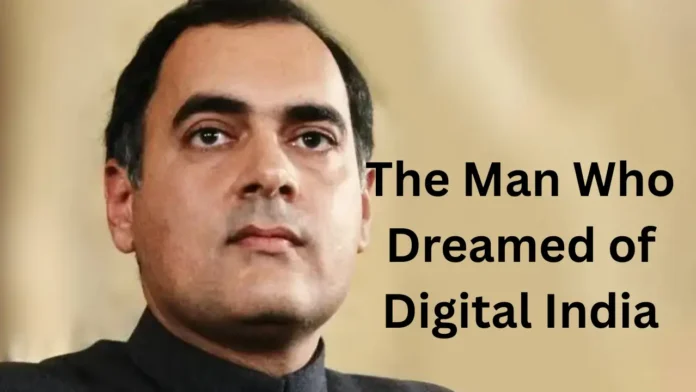
On the morning of May 21, 2026, a quiet procession gathered at Vir Bhumi in New Delhi. Sonia Gandhi arrived first. Then Rahul Gandhi, the Leader of the Opposition. Then Priyanka Gandhi Vadra, along with her children, Miraya and Raihan. Congress President Mallikarjun Kharge and senior leaders Ashok Gehlot and P. Chidambaram followed.
Together, they placed flowers at the memorial of a man who shaped modern India — and left it too soon.
Today marks exactly 35 years since Rajiv Gandhi was assassinated. He was 46 years old. He had never planned to be in politics at all. Yet in the five years he led India, he planted seeds that grew into the digital country we live in today.
To understand what India lost on May 21, 1991, you first have to understand what Rajiv Gandhi was trying to build.
The Reluctant Politician Who Became India’s Youngest PM
Rajiv Gandhi was not born hungry for power. He trained as a pilot. He loved flying. He married Sonia Maino, an Italian woman he met at Cambridge, and the two built a quiet domestic life in Delhi while his mother, Indira Gandhi, ran the country.
Politics was his brother Sanjay’s domain. Not his.
Then, in 1980, Sanjay died in a plane crash. The Gandhi family’s political future suddenly shifted onto Rajiv’s shoulders. He resisted at first. Eventually, he relented. He entered Parliament in 1981.
Three years later, on October 31, 1984, Indira Gandhi was shot dead by her own bodyguards. India went into shock. Rajiv, just 40 years old, became Prime Minister the very same evening.
He walked into the most powerful office in India with almost no political experience — and one of the largest mandates in Indian electoral history. Congress won 404 out of 543 seats in the subsequent elections, riding a massive sympathy wave after Indira’s death.
Now, the question was what he would do with that mandate.
The Five Years That Rewired India
Rajiv Gandhi served from October 1984 to December 1989. Five years. A single term. And yet the changes he pushed through in that time still echo in India’s daily life.
The Technology Revolution
Before Rajiv Gandhi, computers were treated almost as a threat in India. Trade unions feared they would kill jobs. Bureaucrats resisted them. The system was deeply suspicious of technology.
Rajiv Gandhi threw that thinking out entirely.
He set up the Centre for Development of Telematics (C-DOT) in 1984 to build Indian telecom technology from scratch. He launched MTNL in 1986, expanding telephone networks across cities. He introduced PCO booths — Public Call Offices — that brought telephone access to villages that had never had it before. He worked closely with technology advisor Sam Pitroda to push computerisation into railways, banking, and government offices.
He reduced import tariffs on computers and electronics. He welcomed the software industry. He wanted India to stop fearing the machine and start using it.
Because of these decisions, India’s IT sector found its footing. The BPO boom of the 1990s and early 2000s, the rise of companies like Infosys and Wipro, the digital economy of today — none of it would have happened the way it did without the policy ground Rajiv Gandhi broke in the 1980s.
He earned his title: Father of India’s Information Technology and Telecom Revolution.
Democracy at the Grassroots
Rajiv Gandhi understood something most politicians ignore. India’s real democracy does not live in Parliament. It lives in its villages.
So he worked to bring constitutional power down to the village level. He championed the 73rd and 74th Constitutional Amendments, which gave Panchayats and Nagarpalikas constitutional status. These amendments — passed a year after his death, but drafted under his leadership — created formal elected bodies at the village and town level and reserved seats for women, Scheduled Castes, and Scheduled Tribes.
Today, over 40% of elected representatives in these local bodies are women. That number traces directly back to Rajiv Gandhi’s vision for grassroots democracy.
Giving Youth a Voice
In 1989, Rajiv Gandhi pushed through the 61st Constitutional Amendment. It lowered the voting age from 21 to 18. Overnight, millions of young Indians gained the right to choose their leaders.
It was a simple but profound decision. He believed that a country as young as India needed its youth at the centre of its democracy — not waiting on the sidelines until they were older.
Education, Immunisation, and Six Technology Missions
His government introduced the National Policy on Education in 1986, which modernised school curricula and created Navodaya Vidyalayas — residential schools to nurture talent from rural India.
He also launched six technology missions — covering drinking water, literacy, immunisation, oilseeds, dairy, and telecom. The immunisation mission played a direct role in making India polio-free decades later.
The Controversies He Could Never Escape
Rajiv Gandhi’s tenure also carried its shadows. The two biggest followed him to his death.
The Bofors scandal broke in 1987. A Swedish arms company was accused of paying kickbacks to Indian officials in a howitzer gun deal. Rajiv Gandhi denied any personal involvement. But the scandal stuck. It cost him the 1989 elections and the “Mr. Clean” image he had worked hard to build.
The Shah Bano case was equally damaging — and more complex. In 1985, the Supreme Court ruled in favour of Shah Bano, a Muslim woman seeking maintenance from her husband after divorce. It was a landmark judgment for women’s rights. But after pressure from conservative Muslim groups, Rajiv Gandhi’s government passed the Muslim Women Act in 1986, effectively overturning the judgment for Muslim women. Critics — across the political spectrum — called it a betrayal of the Constitution’s secular promise. The controversy never fully died down.
Then there was the Sri Lanka decision. In 1987, Rajiv Gandhi signed the Indo-Sri Lanka Accord and sent the Indian Peace Keeping Force (IPKF) to Sri Lanka to disarm LTTE rebels and end the civil war. The mission dragged on. It cost Indian soldiers’ lives. It angered the LTTE. And ultimately, it planted the seeds of the revenge that killed him.
The Night Everything Ended
May 21, 1991. Sriperumbudur, Tamil Nadu. It was past 10 at night.
Rajiv Gandhi was no longer Prime Minister. He was in opposition, campaigning for the Congress party in a Lok Sabha election. His motorcade pulled into the small town, 50 kilometres from Chennai. Supporters thronged the grounds. There was energy in the air.
As he walked through the crowd, a woman in a green and orange salwar kameez approached him. She was carrying a sandalwood garland. Her name, investigators later established, was Kalaivani Rajaratnam — known inside the LTTE by the alias Dhanu.
A policewoman tried to stop her from getting too close. Rajiv Gandhi waved the policewoman away. He told her to relax.
Dhanu bent down, as if to touch his feet in a traditional gesture of respect. Then she detonated the RDX-laden belt strapped around her waist.
The blast killed Rajiv Gandhi instantly. It killed 14 others around him, including Dhanu herself. Forty-three more people were injured. A photographer who died in the blast left behind his camera, and the surviving film inside it became crucial evidence in the investigation.
India woke up the next morning to a grief it had not prepared for.
Why the LTTE Did It
The reason traces back directly to the IPKF mission in Sri Lanka.
After Rajiv Gandhi sent Indian troops to Sri Lanka in 1987, the relationship with the LTTE soured badly. The LTTE had expected Indian support. Instead, Indian troops ended up fighting them. By the time the IPKF withdrew in 1990, the LTTE’s leader Velupillai Prabhakaran had developed a deep hatred toward Rajiv Gandhi.
When the 1991 elections came, Rajiv Gandhi was openly campaigning on a platform that included returning troops if necessary and continuing pressure on the LTTE. Prabhakaran made the call. Rajiv Gandhi had to die before the election.
Dhanu had carried out two practice runs before the actual assassination. In one run, she had managed to touch the feet of then-Prime Minister V.P. Singh — just to prove the approach would work. On the night of May 21, it did.
The Long Legal Aftermath
Twenty-six people were convicted in the assassination case. Seven received the death penalty. Years of legal battles followed. Eventually, the Supreme Court converted most of those sentences to life imprisonment.
In 2022, one of the convicts, A.G. Perarivalan, who had spent 31 years in prison for procuring batteries allegedly used in the bomb, was released after the Supreme Court ordered his freedom.
The legal journey of the case — its appeals, controversies, and the Tamil Nadu government’s push to free the convicts — became a politically charged saga that lasted three decades.
Bharat Ratna and the Legacy He Left
In 1991, the Government of India awarded Rajiv Gandhi the Bharat Ratna posthumously — the country’s highest civilian honour.
The award acknowledged what his critics had sometimes overlooked. This was a man who entered politics with no desire for it, served with genuine energy and ambition, made real mistakes, but left behind a country meaningfully more connected, more empowered, and more forward-looking than the one he inherited.
India’s software industry employs over five million people today. The IT sector contributes nearly 8% of GDP. Local self-governance through Panchayati Raj covers over 250,000 gram panchayats across the country. Hundreds of millions of young Indians have voted since the voting age dropped to 18.
Every one of those numbers has Rajiv Gandhi’s fingerprints on it.
May 21 as Anti-Terrorism Day
Because of the manner of his death, May 21 is now observed every year as National Anti-Terrorism Day across India. Government offices, schools, and public institutions pause to reflect. Officials and citizens take a formal pledge to oppose terrorism and violence. The Shanti Mantra is recited. Patriotic bhajans are sung.
The day is both a tribute and a reminder — that violence has costs that outlast the moment of the act, and that the people it takes cannot be replaced.
Thirty-Five Years Later
At Vir Bhumi this morning, the flowers were laid. The family came. The country paused.
Rahul Gandhi, the son who grew up without his father for more than half his life, has spoken about Rajiv Gandhi’s most lasting lesson: that hate is a prison for those who carry it. That empathy is not weakness. Forgiveness is something worth teaching.
Thirty-five years is a long time. Long enough for the seeds of the 1980s to grow into a full forest. Long enough to look back clearly.
Rajiv Gandhi was imperfect. He was young. He made political miscalculations that haunted him. But he also looked at India in 1984 — still largely disconnected, still rural, still running on paperwork and bureaucracy — and saw what it could become.
He did not live to see it. But we are living in it.

