


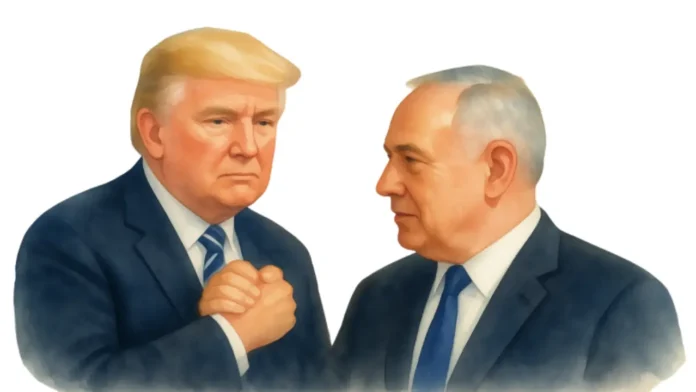
On Tuesday evening, May 20, 2026, Donald Trump picked up the phone and called Benjamin Netanyahu. It was supposed to be a routine update between two wartime allies. Instead, it turned into one of the most tense and consequential conversations in their entire relationship.
By the time the call ended, Netanyahu was furious. His team was scrambling. And a U.S. source who was briefed on the exchange said it plainly: “Bibi’s hair was on fire after the call.”
So what exactly happened?
What Trump Told Netanyahu
Trump had news to share — and Netanyahu was not going to like it.
Regional mediators, specifically Qatar and Pakistan, with backing from Saudi Arabia, Turkey, and Egypt, had drafted a new diplomatic framework. The goal was straightforward: get the United States and Iran to sign a “letter of intent.” This document would formally end hostilities between the two countries. It would then open a 30-day window for deeper negotiations on two major issues — Iran’s nuclear program and the reopening of the Strait of Hormuz.
Trump told Netanyahu he was seriously considering it. He even hinted at where his head was at: “The only question is, do we go and finish it up — or are they gonna be signing a document?”
In other words, Trump was leaning toward the document.
Why Netanyahu Exploded
For Netanyahu, this was not just bad news. It was a betrayal of strategy.
Israel’s position has been clear since the war began. Iran is weakened right now. Its air defenses have taken significant damage. Its missile stockpiles have been degraded. Its nuclear infrastructure has been hit hard. From Netanyahu’s perspective, this is the exact moment to press harder — not to step back.
He argued strongly on the call that the U.S. should keep applying military pressure. He wanted more strikes on Iran’s critical infrastructure. He believed that any ceasefire or negotiation at this stage would give Tehran the breathing room it desperately needs to rebuild.
Put simply, Netanyahu sees a wounded enemy and wants to finish the fight. Trump sees a chance to make a deal and walk away looking like a peacemaker.
That gap — between war and diplomacy — is now out in the open.
The Fallout Was Immediate
After the call, the Israeli ambassador to Washington quietly briefed several members of the U.S. Congress. The message was that Netanyahu was deeply unsettled by what he had heard. That briefing, however, was later denied by an Israeli embassy spokesperson, who said the ambassador does not comment on private conversations.
Still, the damage was done. The story leaked. Multiple sources — American and Israeli — confirmed the tension. And suddenly, one of the most important alliances in the world was showing a very public crack.
Trump, for his part, was unbothered. When reporters asked him about Netanyahu the next day, his response was almost dismissive: “Netanyahu will do whatever I want him to do.”
That is a remarkable thing for a U.S. president to say about a close ally.
What the Deal Would Actually Look Like
The proposed letter of intent is not a final peace treaty. It is a framework — a starting point. If signed, it would do two things immediately. First, it would end the active war between the U.S. and Iran. Second, it would kick off 30 days of structured negotiations.
During those 30 days, two issues would sit at the center of the table. The first is Iran’s nuclear program — specifically, what limits Tehran is willing to accept on uranium enrichment and its stockpile. The second is the Strait of Hormuz, the narrow waterway through which roughly 20% of the world’s oil passes. Iran had been restricting traffic there. Trump wants it reopened immediately.
One Arab official involved in the process described the letter’s deeper purpose: to get Iran to set clear benchmarks for its nuclear program, and to get the U.S. to clarify exactly how frozen Iranian funds would be released in return.
It is a high-stakes bargain. And it is far from finished.
Iran’s Position
Tehran has not said yes. But it has not said no either.
Sources close to Iran’s negotiating team confirmed that the country’s mediators were reviewing the document. Nothing had been finalized. Iran’s demands around the Strait of Hormuz — which it sees as a sovereignty issue — remain the biggest sticking point. Washington’s demands over uranium enrichment are the other major obstacle.
Meanwhile, Iran’s military has been issuing its own warnings. If the U.S. resumes strikes, Iran has promised an unprecedented response. So the pressure on Trump to either seal a deal or commit to full escalation is growing by the hour.
The Bigger Picture: A Historic Rift
This call matters beyond the headlines. It signals something important about where U.S.-Israel relations actually stand right now.
For months, Netanyahu operated on the assumption that Trump would back Israel unconditionally. That assumption is being tested. Trump has always been a dealmaker first. He is not ideologically committed to war. When a better headline appears — in the form of a peace agreement — he will take it.
Netanyahu, on the other hand, is in a different position. His government depends on the continuation of the conflict. A ceasefire with Iran, without achieving all of Israel’s military objectives, would be politically damaging at home. For him, the war is not just a security mission. It is the central pillar holding his coalition together.
Their interests, therefore, are not fully aligned. And that is why the phone call went the way it did.
Where Things Stand Right Now
As of May 21, 2026, the situation remains fluid. The letter of intent has not been signed. Iran is still reviewing the document. Trump says he is in no hurry — but also that he is giving this “one shot.” Qatar continues to support Pakistan’s mediation efforts. Saudi Arabia has publicly urged Iran to seize the diplomatic moment.
Netanyahu is still pushing for more strikes. Trump is still leaning toward a deal.
The next few days could determine which direction this goes. Either the Middle East gets its most significant diplomatic breakthrough in years, or the war resumes at full force.
What is certain is this: the relationship between Trump and Netanyahu has changed. The trust has been tested. And the world is watching to see who blinks first.

