


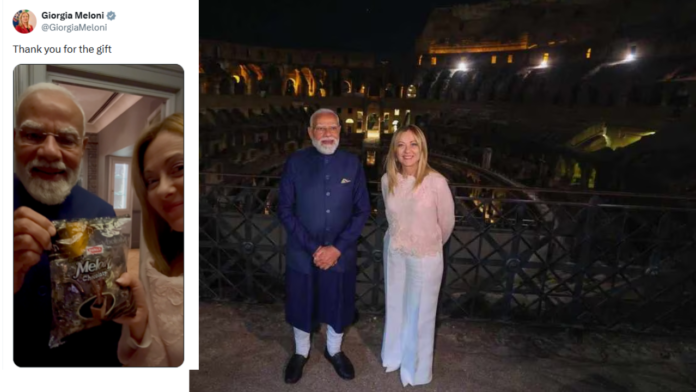
PM Modi’s Melody Toffee Gesture Added a Diplomatic Twist
Melody Toffee recently returned to public discussion after Prime Minister Narendra Modi gifted a pack of Melody chocolates to Italian Prime Minister Giorgia Meloni during an interaction that attracted massive attention online.
The gesture quickly went viral because social media users connected the candy’s name “Melody” with the popular “Modi-Meloni” internet trend. Soon after, memes, jokes, and political commentary flooded social media platforms.
However, the moment also highlighted something deeper. It showed how an ordinary Indian consumer product became part of a global diplomatic conversation.
For Parle Products, the moment acted as unexpected international publicity. Melody, a candy associated with Indian childhood nostalgia, suddenly entered geopolitical pop culture.
The incident also reflected Prime Minister Modi’s communication style. He often uses culturally familiar Indian products and symbols during diplomatic engagements to create relatability and soft-power messaging.
In many ways, the Melody gesture represented modern Indian diplomacy. It mixed politics, internet culture, branding, and emotional storytelling in a simple but memorable way.
After the meeting, searches related to Melody Toffee and Parle Products increased sharply across social media and search platforms. Many younger users, who knew Melody mostly through memes, also became curious about the brand’s history and its connection to the larger Parle business empire.
Who Makes Melody Toffee? Inside the Story of Parle Products
For decades, Melody Toffee has remained one of India’s most loved candies. Its unique mix of caramel and chocolate created a strong emotional connection with consumers across generations. Children loved its taste. Adults remembered its famous advertisements. Even today, the brand enjoys massive recall in urban and rural India.
The company behind Melody Toffee is Parle Products, one of India’s largest food and confectionery manufacturers. The same company also created several household brands that shaped India’s snack culture.
However, the story of Melody is much bigger than a single candy. It is linked to the rise of the Parle business empire, a name deeply connected with Indian consumers for nearly a century.
The Company Behind Melody Toffee
Melody Toffee is manufactured by Parle Products Pvt. Ltd., headquartered in Mumbai.
The company started in 1929 under the leadership of the Chauhan family. At that time, India depended heavily on imported biscuits and confectionery products. Parle entered the market with a clear goal. It wanted to build affordable Indian brands for Indian consumers.
Over time, the company became a dominant force in the fast-moving consumer goods sector, commonly known as FMCG.
Today, Parle Products operates one of the largest distribution networks in India. Its products reach millions of retail stores, including small village shops and large supermarket chains.
How Melody Became a Cult Brand
Melody stood out because it combined two flavors in one candy. It had a soft caramel outer shell and a chocolate filling inside. This simple idea helped the product gain attention quickly.
The company also invested heavily in memorable advertising campaigns. The line “Melody itni chocolaty kyun hai?” became one of India’s most iconic advertising slogans.
Unlike premium imported chocolates, Melody remained affordable. This pricing strategy helped the brand grow rapidly in small towns and rural markets.
Even after several decades, the candy continues to enjoy strong demand because of nostalgia, affordability, and brand familiarity.
The Growth of Parle Products
Parle Products did not rely on one product alone. Instead, the company built a massive portfolio across biscuits, cookies, candies, wafers, and snacks.
The company focused on three important strategies:
Affordable Pricing
Parle understood the Indian middle class very well. It kept product prices low without compromising accessibility.
This helped the company build trust among families with limited budgets.
Massive Distribution Network
Parle products became available almost everywhere. From railway stations to remote villages, the company ensured strong retail penetration.
Distribution became one of its biggest strengths.
Strong Brand Recall
The company created simple but memorable advertisements. Many of its slogans became part of everyday conversations.
This emotional connection helped Parle survive intense competition from multinational brands.
Famous Products Manufactured by Parle Products
Parle Products owns several iconic Indian brands. Many of them dominate their categories even today.
Parle-G
Parle-G is India’s most famous glucose biscuit brand. It is also one of the world’s highest-selling biscuit brands by volume.
The biscuit became popular because of its low price and wide availability. For many Indian families, Parle-G was an affordable daily snack.
During difficult economic periods and emergencies, sales of Parle-G often increased because consumers trusted the brand.
Monaco
Monaco introduced salted crackers to Indian consumers in a major way. The brand became popular as a tea-time snack.
Its light texture and salty taste helped it stand apart from sweet biscuits.
KrackJack
KrackJack created a sweet-and-salty biscuit category that became highly successful in India.
The brand appealed to consumers looking for a different flavor profile.
Hide & Seek
Hide & Seek became one of India’s first mass-market chocolate chip cookies.
The product targeted younger consumers and helped Parle expand into premium cookie segments.
Mango Bite
Mango Bite became another highly successful candy from the company.
Its mango flavor and affordable pricing helped it gain huge popularity in schools and neighborhood stores.
Poppins
Poppins became famous for its colorful fruit-flavored candies packed in roll form.
The product gained popularity among children because of its bright appearance and multiple flavors.
Kismi
Kismi offered a distinct elaichi and caramel flavor combination. It developed a loyal consumer base over the years.
The Parle Group Split Explained
Many consumers believe all Parle-branded companies are part of one organization. However, the original Parle business was later divided into separate entities.
This split created three major business groups.
Parle Products
This company focuses mainly on biscuits, snacks, and confectionery.
Brands include:
- Parle-G
- Melody
- Monaco
- KrackJack
- Hide & Seek
- Mango Bite
Parle Agro
Parle Agro became a separate beverages company.
Its major brands include:
- Frooti
- Appy
- Appy Fizz
- Smoodh
- Bailley packaged water
Frooti, launched in the 1980s, became one of India’s biggest mango drink brands.
Bisleri International
Bisleri became a separate packaged drinking water company.
Today, Bisleri is one of India’s most recognized bottled water brands.
How Parle Competes in Modern India
The Indian FMCG market has changed rapidly. International companies entered the country with aggressive pricing and marketing.
Still, Parle Products managed to remain highly relevant.
The company succeeded because it understood Indian consumption habits better than many global competitors.
Even today, affordability remains a key factor in Indian retail markets. Parle continues to leverage this advantage.
The company also adapts its packaging sizes and pricing according to local demand. Small affordable packs remain a major growth driver.
Challenges Facing the Company
Despite its success, Parle Products faces several challenges.
Rising Raw Material Costs
Prices of wheat, sugar, milk, and edible oils continue to fluctuate. This affects profit margins.
Health-Conscious Consumers
Modern consumers increasingly prefer healthier snacks with lower sugar and fewer preservatives.
Traditional confectionery brands now face pressure to innovate.
Intense Competition
Global FMCG giants and local startups continue to compete aggressively in biscuits and confectionery categories.
Digital-first brands are also attracting younger consumers.
Why Melody Still Matters in India
Very few Indian candies have survived changing consumer trends for decades. Melody is one of those rare brands.
The product succeeded because it delivered three things consistently:
- Familiar taste
- Affordable pricing
- Strong emotional recall
For millions of Indians, Melody is not just a candy. It is part of childhood memories.
That emotional connection gives the brand long-term strength even in a highly competitive market.
Conclusion
Melody Toffee is manufactured by Parle Products, one of India’s oldest and most influential FMCG companies. Over the years, the company built a massive portfolio that includes Parle-G, Monaco, Hide & Seek, Mango Bite, and several other iconic brands.
The larger Parle legacy also gave rise to beverage giant Parle Agro and packaged water leader Bisleri International.
What started as a small Indian confectionery business in 1929 eventually became one of the country’s biggest consumer brand stories.
Even today, Melody continues to remind consumers why simple products with strong emotional value can survive for generations.

