


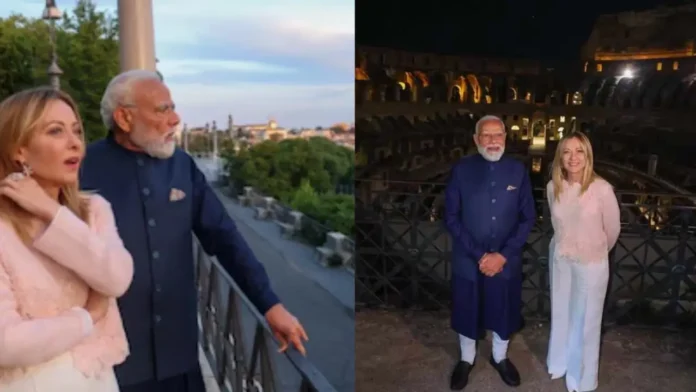
From a candlelit dinner to the ancient arches of the Colosseum, Modi’s first bilateral visit to Italy in 26 years marks a turning point in one of India’s most important European relationships
The Final Stop of a Whirlwind Tour
By the time PM Narendra Modi landed in Rome on the evening of May 19, 2026, he had already covered a remarkable amount of ground. His five-nation tour had taken him through the UAE, the Netherlands, Sweden, and Norway, where he became the first Indian Prime Minister in 40 years to visit the Scandinavian nation. Each stop had its own significance. But Rome was the one everyone was watching.
This was not just another leg of a diplomatic tour. This was Modi’s first-ever bilateral visit to Italy. And notably, the first official visit by any Indian Prime Minister to Rome in 26 years.
Dinner, Friendship, and the Colosseum at Night
Before the formal meetings even began, Giorgia Meloni set the tone. She hosted Modi for dinner on the night of May 19 and then did something rather extraordinary — she took him to the Colosseum.
The two leaders stood inside one of the most iconic structures in human history, the 2,000-year-old Roman amphitheatre, and talked. Not in a conference room with officials and cameras. Just the two of them, in conversation, walking through ancient stone arches.
Meloni posted a picture of the moment on X with five simple words: “Welcome to Rome, my friend.”
Modi responded warmly too. “Upon landing in Rome, I had the opportunity to meet Prime Minister Meloni over dinner, followed by a visit to the iconic Colosseum,” he wrote. “We exchanged perspectives on a wide range of subjects.”
It was a deliberate, personal gesture. And it spoke volumes about the nature of this relationship. This was not a transactional summit. It was the seventh meeting between Modi and Meloni in just three years.
Why This Visit Was Historic
The numbers here matter. Modi had previously visited Italy twice — for the G20 in Rome in 2021 and the G7 Summit in June 2024. But both were multilateral events. He was there for the gathering, not for Italy specifically.
This visit was different. This was a bilateral — India coming to Italy, for Italy’s sake. The last time that happened was 26 years ago.
Moreover, the two countries launched their Strategic Partnership only in 2023. In just two years, that relationship has matured rapidly. By the end of this visit, the two nations upgraded it further to a Special Strategic Partnership — a formal elevation that signals deeper trust, wider cooperation, and long-term commitment.
The Formal Talks at Villa Pamphilj
The morning of May 20 brought formal business. Modi and Meloni held bilateral discussions at Villa Pamphilj — a 17th-century villa and park in Rome, now used for state functions. Senior figures from major Indian and Italian industrial groups joined them for a working lunch, discussing how to push economic, trade, and investment cooperation further.
Modi also met Italian President Sergio Mattarella separately, adding a constitutional dimension to the visit.
Together, the two leaders adopted a joint declaration. The headline outcome: annual heads-of-government summits going forward. That is a serious structural commitment. It means India and Italy will meet, at the very top level, every single year. That kind of regular contact is reserved for only the most important partnerships.
The €20 Billion Trade Target
Money matters in diplomacy, and this visit put a number on the table. India and Italy set a bilateral trade target of €20 billion — roughly $23.2 billion — by 2029.
For context, trade between the two nations already reached $16.77 billion in 2025. So the target is ambitious, but not unrealistic. It reflects where both sides see the relationship heading.
Cumulative Italian foreign direct investment into India stood at $3.66 billion between April 2000 and September 2025. Both governments signalled that investment flows need to accelerate further, especially in clean energy, defence manufacturing, and technology.
IMEC — The Corridor That Connects It All
One of the biggest strategic threads running through this visit was the India-Middle East-Europe Economic Corridor, better known as IMEC.
IMEC is a multimodal trade route — combining shipping lanes, rail, roads, and digital infrastructure — designed to connect India to the Arabian Gulf and then onwards to Europe. Italy sits at a natural Mediterranean gateway position within this corridor. That makes Italian partnership in IMEC not just useful but essential.
Modi specifically named IMEC as a focus area before arriving in Rome. Both leaders reaffirmed that they see it as a shared vision — connecting their regions through modern transport, energy systems, digital networks, and resilient supply chains.
The corridor, established through a 2023 memorandum involving the EU, the US, and several partner nations, still has much groundwork to lay. Italy’s active participation could significantly accelerate its western endpoint development.
Human-Centric AI — A Joint Philosophical Position
One of the more interesting outcomes of this visit was the two leaders’ joint statement on artificial intelligence.
Modi and Meloni did not just talk about AI as a tool. They took a philosophical position on it. They stated clearly that AI must remain human-centric — that technology cannot replace individuals, undermine fundamental rights, or manipulate public debate and democratic processes.
They linked this to Italy’s G7 presidency and the outcomes of the AI Impact Summit 2026, held earlier in New Delhi. The joint language around AI was deliberate and pointed. Both leaders see the governance of technology as a shared civilisational responsibility, not just a technical policy matter.
Space, Defence, and the Bigger Strategic Picture
Beyond trade and AI, the Modi-Meloni talks covered a broad and substantive agenda. Defence cooperation, security, and strategic technologies all featured prominently.
On space, both leaders acknowledged a natural complementarity. India has built remarkable capabilities in satellite technology and space exploration at competitive costs. Italy brings decades of aerospace engineering excellence. Together, the two nations see significant room for next-generation technology development.
On security, their cooperation now formally includes counterterrorism and the fight against human trafficking. Both are areas where intelligence sharing and law enforcement coordination deliver real-world results.
Additionally, the two leaders discussed major global flashpoints — including the war in Ukraine, the situation in the Middle East, and security dynamics in the Indo-Pacific. These conversations signal that India and Italy now coordinate on geopolitics, not just commerce.
A Stop at the FAO — More Than Symbolism
Before leaving Rome, Modi visited the headquarters of the United Nations Food and Agriculture Organisation, which is based in the city.
This was not a ceremonial stop. India has been positioning itself as a voice for the Global South, particularly on issues of food security, agricultural sustainability, and climate-linked hunger. Visiting the FAO headquarters reinforced that position. It was Modi’s way of saying: India’s diplomacy is not just about bilateral deals. It also has a multilateral dimension.
The ‘Melodi’ Factor — A Friendship That Works
There is something genuinely unusual about the Modi-Meloni relationship. In diplomatic circles, it has been nicknamed “Melodi” — a portmanteau of their names that started trending on social media after their chemistry at various summits became impossible to ignore.
They have now met seven times in three years. That is an unusually high frequency for two leaders who are not neighbours, do not share a region, and are not locked in any obvious crisis that demands constant attention.
What explains it? A shared conservative political outlook plays a part. But more than ideology, the two leaders appear to genuinely find common ground — on civilisational values, on the role of culture in statecraft, and on a multipolar world where middle powers have more space to shape outcomes.
In their joint article for the Indian and Italian media, they drew a remarkable parallel between the Indian concept of Vasudhaiva Kutumbakam — the world is one family — and Italy’s Renaissance humanist tradition, which places individual dignity at the centre of society. It was the kind of philosophical framing that rarely appears in diplomatic boilerplate.
What This Visit Means for India’s Europe Strategy
Zoom out, and a clear picture emerges. India is deepening its engagement with Europe in a sustained, structured way.
In the same tour, Modi held the India-Nordic Summit in Oslo — covering Denmark, Norway, Finland, Iceland, and Sweden under a new Green Technology and Innovation Strategic Partnership. Before that, he was in the Netherlands and Sweden. And now Italy, with a full bilateral upgrade.
This is not opportunistic diplomacy. It is a deliberate strategy to build durable partnerships across Europe — country by country, sector by sector — as the global order continues to shift.
Italy is a founding member of the EU, a G7 nation, a Mediterranean power, and, as of this week, India’s Special Strategic Partner. That last title is not handed out lightly.
Final Thought
A walk through the Colosseum at night is a striking image. Two of the world’s significant leaders, standing where gladiators once fought, talking about trade corridors, AI governance, and space satellites.
But behind the symbolism lies something concrete. India and Italy have moved quickly from a cordial friendship to a structured, ambitious, and strategically important partnership. Annual summits. A €20 billion trade target. A joint AI philosophy. IMEC cooperation. Defence ties. Space collaboration.
Modi came to Rome after 26 years of waiting. He leaves having built something that both countries clearly intend to last.

