


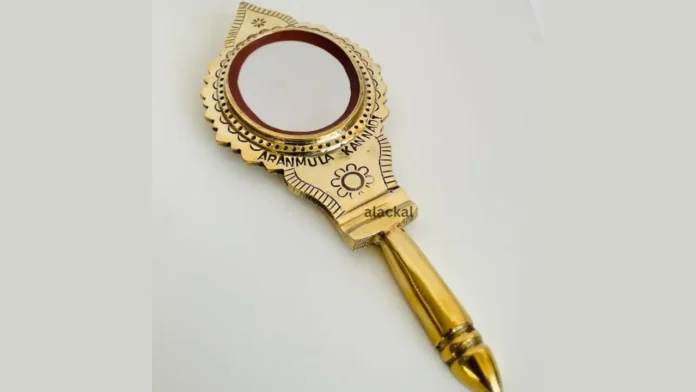
Made by a handful of hereditary artisan families in a small Kerala village, this ancient metal alloy mirror reflects light without distortion — and the secret formula has never left the family
What Is Aranmula Kannadi?
Most mirrors lie to you. Just a little.
Every standard glass mirror — the kind in your bathroom, your bedroom, your phone’s front camera — distorts your reflection slightly. Light has to pass through the glass, bounce off a metallic coating at the back, and travel back through the glass again before it reaches your eye. That journey through the glass bends and scatters the light. The image you see has minor ghost effects, a faint displacement, and optical distortions that vary depending on the thickness and quality of the glass.
Aranmula Kannadi does not do any of that.
Aranmula Kannadi — the name means “Aranmula Mirror” in Malayalam — is a handmade metal alloy mirror produced in the village of Aranmula, in Kerala’s Pathanamthitta district. It is made entirely of metal. There is no glass. There is no reflective coating on a back surface. Instead, the surface of the metal itself, polished to extraordinary smoothness over several days, is the mirror. Light bounces directly off the front face of the metal and straight into your eye, with nothing in between.
The result is a front surface mirror — the same optical principle used today in high-end telescopes, laser systems, and precision scientific instruments. Except in Aranmula, this principle has been in practice for over 500 years, long before modern optics had a name for it.
The Origin Story — A Cracked Crown and a Discovered Secret
The story of the Aranmula Kannadi begins, as many great discoveries do, with a problem.
Several centuries ago — accounts vary between 400 and 700 years — the head priest of the Aranmula Parthasarathy Temple discovered that the crown of the temple deity had cracked. The king summoned the head of the local bronze-casting community and demanded a new crown within three days. The craftsman, pressed for time and short on materials, worked with whatever combination of copper and tin he had at hand.
What emerged from the furnace was not what anyone expected. The crown had an unusual silvery sheen. It was brittle like glass but shone with rare brilliance. When cleaned and polished, it had the quality of reflection — it showed the world back at itself, clearly and without distortion.
The king and the priest recognised they were looking at something exceptional. The alloy was offered to the deity. The crown — called the Kannadi Bimbam, or mirror idol — was kept in the Aranmula Parthasarathy Temple until 1946. The craftsmen, meanwhile, worked out the exact ratios of the metals that produced this remarkable effect. The king decreed that the mirror should become one of the eight auspicious items — the Ashtamangalyam — used in all Hindu religious rites, including weddings.
The families who discovered that secret have held it ever since.
Who Makes It — and Why So Few
Aranmula Kannadi is produced exclusively by families belonging to the Vishwakarma community — specifically, the Kannan sub-group of bronze casters who were originally brought to Aranmula from Sankaran Koil, near Tirunelveli in Tamil Nadu, to work on the Parthasarathy Temple.
The knowledge of how to make the mirror has never been formally written down. It passes from fathers to sons, orally and through direct practice, within the family. For a long time, only two Vishwakarma families actively made the mirrors. Over the second half of the 20th century, a few more families began to learn and practice the craft. But the total number of active artisans remains very small.
This is not secrecy for the sake of exclusivity. It is the preservation of knowledge so intricate, so dependent on hands-on judgment and feel, that it cannot survive without lived transmission. The exact proportions of the alloy, the precise firing conditions, the duration and technique of polishing — each of these involves subtle decisions that no manual can fully capture.
Aranmula Kannadi received the Geographical Indication (GI) tag — the second product in India, and the first from Kerala, to receive this protection. Only mirrors made by the recognised artisan families of Aranmula can legally carry that name.
The Science Behind the Mirror
Scientists and metallurgists have studied the Aranmula Kannadi over the years, trying to reverse-engineer what the artisans have always known instinctively.
The mirror is made of a high-tin bronze — a copper-tin alloy with approximately 32 to 34 percent tin. Metallurgical research has identified this as matching the delta phase of bronze — a specific intermetallic compound designated Cu31Sn8, with a tin composition of exactly 32.6 percent. This delta phase is a hard, stable compound. It does not tarnish or corrode easily. Critically, when polished across its surface, it maintains reflectivity across the entire visible spectrum — meaning it reflects all colours of light without the colour shifts or spectral filtering that some metals produce.
The hardness of the finished mirror — measured at around 520 to 540 VPN (Vickers Pyramid Number) — is close to that of hardened steel. This explains two things simultaneously: why the mirror takes such a precise, lasting polish, and why it is so extraordinarily brittle. You cannot reshape it after casting. You cannot bend it or drop it. A fall from a modest height can shatter it. Every Aranmula Kannadi that exists survived the making process against considerable odds.
What makes this scientifically remarkable is that the same front-surface mirror principle that Aranmula artisans mastered over 500 years ago is now the standard design for precision optical instruments — telescopes, laser components, and sensors that require zero light distortion. The science caught up to the craft, not the other way around.
How It Is Made — Step by Step
Making a single Aranmula Kannadi is an exhausting, labour-intensive process. One artisan can produce only about 10 to 15 mirrors per month. Larger mirrors can take several months of work for a team of craftsmen.
Preparing the Furnace and Crucible
The process begins with a kowa — a wrought iron crucible capable of holding approximately 9 kilograms of molten metal. The artisan cleans the crucible and adds pieces of pure copper (chembu), tin (eeyam), and small amounts of zinc (nagam) in carefully judged proportions. The exact ratios are the family secret.
The mouth of the crucible is sealed with clay. Two small holes are provided — one to pour the molten metal and one to serve as an air vent. The crucible goes into an open pit furnace charged with burning charcoal. It is then covered with pieces of thondu — a material that retains heat and ensures slow, even melting.
The alloy heats for approximately eight hours. Then it is allowed to cool very slowly, over two to three days. This controlled, unhurried cooling is critical. The delta phase of the bronze — the phase that gives the mirror its reflective properties — only forms when the alloy cools at the right rate. Rush the cooling, and you do not get a mirror. You get an ordinary piece of bronze.
Lost Wax Casting — The Shape of the Mirror
Once the alloy is prepared, the mirror disc takes shape through the lost wax (cire perdue) casting technique, one of the oldest metal-casting methods in human history.
The artisan first sculpts the desired shape and any decorative elements in wax. Intricate traditional designs — floral motifs, temple patterns, geometric borders — are carved into the wax at this stage. The wax model is then encased in clay and allowed to dry completely.
When the mould is ready, molten metal is poured in. The heat of the liquid metal melts the wax instantly. The metal fills the space where the wax was, perfectly capturing every detail of the design. Once cooled, the clay mould is broken away — and it is broken away for good. Each mould can only be used once. That is part of why every Aranmula Kannadi is genuinely unique.
Polishing — Where the Magic Happens
Casting produces the shape. Polishing produces the mirror.
This is the most demanding part of the process, and it is entirely done by hand. No machines. No power tools. The artisan works the surface of the metal disc with progressively finer abrasive materials over several days. The traditional polishing paste is made from rice bran mixed with oil extracted from the seeds of maroṭṭi — Hydnocarpus pentandrus, a locally found plant. This combination acts as a gentle but effective abrasive that smooths the surface incrementally without introducing new scratches.
The polishing takes two to three days of sustained, careful work on a standard mirror. The surface must reach a level of smoothness where it can reflect light without scattering it — where the microscopic irregularities on the metal’s face are smaller than the wavelengths of visible light. That is an optical standard, not merely an aesthetic one. It is what transforms a piece of bronze into a mirror.
During polishing, the artisan constantly checks the reflection. The judgement of when the surface is ready — when the image it returns is clear, undistorted, and free of aberration — comes from experience that takes years to develop.
Framing and Finishing
The finished mirror disc is set into a decorative frame, typically made of brass or an ornamental alloy. The frame is hand-chiselled with traditional Kerala motifs — temple designs, floral patterns, peacocks, fish, and other auspicious imagery. This work is as skilled as the mirror-making itself and can take considerable additional time for larger, more elaborate pieces.
The entire process — from alloy preparation to finished, framed mirror — can span anywhere from a few weeks for small pieces to six months or more for large, elaborate commissions.
What Makes the Reflection Different
Stand in front of an Aranmula Kannadi and the experience is notably different from a regular glass mirror.
With a standard bathroom mirror, there is a faint ghosting effect around sharp edges. Images appear very slightly displaced from where they should be. These effects are usually too subtle to notice consciously, but they are there.
With the Aranmula Kannadi, there is none of that. The image has no parallax error, no secondary reflections, no ghost images. What you see is precisely where it is. This is why people describe looking into the mirror as seeing their true self — not a metaphor, but an actual optical fact. The image is more accurate than what any glass mirror produces.
This is also why the same front-surface mirror design is now used in astronomical telescopes, where even a fraction of a degree of image distortion would throw off observations of distant stars.
Cultural and Religious Significance
The Aranmula Kannadi is not just a functional object. In Kerala, it carries deep spiritual weight.
It is considered one of the Ashtamangalyam — the eight auspicious items used in Hindu religious ceremonies, particularly weddings and housewarmings. A bride entering her new home is traditionally received with an Ashtamangalyam set, and the Kannadi occupies a place within it as a symbol of truth, clarity, and self-knowledge.
During Vishu — the Malayalam New Year — the Aranmula Kannadi is placed in the Vishukkani, the ritual arrangement of auspicious items viewed first thing on the morning of the new year. Seeing one’s own face in the Kannadi at that moment is considered a blessing.
Many temples in Kerala keep the Vaalkannadi — the hand-held version of the mirror — as a sacred object. In temples dedicated to Goddess Saraswati, the Kannadi is placed next to the Veena, the goddess’s musical instrument, as a symbol of her presence.
The British Museum in London holds an Aranmula Kannadi 45 centimetres tall in its permanent collection. A mirror created by one artisan family was included in the Rijksmuseum Amsterdam’s exhibition “Asian Bronze: 4000 Years of Beauty.” Oscar-nominated filmmaker Wim Wenders and his wife Donata Wenders spent two days documenting the craft at an artisan’s home.
The Threat of Fakes and the Fight to Protect It
Unfortunately, the reputation of the Aranmula Kannadi has attracted counterfeits.
Mass-produced imitations — often made of glass with a metallic finish, or machine-polished alloy discs — are sold widely as genuine Aranmula Kannadis, both in India and internationally. They bear no resemblance in quality or optical character to the real thing, but to an untrained eye, the surface appearance can seem similar.
This is precisely why the GI tag matters. It legally protects the name and restricts its use to mirrors made by recognised artisans in Aranmula following traditional methods. Buying from a certified artisan family or a reputable Kerala handicrafts outlet remains the only reliable way to ensure authenticity.
The 2018 Kerala floods dealt a severe blow to the craft. Workshops were damaged, mirrors destroyed, and the paddy fields from which artisans collect the clay used in mould-making were left under debris. But the subsequent media attention helped the community rebuild, and brought renewed global interest in the craft.
Caring for an Aranmula Kannadi
Because the mirror is metal and not glass, its care requirements differ from a standard mirror.
Never touch the reflective surface with bare fingers. The oils in human skin can damage the polished metal over time. If the surface becomes dull, a gentle polishing with a soft cloth and a mixture of lime juice and salt can restore its brightness. Avoid moisture and humid environments — store in a cool, dry place. Never use chemical cleaners or abrasive materials. Handle with exceptional care, as the mirror’s brittleness means a fall can shatter it permanently.
Treated with this care, an Aranmula Kannadi lasts generations. One owner in Mumbai reported keeping hers for 35 years through multiple home relocations, and finding it still in perfect condition.
Final Thought
There is something quietly extraordinary about the Aranmula Kannadi. It is a mirror that modern science can explain but could not improve upon. The artisans of a small Kerala village, working with charcoal furnaces and hand-polishing pastes made from rice bran, arrived at the same optical principle that now governs the design of instruments pointing at distant galaxies.
The secret stays in the family. The craft stays in Aranmula. And every mirror that survives the making — the firing, the cooling, the days of patient polishing — carries 500 years of knowledge in its surface.
Published: May 20, 2026

