


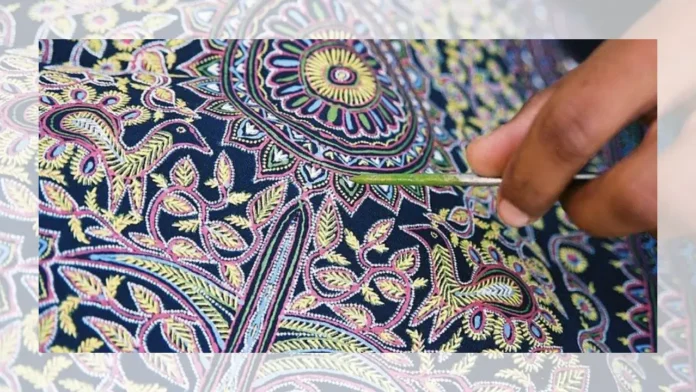
PM Modi gifted a Rogan Painting with Tree of Life, Kesar Mangoes, and Meghalaya Pineapple to the President of the United Arab Emirates (UAE), Sheikh Mohamed bin Zayed Al Nahyan.
Imagine watching an artist paint — but the brush never touches the canvas.
That is exactly what happens in the Rogan painting. The artist holds a metal rod above the fabric. He lifts a thin, thread-like strand of oil paint into the air, twisting and guiding it with extraordinary precision. The paint floats and lands on the cloth — without the tool ever making direct contact.
It looks like magic. It is actually centuries of mastery.
Rogan painting is one of India’s oldest and rarest textile crafts. Its history stretches back at least 1,550 years. Today, only one family in the entire world practices it. And for a long stretch in the 20th century, the art form came terrifyingly close to disappearing forever.
This is its story.
What Does “Rogan” Actually Mean?
The word “Rogan” traces back to the Sanskrit term rangan, which means “to add colour” or “to dye.” Some historians also connect the word to Persian, where rogan means “oil-based” — a nod to the paint’s central ingredient.
Either way, the name fits perfectly. Rogan painting is, at its core, an oil-based fabric art. Everything about it — from the way the paint moves to the way it dries — comes back to oil.
The craft also carries another name: the Drying Oil Technique. That name describes the science behind it. The oil used in the paint polymerises as it dries, bonding permanently to the fabric fibres without fading or cracking over time.
Where Did It Come From?
The origins of Rogan painting stretch across two continents and many centuries.
The oldest evidence comes from the 5th and 6th centuries. Buddhist cave paintings in the Bamiyan valley of Afghanistan show signs of a drying oil technique remarkably similar to Rogan. UNESCO research conducted in 2008 confirmed this connection, linking early Buddhist art from regions stretching from Patliputra in Bihar to Bamiyan in Afghanistan.
From there, historians believe the technique gradually migrated. Around 300 to 400 years ago, the craft arrived in the Kutch region of Gujarat, brought westward through the cultural and trade corridors of Central Asia and Persia. It settled in the village of Nirona, roughly 40 kilometres from Bhuj. And it found a home with the Khatri community — specifically, with the family that still practices it today.
When it first arrived in Gujarat, the craft was practical as much as artistic. Rogan-painted fabrics decorated skirts, quilt covers, bags, tablecloths, and bridal wear. Local farming and herding communities used the painted cloth for festivals and weddings. The art was part of everyday life.
How the Paint Itself Is Made
The secret to Rogan painting starts in a forest — and it starts with castor oil.
Castor is a crop grown naturally in Kutch. Artisans collect the seeds and press them to extract the oil. Then comes the critical step: the oil is boiled continuously for eight to twelve hours, often outdoors in the open air, because the fumes it produces are powerful and need space to disperse. This is traditionally a task for the men of the household.
As the oil boils, it thickens into a dense, viscous residue. That residue — the Rogan — is removed from the heat and left to cool.
Once cooled, artisans mix it with chalk powder and natural pigments. Historically, these pigments came from plants, flowers, soil, and crushed rocks. The combination produces a thick, vibrant paste in five traditional colours: orange, yellow, green, blue, and white.
The paste must stay in water-filled containers between sessions. If it dries out, it loses its special consistency — the exact quality that makes the trailing technique possible. And that consistency must be just right: too thick, and the paint won’t pull into delicate strands; too thin, and the strands collapse.
The exact proportions remain a family secret to this day.
The Technique: A Dialogue Between Two Hands
To watch a Rogan artist work is to watch something that doesn’t seem physically possible.
The artisan takes a small amount of paste and places it on his palm. He rubs it gently with the metal rod — the tulika — using the heat of his own hand to soften and activate the paint. Then, working with extraordinary patience, he lifts a thin strand of paint from his palm and guides it just above the surface of the fabric.
The rod never touches the cloth directly. Instead, the paint — still warm and pliable — drops and adheres to the fabric below, guided by the fingers of the artist’s other hand pressing gently from underneath.
Motifs like the Tree of Life, peacocks, lotus flowers, and intricate geometric patterns emerge this way, line by slow line. A single piece can take days or even weeks.
And here is the rule that allows no mistakes: once the paint touches fabric, it cannot be removed or corrected. Every stroke is permanent. Every line has to be right the first time. That is why learning Rogan painting demands years — sometimes decades — of dedicated practice.
The Mirror Technique: One Design, Two Copies
One of the most remarkable features of Rogan painting is the mirror method.
After the artist completes the design on one half of a piece of fabric, he folds the cloth carefully along the centre. He presses it gently. When he opens it, the design has transferred to the other half — creating a perfectly symmetrical mirror image.
No stencils. No grids. No mechanical assistance. The fold does all of it.
This technique means that every completed Rogan piece carries a natural symmetry — two sides of the same design, each a reverse reflection of the other. It also means the artist must plan the entire composition before laying down a single strand of paint, knowing that the final image will be doubled.
Three Styles of Rogan Art
Over centuries, Rogan painting developed into three distinct styles, each with its own method.
Rogan Chhap is the original, purest form. The artist works entirely freehand, using the trailing technique described above. No mechanical aids. No blocks. Just the rod, the paint, and years of practice.
Nirmika Rogan Chhap takes a different approach. Artisans fill carved brass molds with the Rogan paste and press them onto the fabric using a wooden rod. This creates precise, repetitive patterns — almost like block printing, but with the same oil-based Rogan paint.
Varnika Rogan Chhap adds an extra layer of decoration. After the base design is applied using a single colour, artisans brush additional colours over it. Then they apply embellishments like zari glitter powder or abrakh mica flakes, which give the finished piece a shimmering, textured quality.
All three styles share the same fundamental ingredient: that boiled castor oil paste, made the same way it has been made for generations.
The Near-Extinction
For most of its history, Rogan painting had many practitioners. In Nirona alone, four families once worked in the craft. Across Kutch and Gujarat, the tradition was widely known.
Then the 1950s arrived — and with them, industrialisation.
Machine-made textiles flooded the market. They were faster, cheaper, and easier to produce. The slow, labour-intensive work of Rogan painting could not compete on price. Family by family, the craft was abandoned. Artisans left for other trades.
By the 1980s, only one family remained in Nirona. And even within that family, the situation was desperate. The demand for Rogan-painted fabric had collapsed. Abdul Gafur Khatri — who had inherited the craft from his father — could not earn enough from it to feed his family. He left Nirona in the early 1980s to find work in Ahmedabad and then Mumbai.
But he carried the art with him.
The Man Who Refused to Let It Die
Abdul Gafur Khatri eventually returned to Nirona. And when he did, he made a decision that changed everything.
He recognised something important. If he stopped, the art would vanish permanently. That weight settled on him, and he chose to bear it. He went back to his Rogan practice and committed himself to it fully — even through poverty, even without a reliable market.
Over the next decades, he and his brother Sumar Daud Khatri quietly rebuilt the craft. He participated in exhibitions, craft fairs, and workshops. He demonstrated the technique to visitors from around the world. Slowly, interest began to return.
Then, in 2014, everything changed.
The Moment the World Took Notice
When Prime Minister Narendra Modi visited the United States in October 2014, he chose his gift to President Barack Obama carefully. He selected two Rogan Art “Tree of Life” paintings — both made by Abdul Gafur Khatri and his brother.
That single act of gifting introduced Rogan painting to a global audience practically overnight. International media covered the story. Collectors began seeking out the work. Visitors started travelling specifically to Nirona to meet the Khatri family and see the craft in person.
Today, the Khatri family workshop in Nirona has hosted visitors from more than 70 countries — including the USA, UK, Italy, France, Japan, Switzerland, Australia, South Africa, Canada, and Germany. The village has become a living museum and a pilgrimage destination for craft lovers around the world.
Abdul Gafur Khatri received the National Award for his craft in 1997, the State Award in 1988, and — most significantly — the Padma Shri in 2019, one of India’s highest civilian honours.
Breaking the Old Rules
One of the most meaningful changes Abdul Gafur Khatri made was about who could practice Rogan painting.
For centuries, the craft was taught exclusively from father to son. Women were not included in the tradition — partly because the boiling of the oil was considered men’s work, and partly because of long-standing social convention.
Gafur Bhai broke that rule entirely. He began teaching the women of his household. This decision dramatically expanded the number of practitioners within the family and gave the craft a more resilient foundation. Today, women are active contributors to Rogan painting’s survival.
What the Future Looks Like
Rogan painting now carries a Geographical Indication (GI) tag, protecting it as an authentic craft of Kutch. This recognition prevents the label from being misused and helps ensure that genuine Rogan work can be identified and valued properly.
Fashion designers and students from institutions like the National Institute of Design (NID) have begun collaborating with the Khatri family — incorporating Rogan motifs into contemporary jackets, sarees, and wall hangings. The aesthetic of the craft is finding its way into modern design, slowly but steadily.
Still, the fragility is real. The entire tradition rests on the dedication of one extended family. The Rogan Khatri family is now in its eighth generation of practice. The youngest members are learning the craft. But “learning” means years of full commitment before a practitioner can produce work of publishable quality.
The boiling of the oil still takes eight to twelve hours. The trailing still requires every line to be right the first time. The mirror fold still demands that the artist plan the entire composition. None of that can be automated. None of it can be rushed.
Why Rogan Painting Matters
In a world of fast fashion and mass production, Rogan painting is the opposite of everything.
It starts with a seed from local soil. It involves boiling oil for half a day. It demands a painter who guides colour through the air without letting a tool touch the cloth. It uses a folding technique to create symmetry that no machine could improve. It dries in the sun.
And when it is finished, what you have is something that cannot be replicated. Every piece is unique. Every line reflects a human decision, made in real time, with no ability to undo it.
That is not just art. That is an argument for slowness, for skill, for the value of things made with care over centuries of practice.
The village of Nirona sits quietly in the Kutch desert. Inside a modest workshop, members of the Khatri family still warm paste on their palms and lift colour into the air. The rod moves. The paint follows. The cloth receives it.
And an art form that almost vanished continues — one thread of oil at a time.
If you wish to see Rogan painting in person, visit Nirona village in Kutch, Gujarat, best during the cooler months of November through February when craft fairs are active across the region.

