


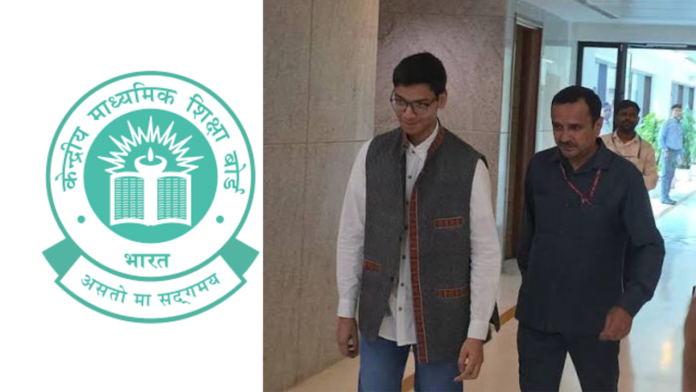
A Class 12 student from Bokaro with no phone and a lot of questions — Sarthak Sidhant spent days combing through government procurement documents and found what he called a rigged exam system. India listened.
The Whistleblower Who Changed Everything, Sarthak Sidhant
Class 12 Student · Bokaro, Jharkhand · Age 17–18
15+ Discrepancies Found
3 Tender Rounds Analysed
2 CBSE Officials Transferred
17L+ Students Affected
He calls himself a dork. He does not own a phone. He grew up in Bokaro — a steel-plant city in Jharkhand where, as he has described it, broken roads stayed broken and nobody was ever held accountable for anything. And yet, Sarthak Sidhant — a soft-spoken, self-deprecating Class 12 student raised by two computer engineers — did what India’s most powerful education oversight bodies failed to do: he read the documents.
In the weeks following the chaotic rollout of CBSE’s new On-Screen Marking (OSM) system for Class 12 board examinations in 2026, millions of students across India took to social media to report blurred answer sheet scans, unexplained mark deductions, a glitchy portal, and opaque re-evaluation processes. Sarthak was among the 17 lakh students affected. Dissatisfied with his results and suspicious of the system, he did something unusual: he went to the Central Public Procurement Portal and started reading CBSE’s bidding documents — all of them, across three successive tender rounds.
What he found became one of the most consequential blog posts in recent Indian education history.
The Blog That Started It All
Sarthak published his findings on his personal website under the title ‘How CBSE Rewrote Rules to Favour Coempt EduTeck’. The investigation was methodical: he cross-referenced hundreds of procurement documents and tracked how the eligibility criteria for the multi-crore OSM contract changed — and kept changing — across three rounds of tendering that began in February 2025.
“This is a story of how a massive public institution deliberately played with students’ futures by rewriting its own rulebook.”
— Sarthak Sidhant, in his blog on sarthaksidhant.com
His central allegation was stark: that the technical and eligibility benchmarks for the contract were progressively lowered across three Request for Proposal (RFP) rounds in ways that appeared specifically tailored to fit the profile of Coempt EduTeck — the Hyderabad-based firm that ultimately won the OSM contract. He identified at least 15 discrepancies in the process.
What He Alleged: The Key Discrepancies
01 CMMI Certification Downgraded
Earlier tenders reportedly required CMMI Level 5 certification. Later versions accepted Level 3 — a standard that matched Coempt’s capabilities but would have disqualified a more capable competitor.
02 Blacklisting Clause Changed
The original RFP barred vendors “blacklisted earlier.” A subsequent corrigendum changed this to “blacklisted currently” — effectively clearing vendors with a problematic past track record from disqualification.
03 Penalty Clauses Removed
The old tender included three clauses penalising poor performance by the service provider. Sarthak alleged these were stripped out entirely in later versions of the document.
04 Financial & Project Eligibility Relaxed
Financial qualification limits and project eligibility criteria were also altered across successive rounds — each change, Sarthak argued, narrowing the field until only Coempt EduTeck could fit through the door.
Sarthak also raised security concerns, noting that the tender required vulnerability assessment and penetration testing certification before deployment — a requirement he alleged was not adequately verified, citing independent security researchers who claimed to have found serious vulnerabilities in the OSM platform.
Who is Coempt EduTeck?
The company at the heart of Sarthak’s allegations is no stranger to controversy. Coempt EduTeck Private Limited — formerly known as Globarena Technologies — is a Hyderabad-based firm with a chequered history. It has been linked to the 2019 Telangana Intermediate examination fiasco, where technical failures in examination management led to widespread student distress. Sarthak, speaking to ANI ahead of his Parliamentary appearance, was blunt about its background.
“Coempt was known as Globarena, and they have a very shady background. 23 students killed themselves because of Coempt.”
— Sarthak Sidhant
Both CBSE and Coempt EduTeck have denied any wrongdoing. CBSE has maintained that the firm met all technical requirements and secured the highest combined QCBS (Quality and Cost-Based Selection) score, and that the entire procurement process was fully compliant with government rules.
From Blog to Parliament: The Timeline
February 2025: CBSE issues the first OSM tender. The process fails to produce a qualified vendor.
May 2025: A second tender round is issued. It too stalls. An internal dry-run report at five Delhi schools flags at least 36 technical, operational, and evaluation issues.
August 2025: A third and final tender is issued. Coempt EduTeck emerges as the successful bidder. A September 2025 corrigendum further removes CBSE’s own power to blacklist vendors.
2026 Board Exams: The OSM system rolls out for 17 lakh Class 12 students. Reports of blurred scans, missing marks, portal glitches, and payment failures flood social media.
May 30, 2026: Sarthak Sidhant publishes his blog after reviewing hundreds of tender documents. It goes viral, fundamentally shifting the national conversation about the CBSE OSM controversy.
June 2, 2026: Sarthak appears before the Parliamentary Standing Committee on Education, presenting a seven-page document of his findings. The same day, the government transfers CBSE Chairman Rahul Singh and Secretary Himanshu Gupta, and orders a high-powered committee probe.
June 5, 2026: Rahul Gandhi meets Sarthak Sidhant and posts a photograph on X with the message: “Sarthak, apne sidhanton pe adig raho” — Sarthak, remain steadfast in your principles.
In Parliament: A 17-Year-Old Faces the Committee
On June 2, 2026, Sarthak Sidhant walked into Parliament to present his findings before a committee comprising 21 MPs from the Lok Sabha and 10 from the Rajya Sabha, chaired by Congress MP Digvijaya Singh. He placed a seven-page document before the Parliamentary Standing Committee on Education, Women, Children, Youth, and Sports.
Parliamentary Standing Committee — June 2, 2026
A Committee of 31 MPs Listens to a Teenager
The committee scrutinised the functioning of the On-Screen Marking system and the concerns raised by students regarding transparency, evaluation methodology, and mark verification. Following Sarthak’s presentation, panel head Digvijaya Singh stated the committee would await CBSE’s formal response. The panel acknowledged the issues raised — on both the OSM system and the three-language formula in Classes 9 and 10. While the committee cannot directly punish CBSE, it can compel accountability through higher authorities — and any failure to cooperate with Parliament can constitute a Breach of Privilege.
Political Reactions: Congress vs BJP
Congress / Opposition
Rahul Gandhi called the CBSE OSM controversy a “deliberate conspiracy,” demanded a judicial inquiry and an SIT, and publicly cited Sarthak’s blog. Congress leader Jairam Ramesh went further, calling for Education Minister Dharmendra Pradhan’s resignation.
BJP / Government
The BJP pointed out that Coempt EduTeck had received contracts from institutions in Telangana and Karnataka — both Congress-governed states — undercutting the opposition’s political framing. The government ordered the probe while defending the process as compliant.
The Boy Behind the Blog
The story of who Sarthak Sidhant is matters as much as what he found. He grew up in Bokaro — a city owned by a public sector steel plant, where civic accountability was conspicuously absent and broken infrastructure never seemed to get fixed. Raised by two computer engineers who ran their own academy, he was using a mouse by age three. He lost his father at some point in his childhood. He describes himself with cheerful self-deprecation as a “dork.”
He has no smartphone. He built civic tech tools as a side project — tools designed to report potholes and push local governments into action. And when his own board exam results came back looking suspicious, he did not just complain on social media. He opened a procurement portal and started reading.
“I am one of the 17 lakh students affected by the On-Screen Marking system. I have just compared the documents. There were at least 15 discrepancies.”
— Sarthak Sidhant
That combination — civic instinct, technical literacy, and a refusal to accept opacity — is precisely what made Sarthak’s intervention so effective. He did not need inside sources or leaked documents. He used publicly available data. He treated the government’s own records as evidence against itself.
What Happens Next
The Cabinet Secretariat has constituted a one-member committee to inquire into the OSM procurement process. CBSE is conducting a re-evaluation of Class 12 answer books. The Parliamentary committee will await a formal response from CBSE. The CBSE Chairman and Secretary have been transferred pending further inquiry.
As for Sarthak Sidhant — a teenager who attended Parliament, met the Leader of Opposition, and may have altered the course of how India evaluates its 10 million board examination students — he is simply waiting, like millions of his peers, to see if the system he exposed will finally be held accountable.

