


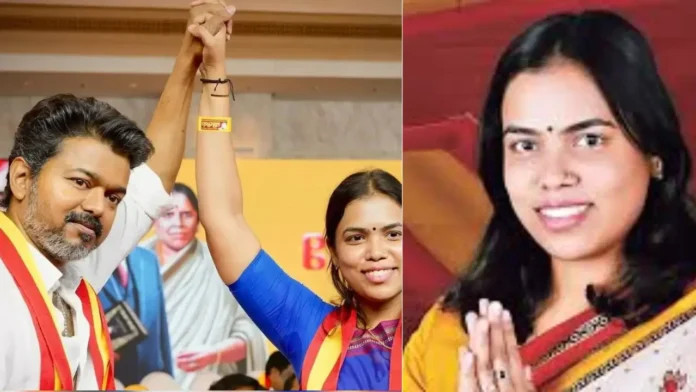
Keerthana Sampath did not come from a political dynasty. She did not grow up with connections or privileges. She came from a lower-middle-class family in Virudhunagar, Tamil Nadu. She studied in a Tamil-medium government school. And yet, at 29, she became the first woman MLA Sivakasi had ever seen — in over seven decades of democratic elections.
That is not a small thing. That is a seismic shift.
Who Is Keerthana Sampath?
Keerthana Sampath, officially known as S. Keerthana, was born in 1996 in Virudhunagar district. Her father’s name is Sampath. She grew up in modest circumstances, but she was academically driven. She completed her B.Sc. in Mathematics from a Madurai University-affiliated college. Then she went further. In 2019, she earned her M.Sc. in Statistics from Pondicherry Central University — one of India’s premier central universities.
So before she ever stepped into politics, she had already trained her mind to read data, spot patterns, and make sense of complex systems. That background would later shape how she approached political strategy.
From Statistics to Political Consulting
After her postgraduation, Keerthana did not head into academia or corporate life. She chose an unusual path — political consulting. This is a field that barely gets talked about in India, yet it is the engine behind how modern campaigns are run.
She worked as a consultant alongside some of Tamil Nadu’s top political leaders, including former Chief Minister M.K. Stalin. Over time, she picked up first-hand knowledge of how governance works — not from textbooks, but from the inside. She saw decisions being made. She understood the gap between promises and delivery. She also built a remarkable skill: she speaks five languages. For someone who began in a Tamil-medium government school, that is extraordinary.
Why Sivakasi? Why TVK?
Sivakasi is not just any constituency. It is known across India as the Fireworks Capital. It is an industrial hub — home to thousands of workers in fireworks factories and match units. The work is dangerous. The pay is often unfair. Women workers, in particular, face enormous risks with little protection.
Keerthana saw this clearly. She became an admirer of TVK chief C. Joseph Vijay — better known as Thalapathy Vijay — and joined his party, Tamilaga Vettri Kazhagam (TVK). When she decided to contest from Sivakasi in the 2026 Tamil Nadu Legislative Assembly elections, she became the first woman candidate the constituency had seen since Independence.
Before the election, she went door to door. She also used an innovative grassroots approach earlier in her career — in Agasan village, Thane, Maharashtra, she built a public library and sports playground entirely through crowdfunding, in just 30 days. That instinct — solve the problem, don’t just talk about it — defined her campaign style.
The Election and the Historic Win
On election day, Sivakasi delivered a decisive verdict. Keerthana polled 68,709 votes. She defeated her nearest rival, Ashokan G of the Indian National Congress, by a margin of 11,670 votes. It was her debut election. She had never contested before. And she won — convincingly.
In doing so, she ended over 70 years of male-only representation in Sivakasi. Every MLA the constituency had ever sent to the assembly had been a man. Keerthana changed that — not narrowly, but with a clear mandate.
The Hindi Moment That Started a National Conversation
After the results, Keerthana did something unexpected. She addressed her supporters in Hindi. In Tamil Nadu — where the anti-Hindi agitation has deep historical roots and language politics remain intensely sensitive — this was a bold move.
She explained it plainly. Hindi, she said, helps carry TVK’s message to a broader audience across India. It is a communication tool, not a political statement. For Keerthana, who speaks five languages, this was natural. She sees multilingualism as a strength, not a provocation.
The debate that followed was national. But Keerthana held her position calmly. That steadiness spoke volumes.
What She Promised Sivakasi
Keerthana’s campaign was rooted in the daily realities of Sivakasi’s people — especially its workers. She did not offer vague aspirations. She offered specific commitments.
For fireworks workers, she promised insurance coverage that actually matches the industrial risks they face. She pledged equal pay for women working in the fireworks and match sectors. She committed to regular health check-ups and easier access to treatment for occupational diseases — conditions that have long gone unaddressed for these workers.
For industrial owners, she proposed a fully-funded international exposure programme — one month to study safer factory practices in other countries and bring those improvements back home.
For students, she pushed for formal agreements between local colleges and manufacturing units. These MoUs would create real internship pipelines, including opportunities abroad, so that graduates from Sivakasi’s colleges could build careers right here — not leave their hometown to find one.
Jobs after education. Women’s safety. Fair wages. Clean drinking water. Better roads. Organised markets. Modern industries. These were her words — direct, grounded, and measurable.
Taking Oath as Minister
On May 10, 2026, Keerthana Sampath took oath as a Minister in the new Tamil Nadu government, led by Chief Minister C. Joseph Vijay. She was among nine TVK legislators sworn in at the historic ceremony.
She told reporters: “Today is a big day for Tamil Nadu and the public of the state. This is the moment everybody has been waiting for.”
After the ceremony, she was clear — every campaign promise for Sivakasi remains a priority.
Why Her Story Matters
Keerthana Sampath is 29 years old. She grew up without political privilege. She built her skills step by step — mathematics, statistics, languages, governance, strategy. She chose a constituency that had never elected a woman. She won on her first try.
That combination is rare in Indian politics. And what makes it more significant is this: she did not arrive as a symbol. She arrived with a plan. For Sivakasi’s workers — the ones who make the fireworks that light up India’s celebrations — that plan could be life-changing.
She is not just the first woman MLA of Sivakasi. She is proof that you can walk into political spaces that were never designed for you — and reshape them entirely.

