


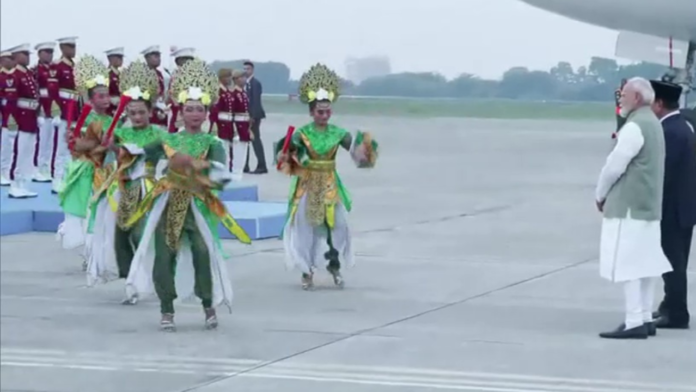
As questions mount over Washington’s staying power in the region and Beijing’s influence keeps expanding, Prime Minister Narendra Modi has embarked on a six-day, three-nation tour of Indonesia, Australia and New Zealand — a tour his own office is framing around the Act East Policy and a “free and open Indo-Pacific.
Prime Minister Narendra Modi departed New Delhi on Monday, July 6, on a three-nation Indo-Pacific tour that will take him to Indonesia, Australia and New Zealand over the next six days. In his departure statement, Modi said the trip would “further strengthen India’s Act East Policy, MAHASAGAR Vision as well as India’s outlook towards a free and open Indo-Pacific.”
The timing has not gone unnoticed. The tour lands just as analysts and international commentators flag growing uncertainty over the United States’ commitment to the Indo-Pacific region, even as China’s naval and economic footprint in the same waters continues to expand. Bloomberg’s framing of the visit put it plainly: Modi is moving to shore up ties with Indo-Pacific nations precisely as that uncertainty grows.
3 Nations on the tour
6 Days, July 6–11
60% India’s trade via Malacca Strait
Jakarta First: Why Indonesia Leads the Itinerary
Modi’s first stop is Jakarta, where he will hold talks with President Prabowo Subianto followed by a state banquet, before visiting the Prambanan Temple complex at Yogyakarta — a nod to the civilisational ties between the two nations. India and Indonesia elevated their relationship to a Comprehensive Strategic Partnership during Modi’s first visit to the country in 2018.
The choice of Indonesia as the opening stop is being read as more than protocol. Indonesia straddles the Malacca Strait, the narrow passage through which more than 60 percent of India’s seaborne trade flows, and it carries its own frictions with Beijing over the Natuna Islands exclusive economic zone. Commentary around the visit has emphasised that maritime security, rather than trade or cultural exchange, sits at the centre of this leg of the trip — a marked shift from previous India-Indonesia engagements.
“The age of equidistance is over, and India is ready to make the first move.”— Framing of Modi’s Jakarta outreach, as reported in Indian foreign policy commentary
Australia and New Zealand: Consolidating the Southern Flank
From Jakarta, Modi travels to Melbourne at the invitation of Australian Prime Minister Anthony Albanese, where discussions are expected to advance the India-Australia Comprehensive Strategic Partnership across defence and security, trade and investment, education and mobility. The final leg takes him to New Zealand, where India and Wellington have already committed to strengthening bilateral trade through a Free Trade Agreement; Modi is also expected to address a large gathering of the Indian diaspora during this stop.
- Jul 6–8Indonesia — talks with President Prabowo Subianto, state banquet, Prambanan Temple visit
- Jul 8–10Australia — Melbourne visit at PM Albanese’s invitation, Comprehensive Strategic Partnership talks
- Jul 10–11New Zealand — Free Trade Agreement follow-through, diaspora engagement
The “Mixed Signals” From Washington
The backdrop to this tour is a list of frictions that has built up over recent months rather than any single incident. Commentators tracking India-U.S. relations point to repeated criticism from President Trump, his disputed claim of having brokered last year’s India-Pakistan cease-fire, the U.S. war against Iran alongside a muted response to the deaths of Indian sailors in the Gulf of Oman, Washington’s backing of Pakistan as a Middle East peace broker, and a talk of a prospective “G-2” arrangement between the U.S. and China. Analysts have also noted the quiet fading of “Indo-Pacific” as a term in U.S. official messaging — a phrase the Trump administration itself had championed during its first term.
What’s Fuelling the “Mixed Signals” Narrative
- Repeated public criticism of India from President Trump
- Disputed U.S. claims over brokering the India-Pakistan cease-fire
- Muted U.S. response to Indian sailor deaths during the Iran war
- U.S. support for Pakistan’s Middle East peacemaker role
- Fading use of “Indo-Pacific” terminology in U.S. official messaging
- Speculation around a U.S.-China “G-2” arrangement
Not every voice reads this as a rupture. A counter-argument circulating in foreign policy commentary notes that every previous India-U.S. friction over the past quarter-century has been followed by an expansion, not a contraction, of strategic engagement — and that Commerce Minister Piyush Goyal has publicly dismissed reports around the renaming of the U.S. Indo-Pacific Command as over-interpreted, adding that the proposed India-U.S. bilateral trade agreement is “99 percent done.”
The Japan Prelude
This tour did not emerge in isolation. Just days before departure, Modi hosted Japanese Prime Minister Sanae Takaichi in New Delhi for the 16th India-Japan Annual Summit — her first official visit for a bilateral summit with Modi. That meeting produced commitments on maritime security, energy security, critical minerals cooperation, and plans to convene the next India-Japan Foreign and Defence Ministerial (2+2) before the end of the year. It also came against the backdrop of Trump-era tariffs affecting both countries, economic fallout from the Iran war, and disruptions to key energy shipping lanes through the Strait of Hormuz.
Seen together, the Takaichi summit and the Indonesia-Australia-New Zealand tour form a single strategic sequence — one in which the India-Japan-Australia triangle within the Quad appears to be strengthening even as the fourth member’s regional posture is being questioned.

