


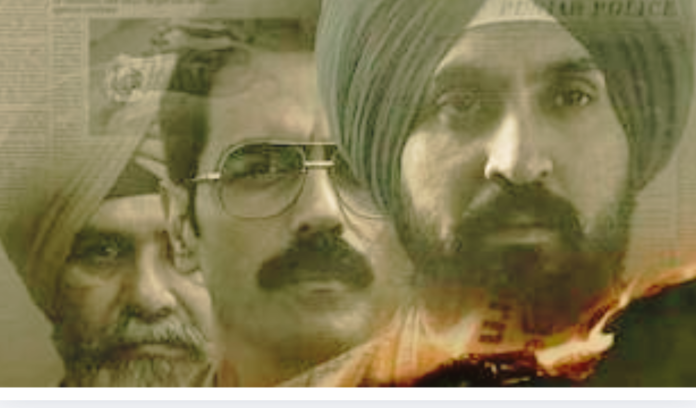
Satluj Pulled From ZEE5 India Sparks Fresh Interest in Jaswant Singh Khalra’s Story.
The removal of Diljit Dosanjh’s much-awaited film Satluj from ZEE5 India has once again brought national attention to one of Punjab’s most significant human rights cases. The film, inspired by the life of human rights activist Jaswant Singh Khalra, premiered on ZEE5 on July 3, 2026, after years of delays and censorship challenges. However, less than two days later, it disappeared from the platform’s Indian catalogue with a notice stating that it was “unavailable until further notice.”
While ZEE5 has not provided an official explanation for the removal, the film continues to stream on ZEE5 Global for viewers outside India. The unexpected withdrawal prompted Diljit Dosanjh to post a cryptic message on Instagram, writing that “the same thing that happened to Satluj also happened to Shaheed Jaswant Singh Khalra,” drawing a parallel between the film’s troubled journey and the activist’s own story.
The controversy has also renewed interest in the extraordinary life of Jaswant Singh Khalra and the unwavering determination of his wife, Paramjit Kaur Khalra, who spent decades seeking justice after his disappearance.
Who Was Jaswant Singh Khalra?
Jaswant Singh Khalra was not a career politician or lawyer. He worked as a bank employee in Amritsar before becoming deeply involved in documenting alleged human rights violations during Punjab’s militancy years in the late 1980s and early 1990s.
While examining municipal cremation records, Khalra reportedly uncovered evidence suggesting that thousands of unidentified bodies had been secretly cremated without proper identification or legal procedures. His findings alleged that many of these deaths were linked to counter-insurgency operations conducted during one of Punjab’s most turbulent periods, following Operation Blue Star and the aftermath of the 1984 anti-Sikh riots.
His investigation drew national and international attention and made him one of the most prominent voices raising concerns about enforced disappearances and alleged extrajudicial killings.
The Day He Vanished
On September 6, 1995, Jaswant Singh Khalra was allegedly abducted outside his residence in Amritsar while washing his car. He was never seen alive again.
His disappearance triggered widespread concern among human rights organisations and legal activists. Investigations later conducted by the Central Bureau of Investigation (CBI) concluded that Khalra had been illegally detained at a police station in Tarn Taran before being killed.
The case eventually led to the prosecution of several Punjab Police personnel. In 2005, six officials were convicted for their roles in the abduction and murder. Their sentences were later enhanced to life imprisonment in 2007, and the convictions were ultimately upheld by the Supreme Court in 2011.
Paramjit Kaur’s Long Road to Justice
Behind the legal battle stood Paramjit Kaur Khalra, whose determination became an integral part of the story.
Within days of her husband’s disappearance, she approached the Supreme Court by filing a habeas corpus petition seeking information about his whereabouts. What began as an urgent plea soon evolved into a legal struggle that lasted nearly two decades.
Throughout the proceedings, she consistently pursued accountability while keeping public attention focused on the case. Her persistence played an important role in ensuring that the investigation continued despite the passage of time.
When the Supreme Court upheld the convictions in 2011, it marked the culmination of years of legal efforts. Yet Paramjit Kaur did not step away from public life after the judgment.
Continuing the Legacy Beyond the Courtroom
Following the conclusion of the case, Paramjit Kaur continued advocating for human rights through the Khalra Mission Organisation, working to preserve her husband’s legacy and raise awareness about issues related to justice and accountability.
She also entered electoral politics, contesting from Tarn Taran in 1999 and later from Khadoor Sahib in 2019. Although unsuccessful in both elections, her campaigns focused on highlighting the experiences of families affected during Punjab’s militancy years and promoting greater accountability for human rights violations.
Family Backed the Film
Before the release of Satluj, Paramjit Kaur publicly expressed support for the project. She confirmed that the Khalra family had been consulted during its development and stated that the released version reflected what they had previously viewed.
The couple’s children, Navkiran Kaur and Janmeet Singh, who now reside abroad, have also remained engaged in discussions surrounding Sikh human rights issues through various community and advocacy initiatives.
Why Satluj Has Become a Talking Point
Originally announced under the title Punjab ’95, the film faced prolonged certification hurdles, reportedly including demands for extensive cuts before eventually being released under the title Satluj. Its brief availability on ZEE5 India, followed by its sudden removal without a detailed explanation, has generated fresh debate over creative freedom, censorship and the challenges of portraying politically sensitive historical events.
At the same time, the film’s availability for international audiences has further fueled discussions about differing approaches to content distribution across regions.
A Story That Continues to Resonate
While Satluj has become the latest subject of public debate, the events that inspired the film continue to occupy an important place in India’s human rights history.
For many, the story extends beyond a film release or streaming dispute. It is also about the determination of a family that spent years pursuing justice through legal institutions and ensuring that the memory of Jaswant Singh Khalra remained part of the national conversation.
As discussions surrounding Satluj continue, Paramjit Kaur Khalra’s decades-long pursuit of accountability remains one of the most enduring aspects of the story behind the film.
This version is written in a neutral, news-style tone suitable for publication, avoiding unverified claims while accurately reflecting the publicly documented legal history and the current Satluj streaming controversy.

