


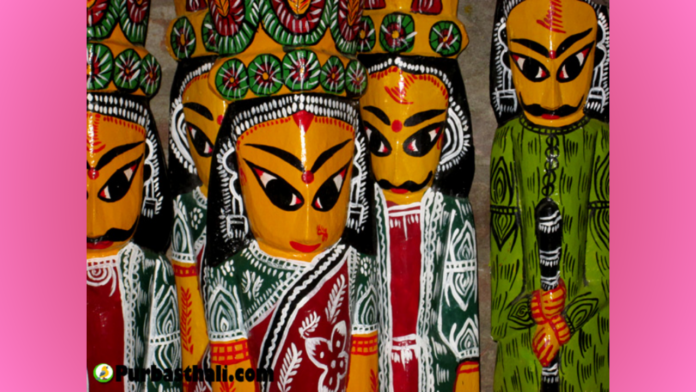
A small village in West Bengal’s Purba Bardhaman district is about to get a big reward for a craft that has survived for two and a half centuries. Natungram, known across Bengal as the village of dolls, is set to receive a Geographical Indication tag for its handcrafted wooden dolls. Local artisans confirmed the development in the first week of July 2026, describing it as recognition they have waited years for.
The tag would place Natungram’s wooden dolls alongside other iconic Bengal products that already carry GI protection, from Joynagar Moa to Banglar Rasogolla. For a craft that has quietly survived plastic, machine-made toys, and the slow disappearance of an entire generation of buyers, this is more than a certificate. It is a lifeline.
What Is Natungram and Why Is It Called the Village of Dolls
Natungram sits under the Katwa subdivision of Purba Bardhaman, about four hours by road from Kolkata. Travellers can also reach it by train to Katwa or Agradwip and then continue by road, or combine the visit with a trip to nearby Shantiniketan.
The village earned its nickname because doll making is not a side occupation here. It is the primary trade of entire families, passed down through generations of two artisan communities: the Sutradhars and the Bhaskars. Their ancestors were originally stone sculptors who worked under the patronage of the local Bardhaman royal family. When that patronage faded and demand for stone work slowed, the craftsmen shifted to wood. Wood was cheaper, easier to source, and faster to carve than stone, and the switch kept the community’s carving skills alive in a new form.
Today, homes in Natungram double as workshops. Visitors can walk through the village and watch artisans carving figures from raw wood on their verandas, with painting done just a few feet away.
The Craft: How Natungram’s Wooden Dolls Are Made
Every doll begins as a single, seasoned block of wood. Artisans use a mix of softer and harder timber depending on the piece. Chatim, mango wood, and ata are cheaper and easier to carve, while gamar, mahogany, and sonajhuri are sturdier and more expensive, sourced from the denser forests nearby.
The work is divided along traditional lines within each household. Men typically handle the chiselling and shaping, cutting the figure out of the block with hand tools. Women take over for the painting, working in bright reds, greens, and yellows against a white base. This division of labour has stayed largely unchanged for generations, even as the products themselves have evolved.
The dolls have no limbs and little of the fine detailing seen in mass-produced toys. That is the point. Their charm comes from a rustic, almost primitive expressiveness, not polish. A well-painted bridal doll, for instance, can convey the texture of a sari and the mood of a face without a single carved finger or arm.
The Owl: Natungram’s Most Famous Export
If one image represents Natungram, it is the painted wooden owl, locally called pecha. The owl is tied directly to Goddess Lakshmi, the deity of wealth, and Bengali households have long kept a pair of these owls at home as a symbol of prosperity and protection from misfortune. According to folklore, the owl earned this status by guiding a poor mother and son toward the goddess’s blessings, which is why the bird is still treated as her vahana, or vehicle.
The owl’s popularity has carried the craft into new markets. Artisans now carve owls into stool legs, cabinet handles, keychains, wall clocks, and string curtains, turning a religious icon into an everyday design object. Export orders and tourist purchases increasingly favour these owl-based items over standalone dolls, since they fit modern homes more easily than a full figurine.
Beyond the owl, Natungram’s repertoire includes Radha-Krishna figures, Durga, Ganesha, soldier dolls linked to the region’s royal past, and the Gour-Nitai pair. The Gour-Nitai dolls, showing two male figures with arms raised overhead, trace back to Bengal’s Bhakti movement in the fifteenth and sixteenth centuries and represent Sri Chaitanya Mahaprabhu and his disciple Nityananda.
Why the Craft Needed Saving
By the early 2000s, Natungram’s wood carvers were in trouble. Cheaper plastic and machine-made decor had eaten into demand for handmade dolls, and younger family members were choosing other professions over an unpredictable, low-paying trade. Artisans selling at Kolkata’s handicraft fairs openly said their children had no interest in continuing the work.
A turning point came through a collaboration between banglanatak dot com, a social enterprise, the West Bengal government, and UNESCO’s New Delhi office. The programme trained Natungram’s artisans to adapt their traditional carving skills to modern lifestyle products, pushing them beyond standalone dolls into furniture and home decor items that city buyers and hotels would actually purchase. That shift helped stabilise incomes and gave the craft renewed visibility at exhibitions and emporiums across the state.
Local institutional support followed. Purba Bardhaman police even set up a no-profit emporium called Maatir Taan to help artisans from across the district, including Natungram’s doll makers, sell directly to buyers without losing margin to middlemen.
The Road to the GI Tag
Recognition for Natungram’s craft did not start with the GI application. The wooden owl of Natungram already holds Intangible Cultural Heritage status from UNESCO, an acknowledgement of its cultural significance that predates any legal trademark protection.
The formal push for a Geographical Indication tag began in 2022, when an application was filed for the Natungram wooden dolls under India’s GI framework. A police officer serving as an honorary member of the National GI Mission Drive was among those who helped file the case on behalf of the artisan community. The Geographical Indications Registry in Chennai lists the Natungram Wooden Doll application in its public database, confirming the claim is formally on record.
Under India’s GI process, an application first goes through examination for technical correctness, then publication in the GI journal for public objections, and finally registration if no valid opposition is raised. A registered GI stays valid for ten years and can be renewed. As of early July 2026, artisans in Natungram say the tag is now close to being granted, marking the final stage of a process that began four years earlier.
What the GI Tag Actually Means for Natungram
A Geographical Indication tag is not a marketing badge. It is a form of legal property right tied to a specific place. Once granted, it confirms that a product’s qualities, reputation, or characteristics are essentially linked to its geographic origin, and it stops anyone outside that region from selling similar goods under the same name.
For Natungram’s artisans, this brings three concrete benefits. First, legal protection against imitation. Wooden owls and dolls copying the Natungram style are already sold in markets far from Bardhaman, and a GI tag gives the original makers a legal basis to challenge counterfeit products carrying their identity. Second, it strengthens credibility in both domestic and export markets, where buyers increasingly look for authenticated, traceable craft origins before paying a premium. Third, artisans hope that greater recognition and better prices will make the trade attractive again to younger family members who might otherwise leave it behind.
This last point matters most. A GI tag cannot single-handedly revive a craft, but it can change the economics around it enough to keep a dying skill inside a family for one more generation.
Natungram in the Wider Map of India’s GI-Tagged Crafts
Natungram’s wooden dolls would join a small, distinguished list of Indian wood-toy traditions that already carry GI protection, including the Channapatna lacquerware toys of Karnataka, recognised for over two centuries of craftsmanship, and the Etikoppaka wooden toys of Andhra Pradesh, GI-tagged in 2017. Within West Bengal itself, the tag would sit next to existing GI entries from the same district, including Bardhaman’s Sitabhog and Mihidana sweets.
What sets Natungram apart within this list is scale and survival. Unlike crafts that industrialised early, Natungram has stayed almost entirely home-based, with families carving and painting inside their own houses rather than in factories. That intimacy is part of what a GI tag is designed to protect.
The Bigger Picture
India’s traditional toys and dolls have always carried more weight than their size suggests. They double as ritual objects, symbols of regional identity, and markers of sustainable, low-waste craftsmanship, standing in quiet contrast to mass-produced global toy trends. Natungram’s owls fit squarely into that story: a religious symbol, a design object, and now, soon, a legally protected piece of Bengal’s cultural map.
For a village where the workshop is the living room and the artisan is also the parent teaching a child to hold a chisel, the GI tag is not the end of the story. It is what gives the next chapter a fighting chance.

