


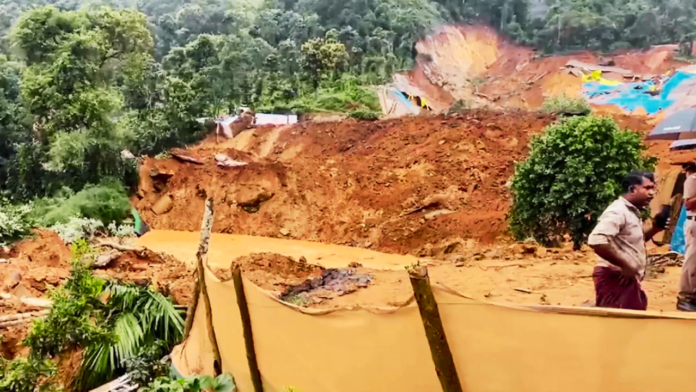
Wayanad, Kerala: At least five people lost their lives after a massive landslide struck a tunnel construction site in Kerala’s Wayanad district on Tuesday following incessant rainfall. The tragedy unfolded near Meenakshi Bridge at Kalladi, where work was underway on the Anakkompoyil–Meppadi tunnel road project connecting Malappuram and Wayanad districts.
Several construction workers were present at the site when the landslide occurred. Rescue teams rushed to the location immediately, while authorities fear that more workers may still be trapped beneath the debris.
Rescue Operations Underway
Personnel from the Fire and Rescue Services, the National Disaster Response Force (NDRF), police, and local volunteers launched an extensive search and rescue operation soon after the incident.
Officials confirmed that several injured workers were shifted to nearby hospitals for treatment. Heavy earth-moving equipment has been deployed to remove debris, although continuous rainfall has made rescue efforts difficult.
Authorities have not ruled out the possibility of additional casualties as search operations continue.
Heavy Rain Triggered the Landslide
According to officials, Wayanad received extremely heavy rainfall over the past 24 hours, with some areas recording more than 250 mm of rain. The continuous downpour is believed to have destabilized the hill slopes surrounding the tunnel construction site.
Several vehicles parked near the project area were also damaged after mud and rocks swept across the road.
Kerala Government Responds
Kerala Chief Minister V.D. Satheesan convened an emergency meeting soon after receiving reports of the disaster. Senior ministers and district officials were instructed to coordinate rescue and relief measures on priority.
The Chief Minister directed Revenue Minister A.P. Anil Kumar and Agriculture Minister T. Siddique to reach Wayanad immediately and supervise rescue operations on the ground.
State authorities have assured that all available resources are being deployed to rescue those trapped and provide medical assistance to the injured.
Minister Alleges Negligence
Agriculture Minister T. Siddique described the incident as a “man-made disaster,” alleging that authorities had previously warned the project authorities about the possibility of a landslide at the construction site.
According to the minister, local officials had issued directions to remove loose soil and strengthen safety measures before the monsoon. He claimed that failure to implement these recommendations may have contributed to the tragedy.
The state government is expected to conduct a detailed inquiry into the circumstances leading to the landslide.
IMD Issues Red Alert
Following the incident, the India Meteorological Department (IMD) issued a Red Alert for Wayanad, warning of extremely heavy rainfall over the next 24 hours.
Red alerts have also been issued for neighbouring districts, while several other parts of northern Kerala remain under Orange Alert due to the likelihood of intense rainfall.
Residents living in landslide-prone regions have been advised to remain vigilant and follow evacuation instructions issued by local authorities.
Wayanad’s History of Landslides
Wayanad has long been identified as one of Kerala’s most landslide-prone districts due to its location in the ecologically sensitive Western Ghats.
The district witnessed one of its worst natural disasters in July 2024, when devastating landslides claimed nearly 300 lives and caused widespread destruction. Over the years, several villages across Wayanad have experienced recurring landslides during the southwest monsoon.
Experts have repeatedly highlighted the need for stricter land-use regulations, better drainage systems, and continuous monitoring of vulnerable hill slopes.
Why Wayanad Is Highly Vulnerable
The hilly terrain, steep slopes, fragile soil structure, and intense monsoon rainfall make Wayanad particularly susceptible to landslides.
Rapid infrastructure development, road cutting, excavation, and deforestation are often cited as factors that increase the risk of slope failures in the region.
As rescue teams continue their operations, authorities remain focused on locating missing workers while assessing the stability of the surrounding area to prevent further accidents.
The latest tragedy has once again highlighted the urgent need for stronger disaster preparedness, scientific planning, and strict adherence to safety norms for infrastructure projects in ecologically sensitive regions.

