


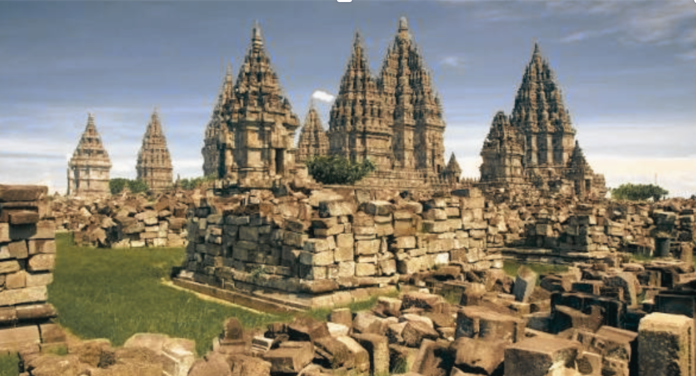
PM Narendra Modi and Indonesian President Prabowo Subianto jointly inaugurated an India-backed restoration project at Prambanan, Indonesia’s largest Hindu temple, on the second day of Modi’s Southeast Asia tour.
Prambanan Temple Complex, Yogyakarta — PM Modi & President Prabowo Subianto, July 8, 2026 PM Modi and Indonesian President Prabowo Subianto at the Prambanan Temple complex during Modi’s Southeast Asia tour.
Prime Minister Narendra Modi stood before towering stone spires that have watched over central Java for more than a thousand years on Wednesday, joining Indonesian President Prabowo Subianto to launch a restoration project at Prambanan, the largest Hindu temple complex in Indonesia. The visit turned a UNESCO World Heritage site into the latest stage for India’s cultural diplomacy in Southeast Asia.
The two leaders inaugurated the India-backed conservation initiative at the temple complex in Yogyakarta, a milestone that followed a Letter of Intent exchanged between the two countries during bilateral talks in Jakarta a day earlier. Modi also offered prayers at the ancient shrine, and the Archaeological Survey of India will now work alongside Indonesian authorities to restore several smaller temples within the sprawling complex.
A Temple Built By A Dynasty, Preserved By A Nation
Prambanan rose in the 9th century under the Sanjaya Dynasty of the Mataram Kingdom, believed to have been commissioned by King Rakai Pikatan. It is dedicated to the Trimurti, the Hindu trinity of Shiva, Vishnu, and Brahma, and its central structure is a soaring 47-metre Shiva temple that remains the tallest at the site. UNESCO inscribed the complex as a World Heritage Site in 1991, recognising it as one of Southeast Asia’s finest examples of Hindu architecture.
9th Century Built
240 Original Temples
47m Height of Shiva Temple
At its peak, the complex held around 240 individual temples spread across nearly 40 hectares. Its walls carry intricately carved stone reliefs depicting scenes from the Ramayana and the Bhagavata Purana, a visual record of how deeply Hindu epics shaped art and storytelling across the Indonesian archipelago centuries before the modern idea of India or Indonesia existed.
“This scent, this cultural heritage, connects us. I thank the people here in Indonesia for the way they have preserved this grand heritage, and maintained it, with devotional faith.”— PM Narendra Modi, at Prambanan Temple
Modi described hearing chants of “Mahamrityunjay” and “Om Namah Shiva” at the temple as a moment that touched him personally, and said he was confident that Indian tourists would now visit the site as the conservation work gets underway. Speaking a day earlier, he had linked the temple to a much older civilisational bond, noting that India and Indonesia are connected not only by the sea but by the shared legacy of the Ramayana and the Mahabharata, and by symbols such as Garuda, Indonesia’s national emblem.
Part Of A Larger Pattern: India’s Temple Diplomacy
The Prambanan project is not an isolated gesture. It extends a decade-long pattern in which the Modi government has used temple restoration as a tool of soft power across Asia, tying India’s foreign policy to shared religious and cultural memory rather than trade figures alone.
India’s Overseas Temple Restoration Track Record
- 2014, Vietnam: Restoration of the My Son Sanctuary, a key Shaivite temple complex of the ancient Champa Kingdom.
- 2015, Sri Lanka: Grant assistance of LKR 326 million for the Thiruketheeswaram Temple, one of five ancient Pancha Ishwarams.
- 2017, Myanmar: Restoration of 12 pagodas in the Bagan Archaeological Zone, including the historic Ananda Temple.
- 2017, Nepal: Conservation of 28 cultural heritage sites under India’s post-earthquake reconstruction assistance.
- 2019, Bahrain: Redevelopment of the 200-year-old Shreenathji Temple in Manama.
- 2020–21, Bangladesh: Reconstruction support for the Joy Kali Mata Temple and the Ramna Kali Temple.
- 2024, Laos: Restoration of key structures at the Vat Phou Temple, among Southeast Asia’s oldest Shiva temple complexes.
Seen against this record, Prambanan becomes the latest, and among the most high-profile, entries in India’s Act East policy, which has increasingly used heritage preservation to reinforce New Delhi’s ties with countries across South and Southeast Asia.
The Broader Visit
The Prambanan stop came during the second leg of a three-day visit to Indonesia, itself the first stop on a longer tour that will also take Modi to Australia and New Zealand. Earlier in the trip, he held bilateral talks with President Prabowo aimed at strengthening the Comprehensive Strategic Partnership between the two nations and addressed the Indonesian Parliament. Enthusiastic crowds waving the flags of both countries lined the streets as the two leaders travelled to the temple.
Ahead of the visit, Modi shared an aerial view of the complex from his helicopter on X, captioning it simply, “The majestic Prambanan Temple!” For a monument that has stood since the 9th century, it was a small, modern footnote to a very old story. What is Prambanan Temple?
Prambanan is a 9th-century Hindu temple complex in Yogyakarta, Java, and is Indonesia’s largest Hindu temple. It is dedicated to the Trimurti of Shiva, Vishnu, and Brahma, and was inscribed as a UNESCO World Heritage Site in 1991. Why did PM Modi visit Prambanan Temple?
PM Modi visited Prambanan alongside Indonesian President Prabowo Subianto to jointly inaugurate an India-backed conservation and restoration project at the temple complex, part of India’s cultural diplomacy under the Act East policy. Who will carry out the restoration of Prambanan Temple?
The Archaeological Survey of India (ASI) will work with Indonesian authorities to restore and conserve several smaller temples within the Prambanan complex, following a Letter of Intent exchanged between India and Indonesia. When was the Prambanan Temple built?
Prambanan was constructed in the 9th century during the reign of the Sanjaya Dynasty of the Mataram Kingdom, believed to have been commissioned by King Rakai Pikatan. What other temples has India helped restore abroad?
India has previously supported restoration of the My Son Sanctuary in Vietnam, the Thiruketheeswaram Temple in Sri Lanka, Bagan pagodas in Myanmar, heritage sites in Nepal, the Shreenathji Temple in Bahrain, temples in Bangladesh, and the Vat Phou Temple in Laos.

