


A tea seller’s son from Gujarat and a fatherless girl from Rome’s working-class suburbs both clawed their way to the top on the same fuel — nationalism, cultural pride, and the anger of people who felt left behind
A Pack of Toffee That Said Everything
On the morning of May 20, 2026, before the bilateral talks, before the joint declaration, before the €20 billion trade targets and the Special Strategic Partnership language, Narendra Modi reached into his pocket and pulled out a pack of Melody toffees.
He handed it to Giorgia Meloni.
She held the packet up, laughed, and posted a video on X with the caption: “Thank you for the gift.” Then she looked into the camera and said, with genuine warmth, “Prime Minister Modi brought as a gift a very, very good toffee — Melody.” Both of them burst out laughing.
The internet already knew the joke. “Melodi” — a mashup of Meloni and Modi — had been trending on social media for two years. But the Melody toffee gift made it official. A prime minister of India had literally handed the Italian head of government a sweet named after their friendship.
It was funny. It was warm. And for anyone paying attention, it was a window into something much deeper than a diplomatic photo opportunity.
Two Stories That Rhyme
Start with the personal stories. They are remarkably similar — not in detail, but in shape.
Narendra Modi was born on September 17, 1950, in Vadnagar, a small town in Gujarat’s Mehsana district. His family lived in a single-storey house measuring roughly 40 by 12 feet. His father ran a tea stall at the local railway station. As a child, Modi helped at that stall before and after school. There was no generational wealth, no political dynasty, no family connection to power.
He joined the RSS — the Rashtriya Swayamsevak Sangh, a Hindu nationalist volunteer organisation — at the age of eight. He became a pracharak, a full-time RSS volunteer, at 21. He slept in simple quarters, made tea for senior RSS colleagues, and devoted himself entirely to the movement. He had no wife, no property, no savings. He had only discipline, ideology, and an extraordinary capacity for organisation.
He entered the BJP in the 1980s, rose steadily, and became Chief Minister of Gujarat in 2001. Thirteen years later, he became Prime Minister of India. His story is the ultimate outsider-becomes-the-establishment arc — except he never really became the establishment. His entire brand is built on the idea that he came from nothing, answers to no dynasty, and exists only in service of the nation.
Giorgia Meloni was born on January 15, 1977, in Rome. She grew up in Garbatella — a working-class neighbourhood in the south of the city, originally built as social housing for industrial workers. Her father left the family when she was eleven years old. Her mother raised her and her sister alone, on a limited income, in a part of Rome that Italian elites rarely visited.
At fifteen, she joined the Youth Front — the Fronte della Gioventù — the youth organisation of the Italian Social Movement (MSI), a post-fascist far-right party. She was one of the youngest people in its ranks. She rose through the organisation’s successor parties over two decades, founded Fratelli d’Italia (Brothers of Italy) in 2012, and built it from a small splinter group into the most-voted party in Italy’s 2022 general election. She became Prime Minister on October 22, 2022 — the first woman to hold that office in Italian history.
Two different countries. Two different centuries. Two entirely different ideological traditions. But the shape of the journey is almost identical. Both came from the margins. Both devoted their youth entirely to a political movement. Both built their identity around cultural nationalism and the idea of a nation betrayed by its own elite. Both arrived at the top without the backing of the political establishment — and made that outsider status central to their appeal.
What Their Nations Share
India and Italy are not obvious twins. One is a South Asian democracy of 1.4 billion people. The other is a Southern European nation of 60 million. Their languages, religions, climates, economies, and colonial histories are entirely different.
But dig a little, and the resonances begin to appear.
Both are ancient civilisations with deep cultural memory. Italy carries Rome, the Renaissance, and two thousand years of continuous artistic and intellectual tradition. India carries the Vedas, Nalanda, and one of the world’s oldest living civilisations. Both nations have a powerful sense that their cultural heritage is something to be protected and celebrated, not apologised for. Both Modi and Meloni have built careers partly on the idea that Western liberal elites have been dismissive of that heritage.
Both nations have strong regional identities that strain national unity. Italy has its North-South divide — the industrialised, wealthy Piedmont and Lombardy in the north, the slower-paced, economically struggling Mezzogiorno in the south. India has its own regional fractures — linguistic, caste-based, political, and cultural. In both countries, the challenge of holding a diverse nation together under a single national idea is permanent and never fully resolved.
Both have experienced decades of political instability before their current leaders. Italy had 65 governments between 1945 and 2022. No political tradition has successfully consolidated lasting power. India, while formally more stable, saw Congress dominate for decades before a fragmented coalition era that no party could fully control. Both Modi and Meloni emerged precisely because the existing political order looked exhausted and people were ready for something that felt decisive.
Both economies occupy a complicated global position. Italy is a founding G7 member and EU state with a legacy of extraordinary industrial and design heritage. But it carries enormous public debt and has struggled with low productivity growth for decades. India is a rising economic power — the world’s fifth-largest economy — but faces persistent challenges around employment, poverty, and inequality. Both are middle powers trying to punch above their weight in a world order that increasingly favours the very large or the very nimble.
Where They Are the Same Person
The similarities between Modi and Meloni as political leaders go well beyond their personal stories. Their governing philosophies share a core grammar.
Civilisational nationalism over liberal universalism. Both Modi and Meloni believe that nations are not interchangeable units of administration. They are civilisations — expressions of culture, language, religion, and historical memory. For Modi, India is not just a state. It is Bharat — an ancient civilisational entity whose Hindu cultural core deserves explicit acknowledgment and celebration. For Meloni, Italy is not just an EU member state. It is the heir to Rome, the Renaissance, and a specifically Italian way of being in the world that cosmopolitan liberalism tends to flatten.
This is why both leaders instinctively resist the language of “post-national” governance. The EU’s supranational ambitions make Meloni uncomfortable. The idea that India’s diversity should translate into cultural neutrality makes Modi uncomfortable. Both want the nation’s identity to be worn proudly, not managed carefully.
The outsider myth as a political engine. Modi built his entire 2014 campaign around one core idea — that he was the chaiwala, the tea seller, the son of nothing, who was going to take on the entrenched dynasty politics of the Congress. Meloni built her rise on a similar idea — that she was the girl from Garbatella, raised by a single mother in public housing, taking on the comfortable, EU-friendly technocrats who had run Italy for decades. Both used their working-class origins not just as biography but as political philosophy. They were proof, in themselves, that the system could be broken from the outside.
Mastery of modern communication. Both are extraordinarily effective communicators in the digital age. Modi was one of the first major political leaders anywhere to build a social media strategy that drove electoral results — his 2014 campaign used data targeting, WhatsApp distribution, and digital rallies in ways that redefined Indian political campaigning. Meloni built her political brand substantially through Facebook videos — unfiltered, direct-to-camera addresses filmed in ordinary settings, without the production gloss of establishment politics. Both leaders bypassed traditional gatekeepers. Both speak directly, in the vernacular, without the careful distance that most politicians maintain.
A specific relationship with religion and culture. Modi’s politics is inseparable from Hindu nationalism. The project of Hindutva — of defining Indian nationhood partly through its Hindu civilisational heritage — runs through BJP’s programme and through Modi’s personal speeches, gestures, and policy decisions. Meloni’s relationship to Catholicism and Christian civilisation is similarly central. Her famous speech in which she declared “I am Giorgia, I am a woman, I am a mother, I am Italian, I am Christian” was not an accidental formulation. It was a deliberate statement of identity politics from the right — a counterpoint to the progressive identity politics she sees as eroding traditional European social structures.
The media-enemy relationship. Both leaders have a complicated, often antagonistic relationship with the mainstream press. Modi’s government has been accused of wielding advertising spend as a lever against critical media. Meloni has repeatedly attacked Italian journalists she considers hostile, and her government has faced scrutiny over media ownership and public broadcasting. Both also benefit from powerful parallel media ecosystems — WhatsApp chains for Modi, social media pages for Meloni — that let them communicate with their bases around traditional media entirely.
Where They Diverge — and Why It Matters
For all the similarities, Modi and Meloni lead genuinely different political projects. Understanding the differences is as important as cataloguing the parallels.
Scale and global weight. India is a nuclear power, the world’s most populous nation, and a rising superpower with independent strategic ambitions. Italy is a significant European economy, a NATO member, and a culturally influential nation — but it operates within the constraints of EU membership, a shared currency it does not control, and a military alliance whose dominant power is the United States. Modi operates in a world where India can increasingly set its own terms. Meloni operates in a world where Italy’s room for manoeuvre is considerably more limited.
Strategic autonomy versus alliance dependency. Modi’s foreign policy is built on strategic autonomy — the idea that India does not join blocs, does not allow itself to be fully aligned with any single power, and pursues its interests independently. India maintained ties with Russia after the Ukraine invasion while simultaneously deepening its Quad partnership with the US, Japan, and Australia. It is a genuine multi-vector foreign policy, and it works because India is large enough to make that stance credible. Meloni does not have that luxury. Italy is embedded in NATO and the EU. Its foreign policy room is narrower. She has been more pro-Ukraine, more aligned with Washington, and more constrained by European structural obligations.
The ideological origins — and their shadows. Modi’s political roots are in RSS and Hindu nationalism — an ideology that critics argue has contributed to the marginalisation of Muslim and other minority communities in India. Meloni’s roots are in the post-fascist Italian Social Movement — an organisation that traced its lineage directly to Mussolini’s state. Both leaders have tried to distance themselves from the darkest implications of those origins. Modi presents his vision as inclusive development for all Indians. Meloni has explicitly condemned fascism and antisemitism in public statements. But the shadows remain, and serious scholars continue to debate how much has genuinely changed versus how much has been strategically moderated.
Their relationship with the EU. Meloni’s Euroscepticism is one of her defining positions. She leads a party that grew partly from opposition to EU overreach, supports Italian sovereignty on immigration and budget matters, and has frequently clashed with Brussels. Modi, by contrast, sees the EU as a potential partner and has no particular ideological objection to regional integration elsewhere in the world. For him, the issue is not supranational governance in principle — it is that India should not be subordinated to any external structure. These are different critiques arriving from different places.
Their domestic political context. Modi governs the world’s largest democracy and remains its dominant political figure, though his 2024 election showed the limits of his coalition. He has built a political machine of extraordinary reach and operational depth through BJP and its allied organisations. Meloni governs a coalition — she needs the Lega and Forza Italia to maintain her majority, which limits her freedom of action in ways Modi does not face. Her position, though strong, is structurally more fragile.
What the Melody Moment Actually Meant
Return to the toffee. On the surface, it is a charming diplomatic anecdote. A playful gift. Two leaders enjoying the internet’s nickname for their friendship. Good content.
But look at it as a symbol and it carries more weight.
Modi chose to give Meloni something made by a small Indian confectionery brand — Parle Products, a family-run Mumbai company that has made Melody toffees since 1983. Not a state gift of Kashmiri art or Madhubani painting or Bidriware metalwork — the kind of culturally significant handicraft India typically presents to foreign leaders at summits. He gave her a ten-rupee toffee from a corner shop.
That choice was intentional. It said something about the nature of the relationship. These two do not need to be formal with each other. They do not need the language of diplomacy. They can stand together and laugh over a candy bar. That comfort — that easy informality between two leaders who see each other as genuinely kindred — is itself a diplomatic asset. It means trust. It means that when difficult conversations come — about trade barriers, about IMEC, about India’s relationship with Russia in the context of Italy’s NATO commitments — there is a human foundation under the negotiating table.
What Their Friendship Tells Us About the World
The “Melodi” friendship is not an accident. It is a symptom of a broader global realignment.
Across the world, a wave of nationalist conservative leaders has risen — not uniformly, not identically, but with shared vocabulary. They speak of national sovereignty against globalisation. Of cultural identity against cosmopolitan erasure. Of the people against the elite. Of civilisational heritage against progressive technocracy.
Modi and Meloni fit this wave. But they fit it in a specific, more sophisticated way than, say, a Trump or a Bolsonaro. Both are serious administrators, not just movement leaders. Both have shown a capacity to govern, to manage complex bureaucracies, to deliver infrastructure and economic results that keep their bases satisfied. Both have modulated their most extreme rhetoric in office, without abandoning their core identities.
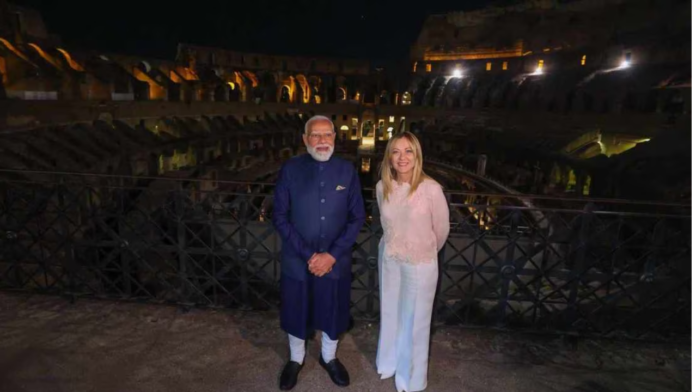
And crucially, both see each other as validation. When Modi stands next to Meloni and they laugh over Melody toffees, each is saying to their domestic audience: look, this is what civilisational nationalism looks like on the world stage. It is confident. It is friendly. It is taken seriously. It goes to the Colosseum at night and talks about trade corridors.
That image is worth more than a hundred policy papers.
The Two Nations Through Each Other’s Eyes
India sees Italy as a gateway into Europe. Not just commercially — though the €20 billion trade target matters — but culturally and symbolically. Having a close, trusted partner at the Mediterranean end of IMEC validates India’s place in the emerging Eurasian connectivity architecture. Having Italy’s prime minister describe India as a “civilisational partner, not just a trade partner” changes the conversation in Brussels, Paris, and Berlin.
Italy sees India as a future. As its own economy ages and its global weight relative to larger powers shrinks, Italy needs relationships with rising powers. India is the world’s most populous nation, its fifth-largest economy, and its fastest-growing major market. Meloni’s bet on deepening India-Italy ties is partly ideological — the civilisational kinship argument — and partly coldly strategic. Italy needs India more than India needs Italy, at this precise moment in history.
That asymmetry is what makes the friendship interesting. Modi is the one with the growing power. Meloni is the one with the legacy cultural capital. Each has something the other genuinely values. That is the foundation of a durable partnership — more durable than one built purely on shared ideology, which can shift, or shared economics, which can fluctuate.
Final Thought
One sold tea as a child in a Gujarat railway station. One grew up without a father in Rome’s working-class Garbatella. Both devoted their twenties to political movements that the establishment dismissed as irrelevant or dangerous. Both became the most powerful people in their countries on a wave of national pride, cultural assertion, and the accumulated frustration of people who felt forgotten.
Now they exchange Melody toffees and laugh in front of the Colosseum.
History produces rhymes. Sometimes it produces them across continents, in two entirely different languages, simultaneously. The story of Modi and Meloni — as individuals, as leaders, as symbols of what their nations are becoming — is one of the more interesting rhymes of this particular moment in the world.

