


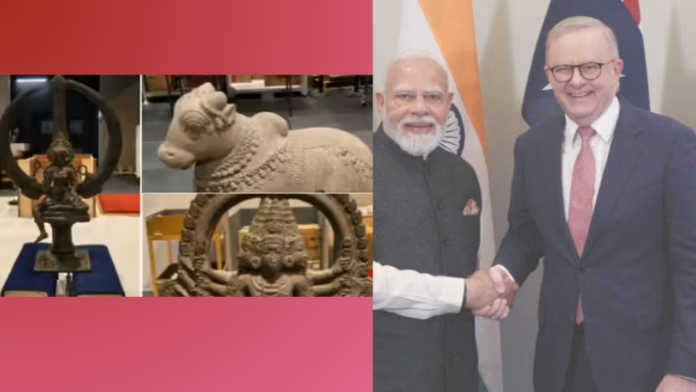
In a significant milestone for India’s cultural heritage and international diplomacy, Australia has announced the return of three priceless Indian artefacts—a ceremonial Bhadrakali Trishula (Trident), a stone idol of Nandi, and an ancient Kartikeya (Murugan/Shanmukha) sculpture—during Prime Minister Narendra Modi’s official visit to Australia.
The decision marks another important step in India’s ongoing efforts to reclaim its stolen cultural treasures from across the world. These artefacts are not merely ancient works of art; they are sacred objects that once formed an integral part of temple worship and reflect India’s rich spiritual and artistic traditions.
The announcement also highlights the growing cultural partnership between India and Australia, with both nations emphasizing the importance of preserving and respecting each other’s heritage.
Why This Repatriation Matters
For centuries, temples across India have safeguarded sculptures, idols, and ceremonial objects that carry immense religious and historical value. Unfortunately, many of these priceless treasures were stolen over the years and illegally taken abroad through international trafficking networks.
Their return represents much more than the recovery of historical objects. It is the restoration of India’s cultural identity, religious traditions, and artistic legacy.
Each artefact carries centuries of history and remains deeply connected to the communities and temples from which it originated.
Bhadrakali Trishula: A Symbol of Divine Power
Among the artefacts being returned is a ceremonial Trishula (trident) featuring the image of Goddess Bhadrakali. The sacred object originally belonged to the Sri Kasiviswanathaswamy Temple in Tamil Nadu and is believed to date back several centuries.
Bhadrakali is revered as one of the most powerful forms of the Divine Mother. She symbolizes courage, justice, protection, and the destruction of evil. Though often depicted in a fierce form, devotees worship her as a compassionate guardian who protects righteousness.
The Trishula itself holds profound spiritual significance in Hinduism. Its three prongs are commonly associated with creation, preservation, and destruction, representing the eternal balance of the universe. It is also seen as a symbol of supreme spiritual power and divine authority.
Temple Trishulas are not merely ceremonial objects—they are considered sacred embodiments of divine energy.
Nandi: The Faithful Guardian of Lord Shiva
The second artefact is a beautifully carved stone idol of Nandi, the sacred bull who serves as the divine vehicle of Lord Shiva.
In every Shiva temple, Nandi occupies a special place directly facing the sanctum where the Shiva Linga is installed. This arrangement symbolizes unwavering devotion and complete surrender to the divine.
For devotees, Nandi represents:
- Faith and devotion
- Dharma (righteousness)
- Strength and patience
- Loyalty and discipline
Many worshippers traditionally whisper their prayers into Nandi’s ears, believing that he carries their wishes directly to Lord Shiva.
The return of this idol therefore has immense religious importance, restoring a sacred symbol that once formed part of daily temple worship.
Kartikeya: The Warrior God Returns Home
The third artefact is an ancient stone sculpture of Lord Kartikeya, also known as Murugan, Skanda, Subrahmanya, or Shanmukha.
The sculpture is believed to belong to the Chola period and originated from the historic Naganathaswamy Temple in Tamil Nadu.
Lord Kartikeya is one of the most widely worshipped deities in South India and is regarded as the God of war, wisdom, courage, and victory.
His six heads symbolize multiple divine qualities, including:
- Wisdom
- Knowledge
- Courage
- Compassion
- Fearlessness
- Spiritual enlightenment
Murugan worship occupies a unique place in Tamil culture, where he is regarded not only as a deity but also as an enduring symbol of bravery, youth, and righteousness.
Tamil Nadu: A Treasure House of Temple Heritage
The three returned artefacts originate from Tamil Nadu, a state renowned for its magnificent temples and centuries-old artistic traditions.
From the grand Chola temples to intricately carved stone sculptures and world-famous bronze idols, Tamil Nadu has preserved one of the richest temple cultures in the world.
The Chola Empire, which flourished between the 9th and 13th centuries, produced some of India’s greatest achievements in architecture, sculpture, literature, and maritime trade.
Many masterpieces created during this period continue to inspire historians, artists, and devotees around the globe.
How Did These Sacred Artefacts Leave India?
Over the past several decades, numerous ancient idols and temple artefacts disappeared from religious sites across India due to organised smuggling operations.
These priceless objects were often removed illegally before passing through complex international networks involving dealers, private collectors, and overseas institutions.
Once taken out of their original surroundings, many lost their cultural and religious context, becoming displayed solely as works of art rather than sacred objects of worship.
Through years of investigation, documentation, and international cooperation, Indian authorities have worked tirelessly to trace these artefacts and establish their rightful origins.
India’s Mission to Recover Its Lost Heritage
India has intensified its efforts to bring home stolen antiquities over the past decade.
Hundreds of idols, sculptures, manuscripts, and ceremonial objects have already been returned from countries around the world through diplomatic engagement, legal cooperation, and heritage conservation initiatives.
Each successful repatriation strengthens the global fight against the illegal trade in cultural property and reinforces the principle that heritage belongs to the communities that created and preserved it.
A New Chapter in India–Australia Relations
The return of these sacred artefacts reflects the growing trust and friendship between India and Australia.
The initiative demonstrates both nations’ shared commitment to protecting cultural heritage and respecting historical traditions.
Such collaborations not only deepen diplomatic ties but also promote greater awareness about the importance of preserving humanity’s shared cultural legacy.
Why These Artefacts Are More Than Museum Pieces
Unlike ordinary archaeological discoveries, these sculptures and ritual objects were once active participants in temple life.
They witnessed generations of festivals, prayers, rituals, and community gatherings before being removed from their sacred surroundings.
For devotees, their return represents the restoration of spiritual continuity. For historians, it fills important gaps in India’s artistic heritage. For future generations, it serves as a reminder that preserving cultural identity is as important as preserving monuments.
The Road Ahead
The homecoming of the Bhadrakali Trishula, the Nandi idol, and the Kartikeya sculpture is a powerful reminder that cultural heritage can never truly be separated from the land and people to whom it belongs.
As these sacred treasures return to India, they carry with them centuries of history, devotion, craftsmanship, and tradition.
Their journey home is not only a victory against the illegal trafficking of antiquities but also a celebration of India’s timeless civilization and its enduring commitment to protecting its rich cultural heritage for generations to come.

