


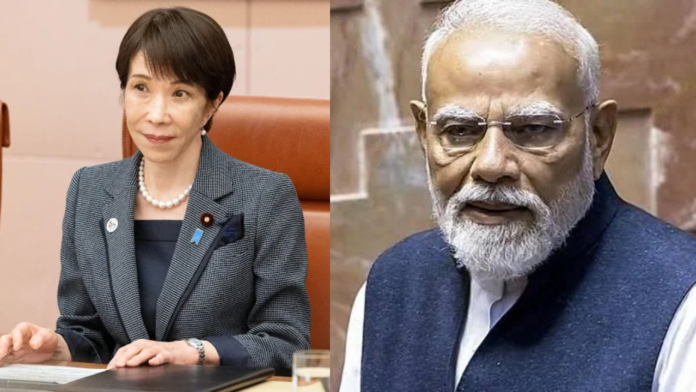
Japanese Prime Minister Sanae Takaichi wrapped up her first official visit to India this week, and it was, by any measure, a packed one. Over three days in New Delhi, from July 1 to 3, she and Prime Minister Narendra Modi presided over the 16th India-Japan Annual Summit — and walked away having signed a stack of agreements that touch everything from semiconductors to biogas plants.
The headline outcomes: a joint Economic Security Declaration, India and Japan’s first joint statement dedicated specifically to artificial intelligence, a new defence co-development project, and confirmation that Japanese investment into India has crossed $10 billion over the past year alone.
$10B+Japanese Investment Pledged
120New Business Agreements
3Landmark Documents Signed
Why “Economic Security” Is The Word Of The Summit
The Economic Security Declaration was arguably the centrepiece of the visit. Modi described it as a joint roadmap built for “an era of uncertainty” — language clearly shaped by a turbulent year for global trade. The conflict in West Asia has disrupted shipping routes, pushed up freight costs, and exposed just how fragile global supply chains for critical goods really are.
The roadmap’s focus areas read like a checklist of the technologies every major economy is racing to secure: semiconductors, quantum technology, and advanced materials. Both sides are betting that tying their supply chains closer together will insulate them from exactly this kind of external shock in the future.
India and Japan view economic security as shared security, and energy transition as a shared opportunity.PM Narendra Modi, Joint Press Statement
A First: A Joint Statement Dedicated To AI
For a relationship built over decades on infrastructure, automobiles and defence, the AI statement marks something genuinely new. Modi called the technology partnership “the strongest pillar” of the bilateral relationship going forward, and said several institutions within India’s AI ecosystem had already signed agreements with Japanese counterparts on the sidelines of the summit.
The pitch, in Modi’s words, is complementary strengths: Japan’s precision hardware and engineering culture paired with India’s software and AI talent pool. If that combination delivers on the scale both sides are hoping for, it could reshape where global AI development leans for compute-adjacent manufacturing and applied software talent.
What The Summit Actually Delivered
- Joint Declaration on Economic Security — supply-chain resilience in semiconductors, quantum tech, advanced materials
- First-ever India-Japan Joint Statement on Artificial Intelligence
- First defence co-development project: naval radio antenna “Unicorn”
- India-Japan Next-Generation Mobility Partnership Framework
- India-Japan Biogas Initiative — 1,000 biogas and organic fertiliser plants nationwide
- Pacts on critical minerals, clean energy, pharmaceuticals, medical devices and biotechnology
Defence Gets Its First Co-Development Project
Beyond economics and AI, the summit also produced a defence milestone: India and Japan’s first joint defence co-development project, centred on a naval radio antenna system named “Unicorn.” Modi framed it as the opening of “a new chapter” in bilateral defence technology cooperation, aimed at strengthening regional peace, maritime security and the rules-based order.
Takaichi, for her part, said the two countries were planning a joint military exercise involving Japan’s forces and an Indian naval vessel, and confirmed that the next India-Japan 2+2 ministerial dialogue would be held before the end of the year. She also reaffirmed Japan’s support for India’s bid to join the International Energy Agency.
The Investment Number Everyone’s Talking About
On the business side, Modi revealed that roughly 120 new business agreements had been concluded over the past year, translating into more than $10 billion in fresh Japanese investment flowing into India. Around 150 Japanese business delegates travelled with Takaichi for the visit — a scale that underlines how central the Indian market has become to Japanese corporate strategy amid its own demographic and growth pressures at home.
A Green Thread: The Biogas Initiative
Not every headline from the summit was about chips and algorithms. The two countries also launched the India-Japan Biogas Initiative, under which 1,000 biogas and organic fertiliser plants will come up across India. Modi tied this directly to the government’s GobarDhan programme, positioning it as a boost for rural livelihoods and sustainability at the grassroots level — a reminder that the relationship still has a strong development-cooperation core alongside the high-tech headlines.
The Bigger Picture
India and Japan upgraded their relationship to a Special Strategic and Global Partnership back in 2014, and the bilateral machinery has only grown since — more than 70 dialogue mechanisms now span trade, defence, technology, and culture. With the two countries set to mark 75 years of diplomatic relations in 2027, this summit was widely read as a marker of intent: that the next phase of the relationship will be defined less by traditional aid-and-infrastructure ties and more by frontier technology, supply-chain security, and defence co-development.
For a content lens, the story writes itself across formats — the AI statement and Unicorn defence project make for strong explainer/social content, while the economic security roadmap and investment numbers work well as data-led breakdowns.

