


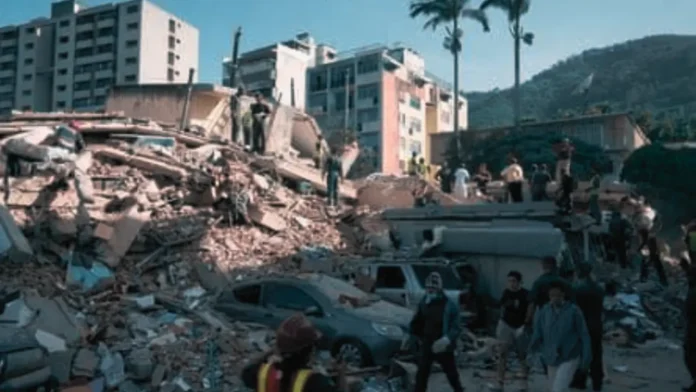
The UN children’s agency says 1.8 million people, including 680,000 children, now require urgent help after twin quakes of magnitude 7.2 and 7.5 flattened buildings across Caracas, La Guaira and neighbouring states — the most powerful seismic event to strike Venezuela in over a century.
The United Nations children’s agency UNICEF has warned that 1.8 million people, including an estimated 680,000 children, are now in need of humanitarian assistance following the devastating earthquakes that struck Venezuela on June 24, 2026. The scale of the crisis has grown steadily clearer in the days since, as rescue teams continue to dig through collapsed structures across the country’s worst-hit regions.
Two earthquakes, measuring magnitude 7.2 and 7.5, struck within barely a minute of each other on the evening of June 24, jolting the capital Caracas and the surrounding states of Aragua, Carabobo, Falcón, La Guaira and Miranda. According to the United States Geological Survey, the epicentre of the first quake lay roughly 100 miles west of Caracas, with the second striking just a few miles further east, near the coastal town of Morón. Officials and seismologists have described the twin tremors as the most significant seismic event to affect Venezuela in over a century.
1.8M People in need of aid
680K Children in need
7.2 & 7.5 Magnitude of twin quakes
Death toll climbs as rescue operations continue
Venezuela’s acting President, Delcy Rodríguez, said on state television on June 26 that at least 589 people had been killed and around 3,000 injured, with officials cautioning that the toll is expected to rise as damage assessments and search-and-rescue operations continue. Earlier estimates from the country’s health minister had put the death count at around 235, with roughly 4,300 injured, underlining how rapidly the human cost has escalated. Local reports also indicate that more than 50,000 people remain unaccounted for, according to a missing-persons tracking website set up in the disaster’s aftermath.
Preliminary satellite analysis conducted by UNICEF found that nearly a third of buildings in Catia La Mar, in La Guaira state — one of the worst-affected areas assessed so far — have sustained damage. Homes, schools, hospitals and water systems have all been hit, disrupting essential services for hundreds of thousands of families even as the threat of aftershocks lingers.
“Hospitals are operating beyond capacity, thousands of children don’t have reliable access to safe water, and many schools have been damaged.”— Manuel Rodríguez Pumarol, UNICEF Representative in Venezuela
3.9 million children live in the affected zone
UNICEF has separately estimated that around 3.9 million children live in the broader areas affected by the earthquakes, placing a vast population of young people and their families at heightened risk of injury, displacement, family separation and disrupted access to healthcare and education. UNICEF Executive Director Catherine Russell said the images emerging from Venezuela, and the accounts relayed by colleagues on the ground, were heartbreaking, and stressed that children’s safety, protection and well-being must remain central to the response as the scale of destruction becomes clearer.
UNICEF’s Response So Far
- A scaled-up emergency response now aims to reach an estimated 650,000 people, including 234,000 children, with health, nutrition, water and sanitation, child protection and education support.
- A first air shipment of 20 metric tons of medical supplies, WASH items and tents arrived in Valencia on June 27 from UNICEF’s regional warehouse in Panama.
- A second shipment is being prepared at UNICEF’s global supply hub in Copenhagen; together, both consignments are expected to support more than 100,000 people.
- UNICEF has already released an initial $1.5 million from its own resources and a further $1 million from global humanitarian thematic funding to enable immediate action.
Funding gap adds to the urgency
The disaster has struck at a particularly precarious moment for humanitarian operations in Venezuela. Before the earthquakes, UNICEF’s 2026 Humanitarian Action for Children appeal for the country stood at $137.6 million, of which only 35 per cent had been funded. The agency now says it needs an additional $52 million specifically to respond to the earthquake emergency, even as aid groups warn that recent cuts to international humanitarian funding have already strained Venezuela’s ability to cope with a crisis that, even before the quakes, had left nearly 8 million people in need of assistance nationwide.
The United Nations system has moved quickly to coordinate a wider response alongside UNICEF. The World Food Programme says it holds enough supplies to feed more than 10,000 families for two months, with over 1,400 metric tons of relief items from partner agencies ready for deployment from a UN humanitarian depot in Panama. The UN refugee agency, UNHCR, is similarly scaling up distribution of tents, mosquito nets and solar lamps from regional stockpiles, while coordinating shelter and protection support on the ground with the Venezuelan government.
Context: A Crisis Within a Crisis
- The earthquakes follow a turbulent political transition in Venezuela, after acting President Delcy Rodríguez assumed power following the removal of Nicolás Maduro earlier this year.
- Aid agencies note that pre-existing economic strain, road closures, power outages and communication disruptions are complicating relief logistics in the affected states.
- International offers of support have followed, including from the United States, with President Donald Trump calling the disaster “devastating” and pledging assistance to Venezuela’s interim government.
For now, UNICEF and its partners say the priority remains reaching displaced and injured children with medical care, clean water, psychosocial support and safe spaces, even as the full scale of the disaster — and the funding required to meet it — continues to come into sharper focus with each passing day.

